Korea's Framework Act Is Still in Subcommittee. The Rules Arrived Anyway.
The Digital Asset Basic Act has sat in subcommittee since August 2025. Meanwhile the AML track shipped an amended statute and a new VASP entry regime, which changes how a Korea entry should be sequenced.
- Topic
- Regulation
- Published
- 2026-08-24
- Reading
- 11 min
- Sections
- 08
- References
- 13
 IUM LABSResearch
Cover artwork and image sources
- Cover: AI-generated editorial illustration · ium Labs Research.
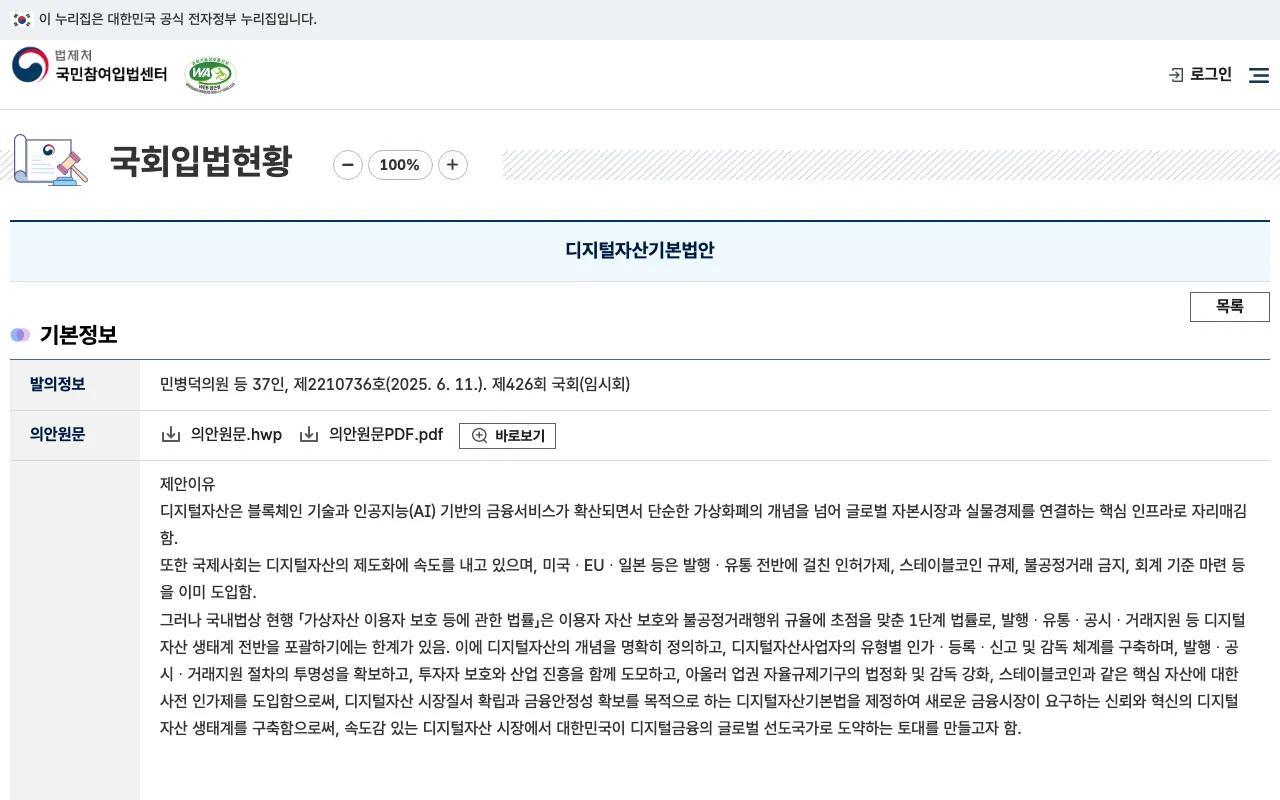
- National Assembly Legislative Status, Bill 2210736, "디지털자산기본법안," Min Byoung-dug and 36 others, June 11, 2025. The proposal statement is still the clearest description of the gap the bill is meant to close. · National Participatory Legislation Center (opinion.lawmaking.go.kr), screenshot
Key takeaways
- 01
The Digital Asset Basic Act has been before the National Assembly's Political Affairs Committee since June 12, 2025: proposed, tabled, referred to the bill subcommittee, and still there fourteen months later
- 02
While the statute stalled, the binding rules arrived through the AML track instead: the amended Specified Financial Transaction Information Act took effect August 20, 2026 with a rewritten VASP entry regime
- 03
The two live disputes in the bills (who may issue a won stablecoin, and what equity limits apply to an exchange's major shareholders) were still without agreement in July, and the administrative track has already started answering both
- 04
For an operator this inverts the planning order: build against the enforceable AML regime now, treat the framework act as an upgrade path, and stop sequencing a Korea entry around a legislative date
This paper is a record as of August 24, 2026. What followed is in The 51% Question (November 10, 2026).
The Digital Asset Basic Act has had more target dates than votes. In January 2026 the ruling Democratic Party aimed to pass the second-stage law in a plenary session within the first quarter, Seoul Economic Daily reported. The quarter came and went. In July a ruling-party lawmaker spoke of filing a unified government-party bill in September.
The bill that started the cycle is on the record and easy to check. Bill 2210736, the Digital Asset Basic Act, was proposed by Representative Min Byoung-dug and 36 other lawmakers on June 11, 2025 and referred to the Political Affairs Committee the next day. It was tabled there on August 26, 2025: presented, reviewed, debated, referred to the bill subcommittee. That is where it has been ever since.
Meanwhile, on August 20, 2026, a different law changed the rules for entering the Korean market. Nobody had to wait for it.
What the Bill Says It Is For
The proposal statement is worth reading in the original, because it concedes the point that most commentary tiptoes around: the law Korea already has was never meant to do this job.
"현행 「가상자산 이용자 보호 등에 관한 법률」은 이용자 자산 보호와 불공정거래행위 규율에 초점을 맞춘 1단계 법률로, 발행·유통·공시·거래지원 등 디지털자산 생태계 전반을 포괄하기에는 한계가 있음" ("The current Act on the Protection of Virtual Asset Users is a first-stage law focused on protecting user assets and regulating unfair trading practices, and has limits in covering the digital asset ecosystem as a whole, including issuance, distribution, disclosure and trading support." Translated from the Korean original.)
Bill 2210736, Digital Asset Basic Act, statement of proposal, Representative Min Byoung-dug and 36 others, June 11, 2025
The bill would allow digital assets to be issued under statute and introduce authorization for issuers of asset-linked digital assets. It would build a tiered authorization, registration and notification regime for digital asset businesses under the Financial Services Commission and prohibit operating without one. It would set up a Korea Digital Asset Industry Association as a statutory self-regulatory body, and hand the FSC supervisory, inspection and investigation powers, including the power to revoke authorization and suspend business.
A second bill takes the same territory from a different angle. Bill 2213449, the Digital Asset Promotion Framework Act, proposed by Representative Choi Bo-yun and nine other lawmakers on October 1, 2025 and referred the next day, writes rules for value-linked digital assets, its term for stablecoins, into Articles 95 through 112 (issuer authorization, redemption reserves, redemption) and governance controls into Articles 28 through 53, including approval for changes of major shareholder.
Neither has left the committee.
What this changes. Read the bills for direction, not for compliance. Neither text is law, and the ruling party talks of a unified government-party bill.
The Two Fights That Are Actually Holding It
Strip away the procedural language and the blockage reduces to two questions, both of them about who is allowed to hold something. Edaily reported on July 21 that no agreement had been found on either.
Who may issue a won stablecoin. This is the fight between the Financial Services Commission and the Bank of Korea, and it is not a drafting problem. It is a question about whether a non-bank can issue a claim on won at scale, and about who supervises reserves when it does. In January, Seoul Economic Daily obtained an FSC paper titled "Coordination Plan for the Main Issues in the Digital Asset Basic Act." It set the issuer as a bank-centered consortium in which banks hold 50% plus one share, with a technology company allowed as the largest shareholder and minimum equity of ₩5 billion. Licensing stayed with the FSC, advised by a council that includes a BOK deputy governor, in place of the unanimous body the BOK had asked for. The FSC's own public line, in December 2025, was that the main contents of the second-stage law had not been decided. By July, whether to confirm that "51% rule" was still open. In our reading, neither institution can concede it without conceding jurisdiction.
What equity limits apply to an exchange's major shareholders. Less discussed, more consequential for anyone building here. A limit on how much of a Korean exchange a single shareholder may hold is a limit on who can own or buy one. The option on the table was a 15 to 20% cap applied across Dunamu, Bithumb, Coinone, Korbit and Streami (Gopax) alike, and it too was without agreement in July.
Bill 2213449 carries a provision on the second point: change-of-major-shareholder approval in its governance chapter. And this is where the story turns, because that question did not wait for the statute.
The Rules Arrived Through the Other Door
On August 13, 2026, the Financial Intelligence Unit and the Financial Supervisory Service published a completely rewritten VASP reporting manual, keyed to the amended Specified Financial Transaction Information Act, which the Assembly passed in January and which took effect on August 20.
That amendment extends criminal-record and soundness screening from the operator, its representative and its executives to its major shareholders, defined to include the largest shareholder, holders of 10% or more of voting stock, shareholders in a special relationship with the largest shareholder, and, where the largest shareholder is a corporation, that corporation's own largest shareholder and representative. It converts changes to major shareholders and to the compliance framework from post-notification within 14 days to pre-notification 30 days ahead, and makes both grounds for rejecting a filing or cancelling a registration.
We took that document apart in detail in the VASP entry exam. The point here is narrower and, for planning purposes, more important:
The question the framework act cannot settle is already being answered administratively. Not identically, and not with the same force: an AML statute regulates entry to a reporting regime, not ownership of a market. But if you are asking "what does Korea require of my shareholders," you now have an answer with a date on it, and it did not come from the bill everyone is watching.
14 months: Time bill 2210736 has spent before the Political Affairs Committee, from referral on June 12, 2025 to this writing, while the AML track produced an amended statute, a supervisory regulation put out for comment and a rewritten manual (Source: National Assembly Legislative Status, bill 2210736; FSC release, August 13, 2026)
The AML statute is also the one being enforced. In March the FIU announced a fine of ₩36.8 billion against Bithumb, subject to the exchange's comments, and a six-month partial business suspension from March 27 to September 26. It cited about 6.65 million violations of the same Act, including 45,772 transfers with 18 unreported foreign operators.
What this changes. Shareholder questions now have a dated answer. If your Korean structure has a 10% holder, that holder is screened today, and a change in it needs a filing a month ahead.
Why Legislative Dates Keep Slipping, Structurally
It is tempting to read fourteen months as dysfunction. It is more useful to read it as a description of how Korean financial regulation actually moves, because the pattern repeats.
The first-stage law, the Act on the Protection of Virtual Asset Users, was enacted on July 18, 2023 and took effect on July 19, 2024. In our reading it moved because it did one thing that nobody had to fight over: protect users from operators, with customer deposits kept at banks, user assets kept apart from the operator's own, and sanctions for unfair trading such as price manipulation. There is no institutional turf in that.
The framework act does the opposite. It allocates authority over a new money-like instrument between the central bank and the financial regulator, and it decides who may own market infrastructure. Those are exactly the provisions that cannot be resolved by a committee's goodwill, because the resolution costs one institution something permanent.
January 2026 showed the same split. The Assembly passed the AML amendment that month, and on January 15 it passed the Electronic Securities Act and Capital Markets Act amendments that bring token securities into law, to take effect about a year after promulgation. Neither, in our reading, moved turf between the central bank and the regulator.
Administrative rulemaking has even fewer constraints. The FIU can tighten entry conditions under its own statute without anyone conceding jurisdiction, because AML supervision is already theirs. That is why the AML track keeps shipping while the framework track keeps slipping, and we see no reason to expect that asymmetry to reverse.
What this changes. A date for the framework act is a forecast. A date in the AML track is an obligation. Budget against the second.
What This Means for Sequencing a Korea Entry
A common way to plan Korea is to treat regulation as a gate: wait for clarity, then enter. That was defensible in 2024. It is now a way to lose time.
The practical reading is that Korea has two regulatory surfaces moving at different speeds, and only one of them binds you today.
| Surface | Status | What it decides | Planning treatment |
|---|---|---|---|
| AML track (특금법, FIU) | In force August 20, 2026 | Whether you can register a Korean entity at all; who your shareholders may be; where your data sits | Build against it now |
| Framework act (DABA) | In subcommittee since August 2025 | Stablecoin issuance, disclosure, trading-support rules, industry authorization tiers | Track, do not sequence around |
The third column is the useful one. The framework act mostly governs activities that a foreign project entering Korea does not perform directly: issuing a won stablecoin, operating an exchange, running trading support. The AML track governs the thing every entrant touches: getting a legal presence.
That surface has teeth today. The FIU counts 28 reported virtual asset businesses and treats any other business serving Korean residents as illegal, punishable by up to five years in prison or a ₩50 million fine. It asks app market operators such as Google and Apple to block access to unreported foreign exchanges in Korea.
If you are launching a token, listing on a Korean venue and running Korean distribution, your dependency is on the listing process and on counterparties who are themselves registered, not on DABA passing. Our GTM Index put the median time from first structured contact to a live won market at 7.2 months on Upbit and 4.5 months on Bithumb, and no engagement in its dataset shortened that through spend. Waiting on a statute is a sequencing error with better PR.
One door the statute does hold shut. On July 23 the head of the FSC's virtual asset division said the timing of the next phase of corporate access to crypto trading is being reviewed together with follow-up legislation, including the Act. A plan that needs Korean corporate buyers does depend on the statute.
What Breaks It
A merged government bill could move fast. Ten digital asset and stablecoin bills are pending, and a ruling-party lawmaker spoke of a unified bill in September. The government's July 14 growth strategy says it will enact the Act with rules for stablecoins, won stablecoins included, and the FSC's director for digital finance policy said on July 21 that it would wrap up stablecoin legislation as quickly as possible. A government bill with ruling-party backing behaves differently from a member bill in subcommittee; if the stablecoin jurisdiction question gets settled politically, the rest can pass quickly. Our confidence that this slips again is a judgment about institutional incentives, not a prediction of the calendar.
A statutory equity limit could override the manual. If DABA sets a shareholder cap different from the AML regime's 10% screening threshold, such as the 15 to 20% discussed this year, entry structures built against the manual may need revisiting. That is an argument for documenting your structure clearly, not for waiting, and for asking a Korean lawyer how a cap would sit with the AML screen.
The AML track could overreach and get pulled back. The FIU and FSS have asked the industry to raise any provision that proves hard to apply in practice, and the draft-to-final softening on data residency shows that invitation is real. The draft required computing facilities to sit in Korea whatever data they handled. The final rule covers only systems that process unique identifiers or personal credit information, and a cloud region inside Korea counts as inside Korea.
The Radar Read
Korea is often described as a market waiting for legal clarity. That framing has always been slightly wrong, and it is now clearly wrong.
Clarity is arriving, just not through the door everyone is watching. The statute that gets the headlines allocates power between institutions and will move when that fight resolves, on nobody's schedule. The regulations that decide whether you can operate here are being issued under laws that already exist, with effective dates, published manuals and briefing sessions for the industry.
Plan against the second one. Read the first one for where the market is going, not for when you can start. None of this is legal advice: entity structure and shareholder arrangements in Korea need a Korean lawyer.
Method and Limits
This paper is written as of August 24, 2026 and uses nothing published after that date. We read the National Assembly's legislative records for Bills 2210736 and 2213449; six FSC releases; reports by Seoul Economic Daily, Edaily, ET News and Dailian; and our own GTM Index. Quotations from Korean are our translations.
The government bill had not been filed at the cut-off, so the state of the two disputes rests on press reports, chiefly Edaily's account of July 21 and Seoul Economic Daily's report in January of an FSC paper that the FSC has not published. The bill summaries come from the Assembly's records of each bill's proposal and main contents, not a reading of the full texts. The Bithumb fine was open to the exchange's comments when announced. The timing of a government bill, the stablecoin issuer rule and any exchange ownership cap were all undecided at the time of writing.
References
[1]National Assembly Legislative Status (opinion.lawmaking.go.kr). 2025-06-11. 디지털자산기본법안 (Digital Asset Basic Act), Bill 2210736, Representative Min Byoung-dug and 36 others; referred June 12, 2025; tabled and referred to the bill subcommittee August 26, 2025. opinion.lawmaking.go.kr.
[2]National Assembly Legislative Status (opinion.lawmaking.go.kr). 2025-10-01. 디지털자산 육성 기본법안 (Digital Asset Promotion Framework Act), Bill 2213449, Representative Choi Bo-yun and 9 others; referred October 2, 2025. opinion.lawmaking.go.kr.
[3]Financial Services Commission / Korea Financial Intelligence Unit / Financial Supervisory Service. 2026-08-13. 가상자산사업자 신고제 강화에 맞춰 신고매뉴얼을 전면 개정합니다 - FIU·금감원, 개정 신고매뉴얼에 대한 「찾아가는 설명회」 개최. fsc.go.kr.
[4]Financial Services Commission. 2024-07-17. The Act on the Protection of Virtual Asset Users to Take Effect from July 19. fsc.go.kr.
[5]Financial Services Commission. 2025-12-19. 가상자산 2단계법 주요내용은 확정된 바 없습니다. (보도설명자료). fsc.go.kr.
[6]Financial Services Commission. 2026-01-15. 토큰증권 도입 및 투자계약증권 유통을 위한 「전자증권법」·「자본시장법」 개정안 국회 본회의 통과. fsc.go.kr.
[7]Financial Services Commission / Korea Financial Intelligence Unit. 2026-03-17. 가상자산사업자 ㈜빗썸 종합검사 결과에 대한 조치 통보. fsc.go.kr.
[8]Financial Services Commission / Korea Financial Intelligence Unit. 2026-06-24. 불법 가상자산 취급업자(특금법상 미신고 가상자산사업자) 이용 및 거래에 각별히 주의하시기 바랍니다.. fsc.go.kr.
[9]Seoul Economic Daily. 2026-01-05. [단독] 원화코인 안정성에 방점…거래소 해킹땐 매출액 10% 과징금 (the FSC's "디지털자산기본법 주요 쟁점 조율 방안"). sedaily.com.
[10]Edaily. 2026-07-21. 금융위 "스테이블코인 조속 입법…AI 커머스 신중 검토"(종합). edaily.co.kr.
[11]ET News. 2026-07-14. 비트코인 현물 ETF, 국내 상장 길 열린다…정부 하반기 도입 추진 (H2 2026 economic growth strategy). etnews.com.
[12]Dailian. 2026-07-23. 법인 가상자산 '상대매매' 길 열리나…개방은 입법 연계. dailian.co.kr.
[13]ium Labs Research. 2026-07-01. The Korea Crypto GTM Index: Benchmarks From 25 Market Entries (2024-2026). iumlabs.io.