The Trading Drought: Korean Crypto Volume Is Down 90%, and the GTM Math Just Changed
Daily trading value on Korea's five won exchanges fell to about ₩537.5 billion in July, roughly 90% below H2 2025. What the drought changes for a Korea go-to-market, and why attention is cheap right now.
- Topic
- Trading volume
- Published
- 2026-07-27
- Reading
- 11 min
- Sections
- 09
- References
- 16
 IUM LABSResearch
Cover artwork and image sources
- Cover: AI-generated editorial illustration · ium Labs Research.
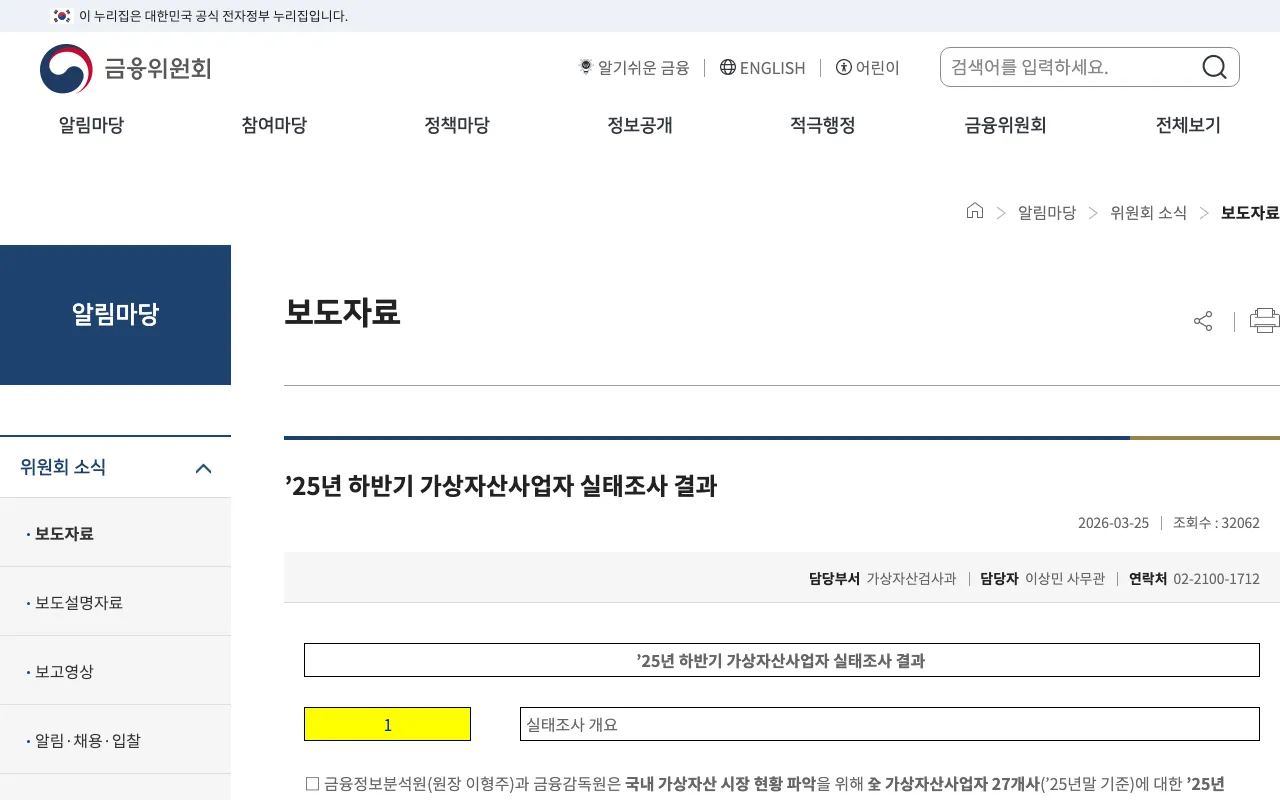
- Financial Services Commission, "'25년 하반기 가상자산사업자 실태조사 결과," March 25, 2026. All 27 registered VASPs surveyed: users and won deposits up from June, trading value, operating profit and market value down. · Financial Services Commission (fsc.go.kr), screenshot
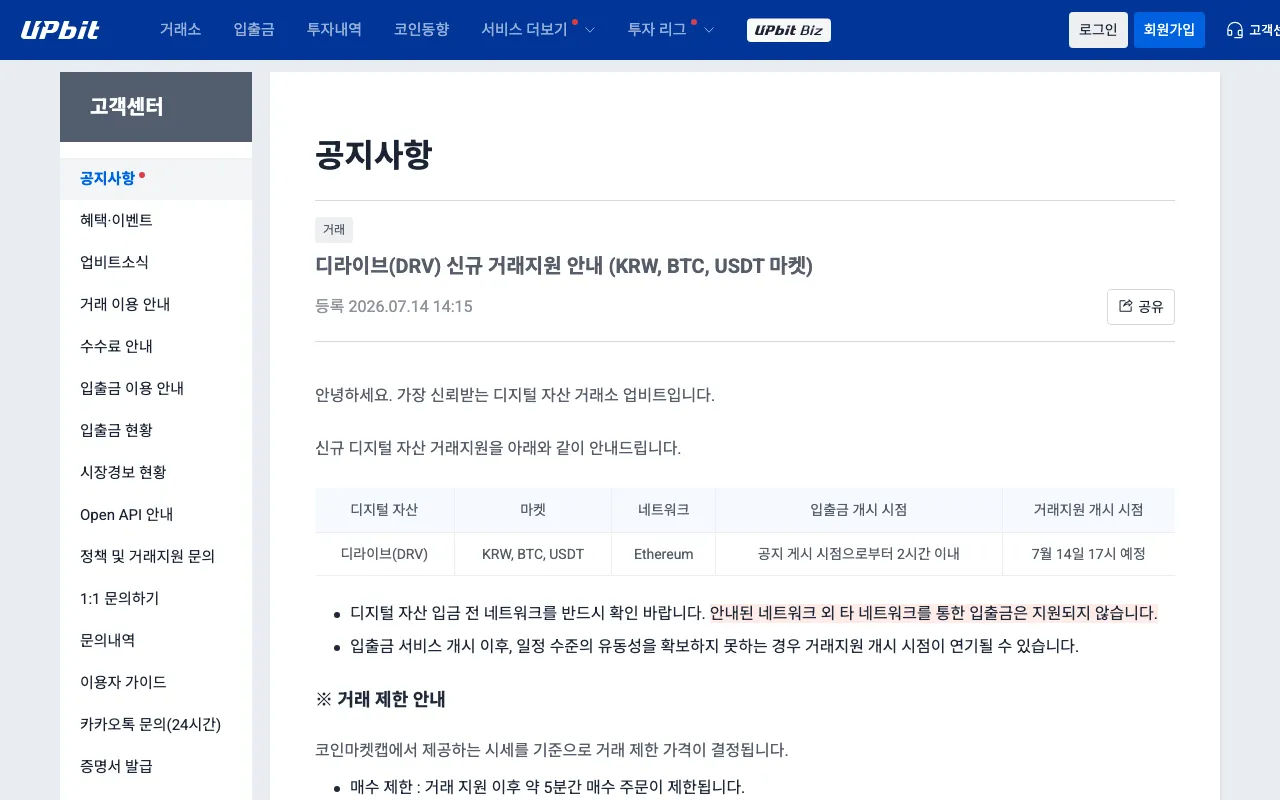
- Upbit service center, "디라이브(DRV) 신규 거래지원 안내," July 14, 2026. The one distribution event Korea still prices in any weather. · Upbit (upbit.com), screenshot
Key takeaways
- 01
Daily average trading value across Korea's five won exchanges fell to ₩537.5 billion over July 1 to 21 on CoinGecko data reported by MTN, about 90% below the H2 2025 average of ₩5.4 trillion in the FSC's survey. Other readings of the same data run slightly higher, but none changes the order of magnitude
- 02
The damage is on exchange income statements: Dunamu's Q1 revenue fell 55% and operating profit 78% year over year, Bithumb's fell 57.6% and 95.8%, and Korbit has sold its own crypto three times this year to raise cash
- 03
Attention is scarce, not dead. Derive (DRV) jumped roughly 30% around its July 14 listings on Upbit and Bithumb. In a drought, the listing event is one of the few distribution moments left
- 04
A volume drought is a GTM window, not a GTM freeze. Our GTM Index already showed KOL rates softening and quiet-window campaigns getting cheaper, and presence built now (community, search, relationships) is in place when turnover returns
This paper is a record as of July 27, 2026. What followed is in After the Drought (October 27, 2026).
Korea's crypto market has not crashed. It has done something quieter and, for anyone planning a market entry, more consequential: it has stopped trading. Over July 1 to 21 the five won exchanges (Upbit, Bithumb, Coinone, Korbit, Gopax) averaged ₩537.5 billion a day in trading value, with a July 5 low of ₩263.7 billion, on CoinGecko's data as MTN reported it. In the second half of 2025 the daily average was ₩5.4 trillion. The bid for new narratives has thinned to the point where an exchange is selling its own bitcoin and ether to raise cash. And yet the one distribution event Korea still reliably prices, a domestic dual listing, just lifted a token about 30% on the day. Both facts are true at once, and the space between them is where your 2026 Korea plan should live.
The Numbers, and the Baseline That Matters
The headline decline depends on which baseline you pick, so here is the honest ladder. Against H2 2024's average of ₩7.3 trillion a day, the July figure is down roughly 93% (our arithmetic). Against H2 2025's ₩5.4 trillion, it is down about 90%, MTN's comparison. Against June 2026 alone, Seoul Economic Daily puts the drop at 83.6%: about $380 million (₩562.6 billion) a day over July 1 to 16, against June's $2.32 billion (₩3.43 trillion). Pick any rung; the direction is the same and the speed is the story.
Source: FSC surveys, May 20, 2025 and March 25, 2026, for H2 2024 and H2 2025; CoinGecko data for the five won exchanges as reported by MTN, July 22, 2026, for July 1 to 21
₩537.5B: Daily average trading value across Korea's five won exchanges, July 1 to 21, 2026, roughly a tenth of the H2 2025 run rate (Source: CoinGecko data as reported by MTN, July 22, 2026)
₩263.7B: The July 5 single-day low on the same five exchanges (Source: CoinGecko data as reported by MTN, July 22, 2026)
Counts differ even on the same data. Herald Business, also citing CoinGecko for July 1 to 21, put the five-exchange daily average at ₩597.8 billion. ZDNet Korea put the single day of July 20 at about ₩412.7 billion, down about 88% from a year earlier. None changes the order of magnitude.
For calibration, this is a market that out-traded the stock market in 2024. Figures the financial authorities submitted to the National Assembly put the five exchanges' 2024 daily average at ₩11.64 trillion, against ₩10.74 trillion for the KOSPI, as MTN reported in April 2025. How that volume splits between the two leading venues is in The Bithumb Squeeze. The drought does not repeal that structure. The rails, the user base, and the duopoly listing game are all intact. What has evaporated is turnover.
And here is the detail most coverage skips: the users did not leave. The FSC's survey of all 27 registered virtual asset businesses found that in H2 2025, as trading value, operating profit, and market capitalization declined, exchange users and won deposits increased. Accounts able to trade reached 11.13 million at the end of 2025, up 3% from the end of June, and won deposits rose 31% to ₩8.1 trillion. The baseline matters here too. At the end of 2024, in a survey of 25 businesses, deposits stood at ₩10.7 trillion, so they were up on the half and down on the year. The accounts are funded and idle. That is not an audience that disappeared; it is an audience waiting for a reason.
What this changes. Plan for reach, not for turnover. The registered audience is still there; the trading is not.
Why the Tape Died
The proximate causes are not Korean. Bitcoin set a record above $126,000 in October 2025 ($126,198.08 in MTN's figure) and now trades around $65,000, about half its peak, by MTN's count; ZDNet Korea describes it as moving sideways in the low $60,000s. The record was followed by the liquidation wave of October 10: more than $19 billion of positions liquidated in 24 hours on CoinGlass data, a record, as Decrypt reported. Global crypto market capitalization stood at $2.322 trillion on ZDNet Korea's count, down 41% from a year earlier. The Fear & Greed Index read 39, in the fear zone, in MTN's July 22 report.
"Since last October's liquidation of leveraged positions and 'Black Friday,' the crypto winter has continued and trading value keeps falling. Large amounts of liquidity have moved into the stock market, centered on AI and semiconductors, and macroeconomic uncertainty from regulation and tariffs has strengthened risk aversion."
Hwang Seok-jin, Professor, Dongguk University Graduate School of Information Security, as reported by MTN, July 22, 2026 (translated from the Korean original).
What is Korean is the amplitude. On ZDNet Korea's numbers, the five won exchanges' daily trading value on July 20 was down about 88% from a year earlier, while global market capitalization was down 41%. Prices fell; Korean turnover fell more than twice as hard. Our reading is that Korean retail is a momentum market: it chases rallies, and in the absence of momentum it does not rotate to value, it stops trading. The desk view at Tiger Research is blunt about the label:
"It is fair to call this period a crypto winter."
Yoon Seung-sik, Director, Tiger Research, as told to ZDNet Korea, July 21, 2026 (translated from the Korean original).
What this changes. The causes sit outside Korea. Time Korea spend against global prices as well as Korean headlines.
The Exchange P&L Is the Tell
Trading venues are the purest volume derivative in the market, and their numbers now read like a stress test. Dunamu, Upbit's operator, reported Q1 2026 revenue down 55% and operating profit down 78% year over year. Bithumb reported revenue down 57.6% and operating profit down 95.8%, according to Seoul Economic Daily. Below the duopoly it is worse. Coinone, Korbit, and Gopax all posted operating losses last year and are expected to stay in the red this year, ZDNet Korea reports. Korbit has sold its own crypto three times this year; on July 3, ZDNet Korea reports, it had sold 15 BTC and 60 ETH over ten days, raising about ₩1.6 billion in cash.
The thinness shows in the books. At Gopax, less than 1 BTC changed hands on every day of July except the 10th. At Korbit, daily bitcoin volume ran from about 6 BTC to 26 BTC through July 22, Herald Business found.
This matters to operators for a practical reason: exchange behavior changes when exchange revenue collapses. In our reading, listing teams get more selective about what they spend integration resources on, but they also get hungrier for anything that can print volume. The listing strategy calculus does not pause in a drought; it sharpens. How the reviews work is in our listing playbook.
The Listing Paradox: DRV Popped Anyway
On July 14, Upbit opened KRW, BTC, and USDT markets for Derive (DRV), with trading from 5 p.m. Korean time. Bithumb added a won market the same day, with trading from 8 p.m. at a reference price of ₩174: the classic dual listing. In a market doing about a tenth of H2 2025's daily volume, DRV still jumped roughly 30%, rising from about $0.12 toward $0.18 before settling near $0.15, according to BeInCrypto.
Read that correctly. It is not evidence that Korea is secretly healthy. It is evidence that in a drought, attention concentrates rather than disappears. When nothing is moving, the few sanctioned events that force price discovery, a won-market listing above all, capture a disproportionate share of whatever risk appetite remains. That fits the timing effect in our Korea Crypto GTM Index: campaigns launched within two weeks of a major catalyst such as an exchange listing saw a median 2.3x engagement multiple over equal-budget campaigns in quiet windows, up from roughly 1.8x in the H2 2025 pool.
What this changes. If a listing is on your path, build the campaign around its window. Do not expect spend to bring the window forward: the Index's medians were 7.2 months from first structured contact to a live won market on Upbit and 4.5 months on Bithumb, and no engagement in its dataset shortened them through spend.
What a Drought Does to GTM Economics
Most inputs on the Korean acquisition stack reprice in a downturn, and most of them reprice in the buyer's favor. Our GTM Index, published on July 1, already showed the drift. Against its H2 2025 engagement pool, KOL rates had softened roughly 10 to 15% across tiers as the memecoin cooldown cut discretionary campaign demand, with nano rates softening least. The Index also warned that the 2024 bull-market rates inside its medians are likely 15 to 25% above what a 2026 bear-window negotiation would settle at. And it found quiet-window campaigns getting cheaper in absolute terms but even weaker in relative ones.
The one thing a drought does not discount is the thing most teams try to buy: instant conversion. There is no campaign spend that manufactures turnover in a market where the marginal trader has left. What spend buys now is position (mindshare, community, search presence, listing readiness) that can convert when volume returns.
The Slow Channels, Priced From the Index
We can put numbers on the slow channels, but only those the GTM Index published on July 1: settled prices and outcomes from 25 market entries, not quotes taken during the drought. The Index's settled medians per X post were ₩550,000 at nano tier, ₩3.2 million at mid tier and ₩12 million at top tier, and three-post bundles settled a median 18% below the single-post rate.
Source: ium Labs, The Korea Crypto GTM Index, July 1, 2026, n=214 paid engagements
The same Index measured the slow channels themselves. Telegram communities seeded with coordinated KOL pushes reached 10,000 members in a median 11 weeks, against 26 weeks for organic growth, with 90-day retention around 34% either way. Projects that ran the eight-week Naver PR-plus-SEO program saw a median 210% lift in branded search volume, still at roughly 60% of peak six months later with no further spend. In our reading these are the channels whose results outlast the campaign. Caveats apply: 25 entries is a small sample, the medians mix bull-market and bear-market prices, and the Index is re-cut every two quarters.
What this changes. Negotiate against the Index medians and the softening it reported, and put drought budget into channels whose results compound.
What Breaks It
The bear case for this read is that the drought is not cyclical but structural: that Korean retail found the leverage it wanted offshore, that the 2027 tax regime permanently caps domestic appetite, and that volume never returns to the old baseline. That case is not absurd. Futures and leverage are banned on Korean exchanges, and a joint CoinGecko and Tiger Research report estimated that Korean investors moved about ₩160 trillion ($110 billion) from domestic to overseas exchanges in 2025, as Newsis reported. The tax is scheduled too: from January 1, 2027, crypto gains above ₩2.5 million a year are to be taxed at 20%, or 22% with local tax, after three postponements (MTN).
The counter-evidence is the pipeline of domestic catalysts. The government's growth strategy of July 14 says it will enact a Digital Asset Basic Act with rules for stablecoins, won stablecoins included, and will support the Capital Markets Act amendment that spot ETFs need, with the second half of 2026 given as the timing, ET News reported. The FSC's February 2025 roadmap planned to let about 3,500 listed companies and professional-investor corporations trade crypto on a pilot basis from the second half of 2025. None of this is law yet, and nothing here predicts when the drought ends. If any of it lands, the funded, idle accounts in the FSC survey are the audience it reaches first.
What this changes. Put the catalysts on a calendar as possible windows, not on a list of reasons to wait.
The Radar Read
Treat H2 2026 as an accumulation window for Korean presence, priced at winter rates. If your token has a listing path, the DRV print says the event still pays even in fear-zone conditions. If it does not, spend the drought on the slow channels (community, search, KOL relationships) whose results the GTM Index shows outlasting the campaign, and time the push against the catalyst calendar. The market you are buying into is not only the ₩537 billion market of July. It is the market that averaged ₩5.4 trillion a day in H2 2025, if and when turnover returns.
Method and Limits
This paper is written as of July 27, 2026 and uses nothing published after that date. We read two Financial Services Commission surveys of virtual asset businesses (H2 2024 and H2 2025), the FSC's February 2025 roadmap for corporate accounts, Upbit's DRV notice, and reports by MTN, Seoul Economic Daily, ZDNet Korea, Herald Business, Blockmedia, ET News, Newsis, BeInCrypto and Decrypt. KOL and channel figures come only from the GTM Index as published on July 1, 2026.
There is no official daily or monthly volume series. The July figures are press readings of CoinGecko data, and two outlets reading it for the same three weeks published ₩537.5 billion and ₩597.8 billion. The H2 baselines come from FSC surveys that compile what the businesses submit, cover every exchange rather than five, and are not approved national statistics, so setting a CoinGecko reading against them mixes two rulers. The 93% decline against H2 2024 is our arithmetic. Exchange results are as reported by the press; we did not open the filings. DRV's price path is one outlet's data. An earlier version of this page also cited a July sample of KOL quotes and search prices from the desk; neither was published with data or a method, so those figures have been removed. Whether and when turnover returns was unknown at the time of writing.
References
[1]MTN. 2026-07-22. 크립토윈터 장기화에 거래 급감…코인 거래대금 90% '뚝' (CoinGecko data, July 1 to 21; FSC baselines; Hwang Seok-jin quote). news.mtn.co.kr.
[2]Herald Business (via Daum News). 2026-07-23. 하루 1 비트코인도 거래가 안 된다…중소 코인거래소 '유동성 절벽' [크립토360]. v.daum.net.
[3]Seoul Economic Daily. 2026-07-17. 증시 흔들려도 코인은 외면...7월 일평균 거래대금 84% 급감 (July 1 to 16 against June; Q1 2026 results of Dunamu and Bithumb). sedaily.com.
[4]ZDNet Korea. 2026-07-21. 거래절벽에 보유 코인도 처분…가상자산 거래소 '혹한기' (Korbit disposals, July 20 volume, global market cap, Yoon Seung-sik quote). zdnet.co.kr.
[5]Financial Services Commission / Korea Financial Intelligence Unit / Financial Supervisory Service. 2026-03-25. '25년 하반기 가상자산사업자 실태조사 결과. fsc.go.kr.
[6]Financial Services Commission / Korea Financial Intelligence Unit / Financial Supervisory Service. 2025-05-20. '24년 하반기 가상자산사업자 실태조사 결과. fsc.go.kr.
[7]MTN. 2025-04-02. [단독] 역대급 불장에…코인 거래대금 코스피 앞질렀다 (2024 daily averages of the five exchanges and the KOSPI). news.mtn.co.kr.
[8]Upbit service center. 2026-07-14. 디라이브(DRV) 신규 거래지원 안내 (KRW, BTC, USDT 마켓). upbit.com.
[9]Blockmedia. 2026-07-14. 빗썸, '디라이브' 원화 마켓 신규 상장…14일 오후 8시 거래 개시. blockmedia.co.kr.
[10]BeInCrypto (via Yahoo Finance). 2026-07-14. Upbit and Bithumb Listings Send Derive (DRV) Soaring Nearly 30%. finance.yahoo.com.
[11]Decrypt. 2025-10-11. Bitcoin, Ethereum, Dogecoin Down Bad Amid Record $19 Billion in Crypto Liquidations. decrypt.co.
[12]Newsis. 2026-03-12. 국내 가상자산 자금 160조 해외로…작년 거래소 순위 봤더니. newsis.com.
[13]MTN. 2026-04-07. 주식은 비과세, 코인은 수익 22% 과세…형평성 논란 재점화. news.mtn.co.kr.
[14]ET News. 2026-07-14. 비트코인 현물 ETF, 국내 상장 길 열린다…정부 하반기 도입 추진 (H2 2026 economic growth strategy). etnews.com.
[15]Financial Services Commission. 2025-02-13. 법인의 단계적인 가상자산시장 참여를 추진합니다 - 제3차 가상자산위원회 개최. fsc.go.kr.
[16]ium Labs Research. 2026-07-01. The Korea Crypto GTM Index: Benchmarks From 25 Market Entries (2024-2026). iumlabs.io.