Japan Just Made Crypto a Financial Product. Korea Is Still Drafting
Japan's Diet moved crypto into securities law in July. Tougher penalties have applied since August 12, the rest takes effect by July 2027, and a 20% tax and ETFs are expected around January 2028. Korea's framework bill is still unfiled and its crypto tax is heading to 2029. What each calendar means for a Korea entry.
- Topic
- Japan and Korea
- Published
- 2026-07-27
- Updated
- 2026-11-16
- Reading
- 16 min
- Sections
- 10
- References
- 20
 IUM LABSResearch
Cover artwork and image sources
- Cover: AI-generated editorial illustration · ium Labs Research.
- Financial Services Agency (Japan), 221st Diet legislative submissions page, retrieved July 27, 2026. The amendment was submitted April 10 and enacted July 15, 2026. · Financial Services Agency of Japan (fsa.go.jp), screenshot
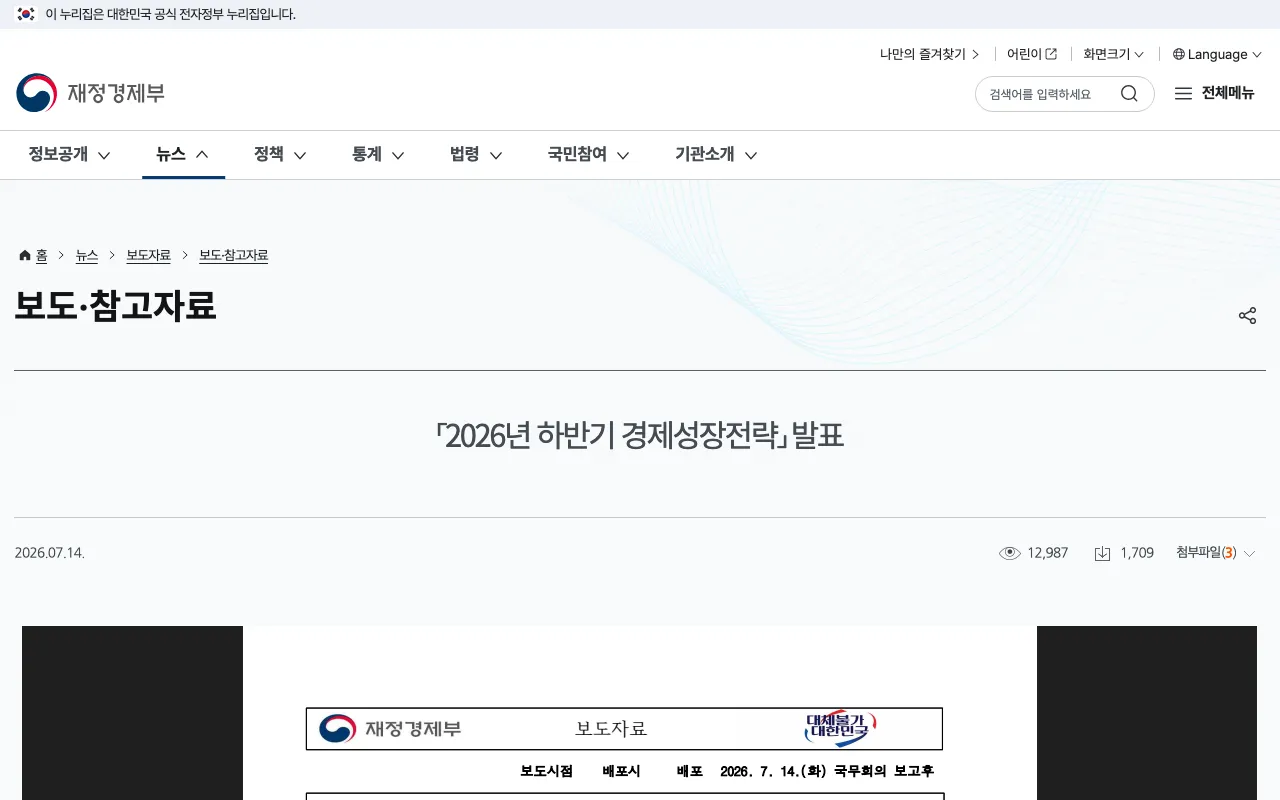
- Korea's Ministry of Finance and Economy (재정경제부), "「2026년 하반기 경제성장전략」 발표," July 14, 2026. The digital asset agenda is in the strategy; on November 16, 2026 the statute was still not on the books. · 재정경제부 (mofe.go.kr), screenshot
Key takeaways
- 01
Japan's amendment is law: enacted July 15, 2026, promulgated July 23. Higher penalties for unregistered crypto business have applied since August 12. The rest takes effect on a cabinet-order date within a year, expected in 2027
- 02
Japan's 20.315% separate tax on qualifying tokens applies from January 1 of the year after that date, which points to 2028. Crypto ETFs still need an Investment Trusts Act order and are expected around January 2028
- 03
Korea is still drafting. On November 12 the Digital Asset Basic Act had not been filed, listed companies and professional-investor corporations were still shut out of exchanges, and a spot ETF still waits on a Capital Markets Act amendment
- 04
Korea's tax clock has reversed. The government plans to defer the 22% crypto tax from 2027 to 2029; the Assembly's tax subcommittee agreed in principle on November 11 but did not vote that day
- 05
The two markets now do different jobs. Japan gives a dated rulebook for disclosure and institutional products; Korea gives retail reach under today's rules. Sequence them, and do not wait on Seoul's calendar
First published July 27, 2026; updated November 16, 2026: Japan's law has since been promulgated, its first provisions are in force, and its tax and ETF steps now have expected dates. In Korea the framework bill is still unfiled and the crypto tax is moving from 2027 toward 2029, which reverses the tax comparison in our first version.
For a decade the comparison ran one way: Korea had the volume, Japan had the caution. On July 15 Japan's Diet moved cryptoassets out of the Payment Services Act and into the Financial Instruments and Exchange Act (FIEA), the statute that governs securities. Six days later the Financial Services Commission (FSC) in Seoul said Korea would finish its own law "as soon as possible."
Four months on, Japan's law is partly in force and Korea's government bill has still not reached the National Assembly. This update sets out what Japan's rulebook contains and when each part applies, where Korea stands, and what the gap means for a team entering Korea.
What Passed in Tokyo, and What Has Applied Since
The bill, formally an amendment to both the FIEA and the Payment Services Act, was submitted to the 221st Diet on April 10, 2026 and enacted on July 15. The Financial Services Agency (FSA) summarizes its purpose in one line: to build rules for cryptoassets, sustainability disclosure, startup financing and unfair trading. Crypto stops being a payments question and becomes a capital-markets question.
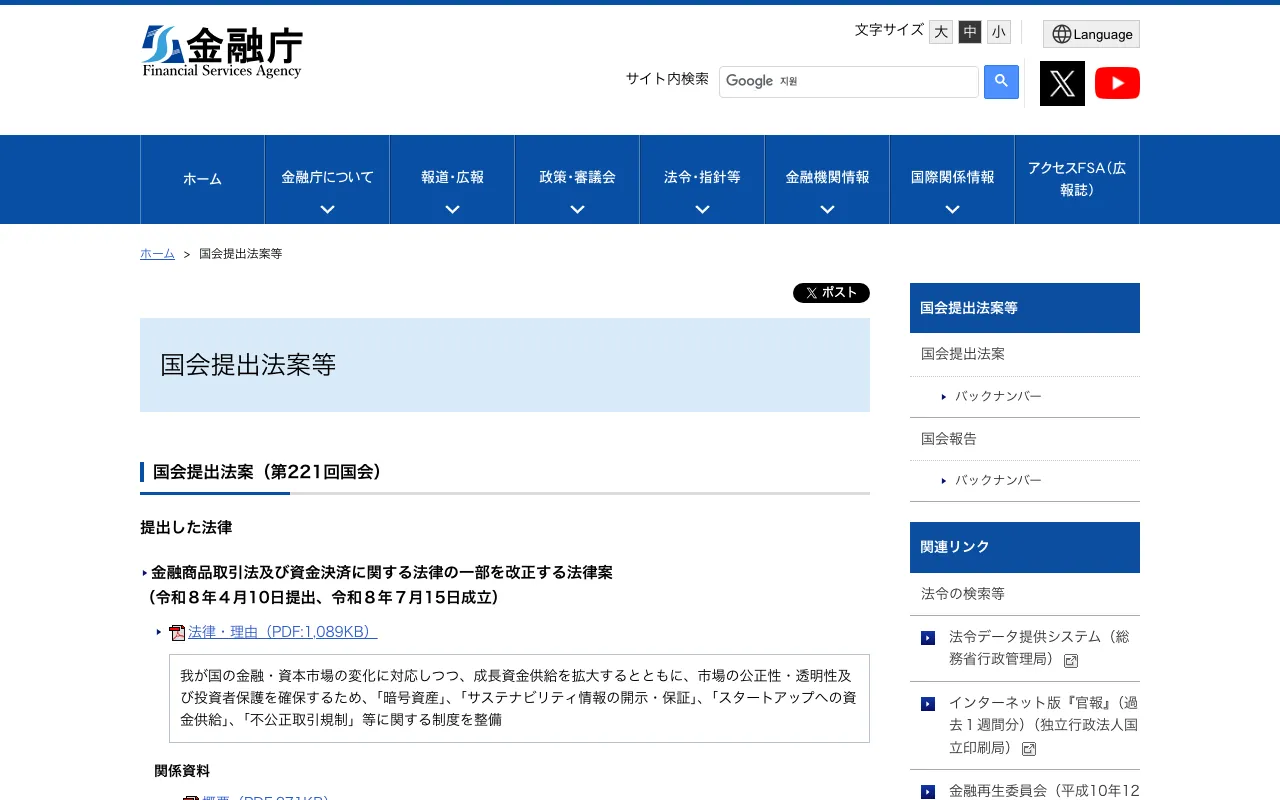
The law was promulgated on July 23, according to a review published after enactment by lawyers at Nagashima Ohno & Tsunematsu. Two parts did not wait for the rest. On July 29 the FSA announced that the provisions raising the penalties for unregistered business and adding criminal investigation powers for the Securities and Exchange Surveillance Commission (SESC) would apply from August 12, 20 days after promulgation.
August 12, 2026: The day Japan's higher penalties for unregistered business took effect, 20 days after the amendment was promulgated (Source: Financial Services Agency, July 29, 2026)
Everything else in the crypto chapter takes effect on a date set by cabinet order within one year of promulgation, so by July 2027 at the latest. So & Sato, a Tokyo law firm, expected the date in 2027 in a November 6 note, and Four Pillars, a research firm, wrote in July that enforcement is targeted for 2027.
What this changes: Japan's calendar now has an outer limit. A team planning disclosure, a listing or marketing in Japan can work back from mid-2027 at the latest. For unregistered business, the higher penalties apply already.
From Payments Law to Securities Law: What Actually Changes
Four changes matter to an operator.
Categories. The amended FIEA defines cryptoassets broadly and adds a narrower class of "specified cryptoassets": tokens that only specific persons have the authority to issue. Nagashima Ohno & Tsunematsu give a token sold by an exchange in an initial exchange offering (IEO) as the example. They expect a Cabinet Office ordinance to add tokens on permissioned chains and tokens issued under standards such as ERC-20. Bitcoin sits outside the narrower class. Stablecoins, which Japanese law treats as electronic payment instruments, are excluded from the definition.
Disclosure. An issuer must publish information before an offering of a specified cryptoasset. It must publish part of that information again once a year, in principle within three months of its financial year-end, and disclose material events without delay. An exchange must publish information before it handles a token outside that class, and exchanges already handling tokens must do so within three months of the effective date. Issuers that skip an audit of their financial information face a proposed investment cap: in principle ¥500,000 per case for an ordinary investor and ¥2 million a year in total.
Insider trading. Trading on undisclosed material facts about a token becomes a crime. The rules cover facts about issuers, about trading operators and about large-volume traders, reach the people connected to each, and ban tipping. The penalty matches listed securities: up to five years in prison, a fine of up to ¥5 million, or both. Surcharges, SESC investigation powers and cooperation with foreign regulators come with it.
Enforcement. The maximum penalty for operating without registration rose from three years in prison or ¥3 million to ten years or ¥10 million. On So & Sato's reading of the bill, when an unregistered operator sells tokens that domestic operators do not handle and whose prices are hard to find, the contracts with customers are in principle void. Existing exchanges may keep operating without FIEA registration for six months from the effective date and, if they apply in that window, until a decision, for up to two years. Banks are in principle barred from crypto trading business, with exceptions such as investment under the Banking Act.
| Item | Rule | Applies from |
|---|---|---|
| Unregistered business | Up to 10 years or ¥10 million | August 12, 2026 |
| Insider trading | Up to 5 years or ¥5 million | Main date, by July 2027 |
| Tokens already listed | Exchange publishes information | Within 3 months of the main date |
| Existing exchanges | Grace period to register | 6 months, up to 2 years |
| Separate taxation, 20.315% | Qualifying transfers to registered operators | January 1, 2028, if the main date is in 2027 |
| Crypto ETFs | Investment Trusts Act order needed | Around January 2028, expected |
Korea took a different route: an independent Digital Asset Basic Act linked to the Capital Markets Act, Etoday notes, where Japan moved general cryptoassets into its securities statute itself.
What this changes: if a Japanese exchange handles your token, your communications calendar becomes a compliance surface once the main date arrives. A delisting, a protocol change or a large treasury move can be the kind of fact the insider rules cover. An IEO or ERC-20 token for Japan should expect issuer-style disclosure. Ask Japanese counsel which class your token falls into before you plan a launch.
The Tax Pivot, and Korea's Reversal
Japan taxes crypto gains today as miscellaneous income, added to other income, at rates of up to 55%. Under the FY2026 tax reform, gains on transfers of qualifying tokens to registered crypto trading businesses move to separate taxation at 20.315%: 15% national income tax, 5% local inhabitant tax and a surtax. Losses can be carried forward for three years. The new rate applies from January 1 of the year after the amended FIEA takes effect, which points to January 1, 2028.
Two details matter. First, the lower rate is tied to registered venues: the rules cover transfers to registered operators, and Yamada & Partners, a Japanese tax firm, say the treatment of transfers made without an operator still has to be checked. Second, the tax rules use the same Japanese term as the FIEA, specified cryptoassets, for a different set of tokens. So & Sato note that the two scopes differ. A token's tax status and its disclosure class are separate questions.
In July, Korea looked like the mirror image: a 22% tax, including local tax, on annual crypto income above a ₩2.5 million deduction, due in January 2027, ahead of its framework law. That has changed. On November 5 Lee Hyoung-il, deputy prime minister and finance minister, said the government would work with the Assembly to defer the tax for two years, to 2029, and add a three-year loss carryforward.
On November 11 both parties on the Assembly's tax subcommittee agreed in principle to the delay but did not vote; exchanges' data submission and a higher deduction were still open. On November 15 Herald Business reported that the Assembly's expert review called a rise in the basic deduction from ₩2.5 million to ₩50 million unreasonable next to the ₩2.5 million that applies to overseas stocks, and that the subcommittee was expected to meet again on November 19 and 20. If the Income Tax Act amendment passes, the tax starts in 2029, Etoday reports.
Sources: Yamada & Partners on Japan's FY2026 tax reform; Etoday, November 5 and 11, 2026. Japan's 2028 start assumes the amended FIEA takes effect in 2027; Korea's 2029 start assumes the deferral passes
The order has flipped. Our July version said Korea was sequencing tax first and infrastructure on a promise. If the deferral passes, Japan's lower rate arrives on January 1, 2028, a year before Korea's tax starts, and Japan's framework is in force before either.
What this changes: our July GTM Index expected the January 2027 tax start to pull Korean retail attention into the fourth quarter of 2026. If the deferral passes, that pull is gone. Plan Korean campaigns around listings and market events, not a tax deadline. Ask a Japanese tax adviser before telling Japanese users which trades qualify for the lower rate.
The ETF Door
The amendment does not by itself allow a crypto ETF. Under Japan's Investment Trusts Act cryptoassets are not "specified assets", so a crypto ETF cannot be formed or sold in Japan today. So & Sato list the remaining steps: add cryptoassets to the specified assets in the act's enforcement order, revise a 2019 supervisory guideline, and write exchange listing rules. They expect crypto ETFs to be permitted around January 2028, and cite press reports that the FSA intends to allow them together with the new separate taxation.
Four Pillars reports that Hiromi Yamaji, chief executive of Japan Exchange Group, has raised the possibility of listing crypto ETFs, and puts a listing as early as 2027 and as late as 2028, depending on the legal amendments. CoinDesk, citing Nikkei, reported in January that SBI Holdings had filed for a dual-asset crypto ETF in August 2025 and that Nomura Holdings had expressed interest. Asset management experts in the same report estimated the market at up to ¥1 trillion ($6.4 billion); that is their estimate, not ours.
One problem is unsolved. A Japanese trust bank acting as trustee cannot contractually limit its liability to beneficiaries, So & Sato point out. In US spot ETFs, by contrast, losses not recoverable from the custodian or insurers reduce the trust property. How Japan resolves that will decide who is willing to act as trustee.
Korea's spot ETF path runs through a different statute. Under the current Capital Markets Act cryptoassets are not accepted as ETF underlying assets, so Korean asset managers cannot launch a spot bitcoin ETF. The July 14 growth strategy committed the government to support the Assembly's amendment. Blockmedia adds the catch: custody licensing and other business requirements are set in the Digital Asset Basic Act, so the ETF's timing depends on how fast both laws pass.
What this changes: for a token with a Japanese institutional story, the ETF line now has a plausible date and a named list of steps. For Korea there is no date. Keep a Korean spot ETF out of any demand forecast until both laws pass.
Seoul Since July: Still Drafting
On July 14, the day before Tokyo's vote, Korea's finance ministry published its growth strategy for the second half of 2026. ET News listed the digital asset items: a Digital Asset Basic Act that governs how stablecoins, won stablecoins included, are issued and distributed; bringing cross-border stablecoin trading into the regulated system; support for the spot ETF amendment; and a 2027 pilot tokenizing government bonds, linked to the Bank of Korea's wholesale CBDC.
A week later the FSC described the bill it was preparing:
"The bill's basic frame will be rules on the classification, definition and conduct of virtual assets, the creation of a fair and efficient virtual asset market, and the protection of virtual asset users, and of course matters on the issuance and distribution of stablecoins will be included."
Yoo Young-joon, Director General for Digital Finance Policy, Financial Services Commission, at the Korea Strategic Economy Forum, Seoul, July 21, 2026, as reported by Edaily (translated from the Korean original).
As of November 12 the bill had not been filed. On November 9 Blockmedia expected the government text this month as a lawmaker's bill, reportedly moving exchanges from registration to authorization and listing review into law, with foreign stablecoins still an open question. On November 12 Yu Dong-su, chair of the Assembly's National Policy Committee, said the FSC would submit it soon. Seoul Shinmun reported the same day that the text was expected to be made public around November 25. The fight over who may issue a won stablecoin is in The 51% Question; how the binding rules arrived through anti-money-laundering supervision meanwhile is in our August paper.
Corporate access has not moved either. Donation organizations, universities and law enforcement agencies can sell crypto, but listed companies and registered professional-investor corporations had still not entered the market on November 12, ZDNet Korea reported; some expect the corporate market to open only after the Basic Act. At the same seminar Yu argued that an independent custody system, separating trading from safekeeping, has to come first.
What this changes: the Act will decide who your Korean counterparties are: which exchanges hold an authorization, how listings are reviewed, whether institutions can buy. None of that is decided. Build the plan on today's rules and keep what depends on the Act in a separate column. The Corporate Door sets out what institutions can do now.
Two Markets, Side by Side
The legal gap sits on top of two markets of comparable account counts that are measured in different ways.
| Measure | Japan | Korea |
|---|---|---|
| Accounts | 14,471,551 user accounts, of which 8,975,519 active (end-August 2026) | 11.175 million accounts able to trade (end-June 2026) |
| Trading | ¥764.4 billion of spot trading in August 2026, 30 member firms | ₩3.1 trillion a day on average in the first half of 2026 |
| Client money | ¥3.51 trillion of user deposits (end-August 2026) | ₩5.2 trillion of won deposits (end-June 2026) |
| Venues counted | 30 member firms in the spot count | 17 exchanges in the survey |
The counts are not like for like: Japan reports monthly totals and user accounts, Korea daily averages and accounts able to trade, from figures the businesses submit. We do not convert currencies. Two points stand out. Japan's July spot volume, ¥674.2 billion, was its lowest since September 2023, so Japan passed its law in a quiet market too. And Japan's exchanges are divided among several operators of similar weight, such as GMO Coin, bitFlyer, Coincheck and bitbank, Four Pillars notes, while Korea set high entry requirements, such as information-security certification and real-name bank accounts, from the start.
Japan's venues are also consolidating. SBI Holdings signed a share transfer agreement to make bitbank a wholly owned subsidiary, Etoday reported in July. For the Korean tape since August, see After the Drought.
What this changes: do not choose between the two markets on account counts. Japan offers a dated regime spread across several venues. Korea offers a large base under rules still being written. Choose on what you need each market to do.
Stablecoins: Japan Settled the Plumbing First
Japan kept stablecoins out of the new cryptoasset definition. They stay under the Payment Services Act as electronic payment instruments, and the market is building on that base. SBI Shinsei Trust Bank's yen stablecoin JPYSC, distributed by SBI VC Trade, launched in June inside customer accounts, Etoday reported. JPYC Inc. has said that on some days its coin's trading volume exceeds its issuance balance, according to Four Pillars.
Korea runs the other way. Stablecoin issuance and distribution are part of the Basic Act's frame, so the most commercially interesting part of Korea's agenda sits inside its least finished statute. Who may issue, how much banks must own and how foreign coins would be treated are covered in our November paper.
What this changes: a payment or settlement product that needs a regulated yen stablecoin can plan against Japan's existing regime now. One that needs a won stablecoin is waiting on Korea's Act, and should keep its design neutral between the issuer models still on the table.
What This Changes for a Korea Go-to-Market
Our July read was that Japan had become the market where you plan against statutes and Korea the market where you position against catalysts. Four months on that holds, with dates attached on the Japanese side and one catalyst gone on the Korean side.
- Sequence, do not choose. Use Japan's dated rulebook for the institutional story and product roadmap: the main regime by July 2027, the tax change and ETFs expected around January 2028. Use Korea for retail reach under today's rules.
- Write disclosure once, to the stricter text. Japan's disclosure duties are law, and Korea's coming text reportedly writes listing review into law. A white paper built to Japan's standard is a good base for a Korean listing file too.
- Drop the tax-deadline assumption. Time Korean spend to listings and market moves. The GTM Index found a median 2.3x engagement multiple for campaigns launched within two weeks of a major catalyst, against quiet-window campaigns at the same budget.
- Keep Korean institutions out of the near-term demand model. Listed and professional-investor corporations cannot yet buy through Korean exchanges, and a Korean spot ETF has no date. Count Japanese institutional demand on the ETF timetable, Korean only once the Act passes.
- Plan listing lead times under today's rules. The GTM Index put the median time from first structured contact to a live won market at 7.2 months on Upbit and 4.5 months on Bithumb. A listing effort begun now runs under the current regime, whatever the Act later says.
| Dimension | Japan | Korea |
|---|---|---|
| Framework law | Promulgated July 23; main date by July 2027 | Government bill not filed (November 12) |
| Spot ETF | Expected around January 2028 | No date; tied to the Basic Act |
| Individual tax | 55% today; 20.315% expected from 2028 | 22%; deferral to 2029 agreed in principle, not voted on November 11 |
| Stablecoins | Payment Services Act; yen coins live | Inside the unfiled Basic Act |
| Institutional access | Banks in principle barred from crypto trading business | Listed and professional-investor corporations not yet admitted |
None of this is legal or tax advice. A token's class in Japan, a sale to Korean corporations and the tax treatment of a user's trades each need a lawyer or tax adviser in that market. Nothing here predicts a vote.
What Would Change This Read
- Japan's cabinet order. It sets when disclosure and insider rules bite; a date in 2027 keeps the tax change at January 1, 2028.
- The filing of Korea's government bill. Its text on authorization, listing review, custody and stablecoins decides who your Korean counterparties will be.
- The vote on Korea's tax deferral. If it fails, the January 2027 start comes back into every plan.
- A Korean date for corporate access or spot ETFs. Either changes the institutional half of a Korea plan.
What this changes: watch the documents, not the speeches: Japan's cabinet orders and ordinances, and Korea's bill once filed.
Method and Limits
This update is written as of November 16, 2026 and uses only material published on or before that date. We re-checked the July claims and added what happened since from 20 sources: two FSA pages; four Japanese law and tax firm analyses (Nagashima Ohno & Tsunematsu, two by So & Sato, Yamada & Partners); association statistics via CoinPost; Four Pillars; CoinDesk; the Korean finance ministry's release; the FSC survey; and Korean press (ET News, Edaily, ZDNet Korea, Blockmedia, Seoul Shinmun, Herald Business, three Etoday reports). Translations from Korean are ours. GTM Index figures are ium Labs' own, as published there.
Corrections to the July version: its figure of 105 designated assets is gone, because the press report it cited gives no such number. Contracts by unregistered operators are void in principle, not voidable, in the analysis we read. Its 2027 ETF target is now 2027 to 2028 in the exchange's account and around January 2028 in legal analysis. A reference to a Korea-Japan comparison paper the desk never published is removed.
Limits. Japan's cabinet order fixing the main date, the ordinances on token classes and disclosure, and the ETF order had not appeared in what we read. The transition, void-contract and bank rules come from So & Sato's analysis of the bill as submitted and may differ in detail. The tax summary rests on a tax firm's reading of the reform outline, not the statute. The ETF issuer plans come through CoinDesk's report of Nikkei. The market counts use different definitions and periods. In Korea the government bill was unpublished, the latest tax report we read (November 15) had no vote, and we found no date for corporate access or a spot ETF. This paper is not legal, tax or investment advice.
References
[1]Financial Services Agency (Japan). 2026-07-15. 国会提出法案等 (221st Diet legislative submissions): 金融商品取引法及び資金決済に関する法律の一部を改正する法律案, submitted April 10, 2026, enacted July 15, 2026. fsa.go.jp.
[2]Financial Services Agency (Japan). 2026-07-29. 令和8年金融商品取引法等改正(20日後施行)に係る政令の公布について (penalties for unregistered business and SESC investigation powers in force from August 12, 2026). fsa.go.jp.
[3]BUSINESS LAWYERS. 2026-08-28. 2027年施行 暗号資産に関する金商法・資金決済法改正の概要 (Nagashima Ohno & Tsunematsu). businesslawyers.jp.
[4]So & Sato Law Offices. 2026-05-18. Japan's 2026 FIEA Amendment Bill: Overview and Practical Implications for Cryptoasset Regulation. innovationlaw.jp.
[5]So & Sato Law Offices. 2026-11-06. Crypto ETFs in Japan: Why They Cannot Be Offered Today, the Road to 2028, and the Trustee Liability Gap. innovationlaw.jp.
[6]Yamada & Partners (税理士法人山田&パートナーズ). 令和8年度税制改正 速報: 暗号資産の申告分離課税 (separate taxation of cryptoassets under the FY2026 tax reform outline). yamada-partners.jp.
[7]CoinPost. 2026-10-05. 国内暗号資産の現物取引高、8月は7644億円 2カ月ぶり増加 (JVCEA statistics for August 2026). coinpost.jp.
[8]Four Pillars. 2026-07-23. Japan Crypto Market Report, Q2 2026: When Market Sentiment and Regulation Diverged. research.4pillars.io.
[9]CoinDesk. 2026-01-26. Japan ETFs said likely to trade by 2028 as SBI, Nomura ready products. coindesk.com.
[10]Etoday. 2026-07-23. 日 가상자산 제도 정비에 SBI '광폭 행보'…韓 입법 동향 주시. etoday.co.kr.
[11]Ministry of Finance and Economy (Korea). 2026-07-14. 「2026년 하반기 경제성장전략」 발표. mofe.go.kr.
[12]ET News. 2026-07-14. 비트코인 현물 ETF, 국내 상장 길 열린다…정부 하반기 도입 추진. etnews.com.
[13]Edaily. 2026-07-21. 금융위 "스테이블코인 조속 입법…AI 커머스 신중 검토"(종합) (Yoo Young-joon at the Korea Strategic Economy Forum). edaily.co.kr.
[14]ZDNet Korea. 2026-11-12. 유동수 정무위원장 "디지털자산기본법 조만간 제출"…정부안 곧 국회로. zdnet.co.kr.
[15]Blockmedia. 2026-11-09. 디지털자산기본법 정부안 이달 공개 유력…코인 발행·상장 규제 어떻게 바뀌나. blockmedia.co.kr.
[16]Etoday. 2026-11-05. 가상자산 과세 2029년부터…손실 3년 이월공제 도입. etoday.co.kr.
[17]Etoday. 2026-11-11. 가상자산 과세 2029년으로 미뤄지나⋯여야 2년 유예 잠정 합의. etoday.co.kr.
[18]Financial Services Commission / Korea Financial Intelligence Unit / Financial Supervisory Service. 2026-10-01. '26년 상반기 가상자산사업자 실태조사 결과. fsc.go.kr.
[19]Seoul Shinmun. 2026-11-12. 與, 디지털자산기본법 속도… 정부안 25일쯤 공개 (government bill expected around November 25). seoul.co.kr.
[20]Herald Business. 2026-11-15. 과세도 미뤘는데 코인 공제 250만원→5000만원?…국회 "불합리" 제동 (deduction rise questioned; next tax subcommittee November 19-20). biz.heraldcorp.com.