A Forensic Assessment of Binance and OKX
ium Research — James, Co-founder — Mar 29, 2026 Canonical: https://iumlabs.io/blog/a-forensic-assessment-of-binance-and-okx
IUM LABS | INSTITUTIONAL RESEARCH
Date: February 2026 Subject: A Forensic Assessment of Binance and OKX
Note to reader: The following four diagrams represent the architectural, operational, economic, and risk logic skeleton of the analyzed ecosystems. They will be referenced throughout the deep dive sections.
THE MACRO THESIS
The Institutional Executive Summary
The public feud that erupted between OKX CEO Star Xu and Binance following the catastrophic October 10, 2025, cryptocurrency flash crash is a performative distraction. Xu’s characterization of Binance’s operations as a "man-made crisis" attempts to frame a systemic, industry-wide architectural vulnerability as the isolated malfeasance of a single dominant actor. Stripping away the retail marketing narratives reveals a far more cynical reality: both Binance and OKX operate highly leveraged, centralized, and opaque economic ecosystems thinly disguised as decentralized Web3 infrastructure.
The primary market inefficiency in this sector is the fundamental mispricing of infrastructural risk. Retail participants and mercenary liquidity providers treat centralized exchange tokens (BNB, OKB) and synthetic, yield-bearing wrappers (like Ethena’s USDe) as risk-free, delta-neutral assets. This retail delusion obfuscates the fact that these assets are inherently tied to localized order book depth and centralized administrative cartels. The market inefficiently prices the risk of a single point of failure within centralized exchange (CEX) matching engines, incorrectly assuming that localized spot prices will perpetually reflect protocol-level fundamental value.
The core economic flywheel for both entities relies entirely on the internalization of order flow and the extraction of collateralized leverage. The primary value capture mechanism is not decentralized computation or organic block space demand. Instead, it is the continuous funneling of retail liquidity into proprietary, centrally sequenced execution environments—BNB Chain and X Layer—designed to manufacture artificial utility for native exchange tokens while shielding the underlying margin engines from public audit.
3 Key Alphas
The institutional thesis rests on three data-backed drivers that expose the divergence between perceived Web3 value and structural reality:
- The Regulatory Liquidation Vector: The competitive moat is no longer defined by trading depth, but by jurisdictional access and compliance agility. The global net is tightening symmetrically. On January 28, 2026, the South Korean Financial Intelligence Unit (FIU) blocked the applications for both Binance and OKX, instantly cutting off a critical vein of retail liquidity. Compounding this market access denial is severe organized crime liability. The late-2025 ICIJ "The Coin Laundry" report exposed $408 million in digital currency from the Huione Group flowing through Binance, and over $161 million through OKX accounts. The structural reliance on opaque capital inflows represents a terminal regulatory tail-risk; secondary indictments would instantly trigger systemic insolvency protocols.
- Architectural Centralization as a Yield Trap: Neither ecosystem operates trustless infrastructure. OKX's X Layer relies entirely on a single trusted sequencer managed by the OKX Asset Security Team with a zero-day upgrade delay (via the Xlayer Multisig). Binance’s foundation, the BNB Smart Chain (BSC), operates on a Proof-of-Staked-Authority (PoSA) consensus restricted to 21 active "Cabinets." This extreme centralization is not a bug; it is a feature designed to trap liquidity and guarantee fee extraction, rendering both chains internal corporate ledgers dressed in the nomenclature of decentralized consensus.
- Engineered Tokenomics vs. Organic Revenue: The value capture models represent distinct philosophies in synthetic price generation. OKX relies on deflationary shock tactics. The August 13, 2025, destruction of 65.26 million OKB tokens ($7.6 billion) permanently capped the supply at 21 million. This engineered scarcity attempts to mimic Bitcoin's psychological premium. Conversely, Binance utilizes a programmatic Auto-Burn, continuously reducing its 136.36 million circulating supply toward a 100 million target based on actual block generation and price. Binance captures genuine on-chain economic velocity; OKX captures the illusion of it.
Market Positioning: The Ecosystem Hierarchy
Reference [Diagram 1: The Ecosystem Hierarchy].
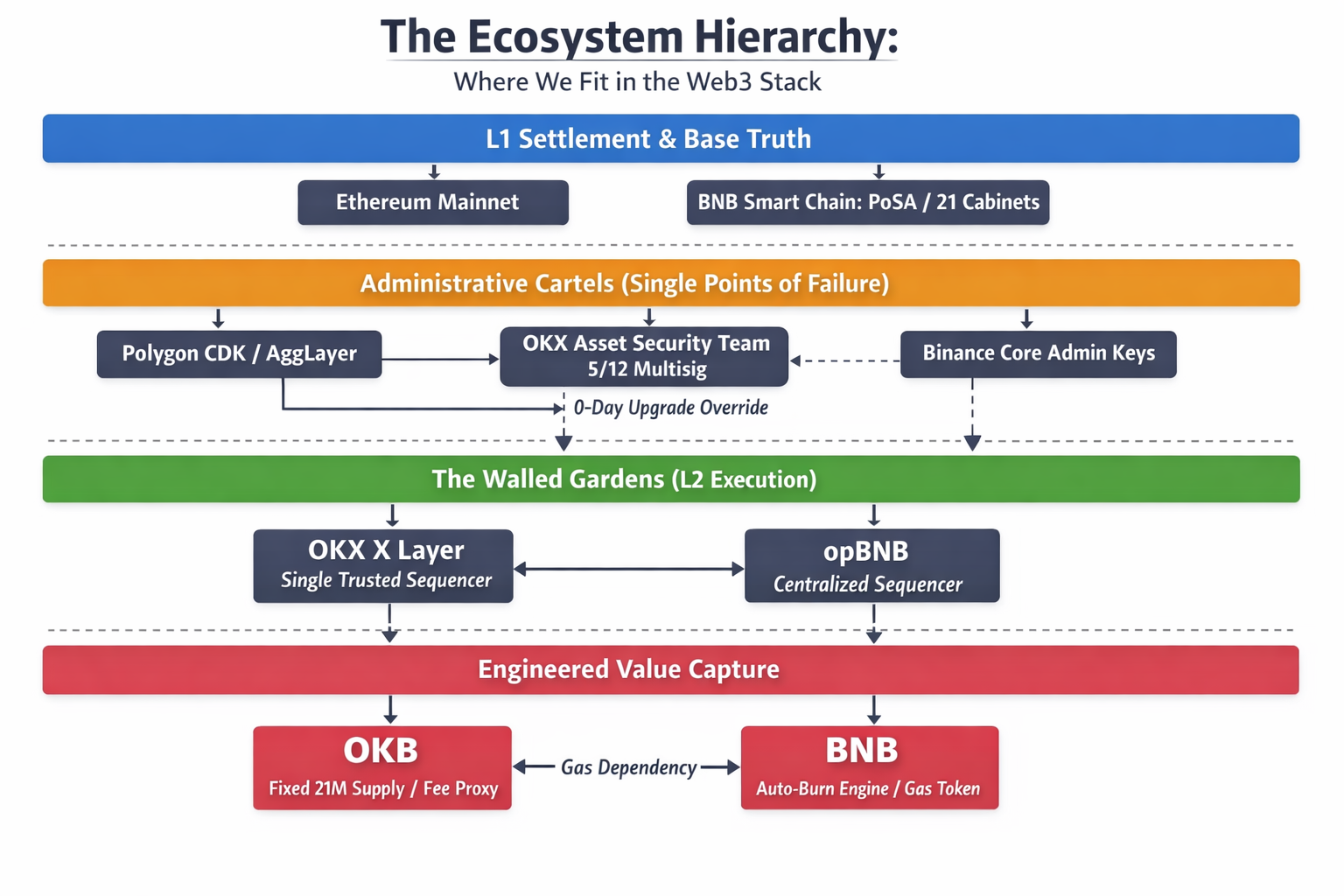
The positioning of both projects within the Web3 stack reveals a deliberate strategy of "walled garden" containment rather than genuine Layer 1/Layer 2 scaling. By positioning their proprietary chains as Ethereum or Optimism-aligned scaling solutions (X Layer utilizing Polygon CDK; opBNB utilizing the Optimism OP Stack), they hijack the security narratives of established decentralized networks.
This specific stack placement is designed to be superior for capital extraction. By controlling the sequencer and the administrative multisig keys, both Binance and OKX eliminate the interoperability frictions of decentralized networks, achieving sub-second block times and near-zero gas costs (X Layer: < $0.01 gas, 5,000 TPS; BSC: 0.75s block time, 0.05 gwei gas).
However, this positioning is entirely reliant on the operational hygiene of a small administrative cartel. X Layer’s reliance on Polygon's Pessimistic Proof mode—where transaction data is not posted to the Ethereum L1 via calldata or EIP-4844 blobs—means the architectural integrity relies on off-chain accounting and a 5/12 multisig. The structure dictates that in the event of a regulatory seizure or a malicious sequencer takeover, user funds would be completely frozen without a trustless escape hatch to the base layer. The ecosystem hierarchy is optimized for corporate sovereignty, not user security.
The Gap Analysis
A direct comparison of "Hard Numbers" between Binance and OKX exposes the asymmetric reality of the CEX oligopoly. OKX is actively subsidizing a ghost chain, while Binance commands mercenary dominance.
| Metric (Feb 2026 Data) | BNB Chain (Binance) | X Layer (OKX) | Institutional Implication |
| L1/L2 TVL | ~$10.2 Billion | ~$9.86 Million | OKX X Layer is a verifiable ghost chain. | | Supply Logic | Auto-Burn (Target 100M) | Fixed at 21M (Post 65M Burn) | OKB relies strictly on manufactured scarcity; BNB captures actual retail velocity. | | Developer Activity | 1,227 Active Devs | Obscured / Negligible | Binance retains mercenary engineering; OKX fails to attract organic protocol building. | | Market Share (CEX) | 38.0% | 7.1% | Binance dictates global market microstructure; OKX is a subordinate liquidity taker. |
PHASE 3: TECHNICAL & FINANCIAL DEEP DIVE
The Technical Engine: Auditing the Logic
Reference [Diagram 2: The Core Interaction Flow].
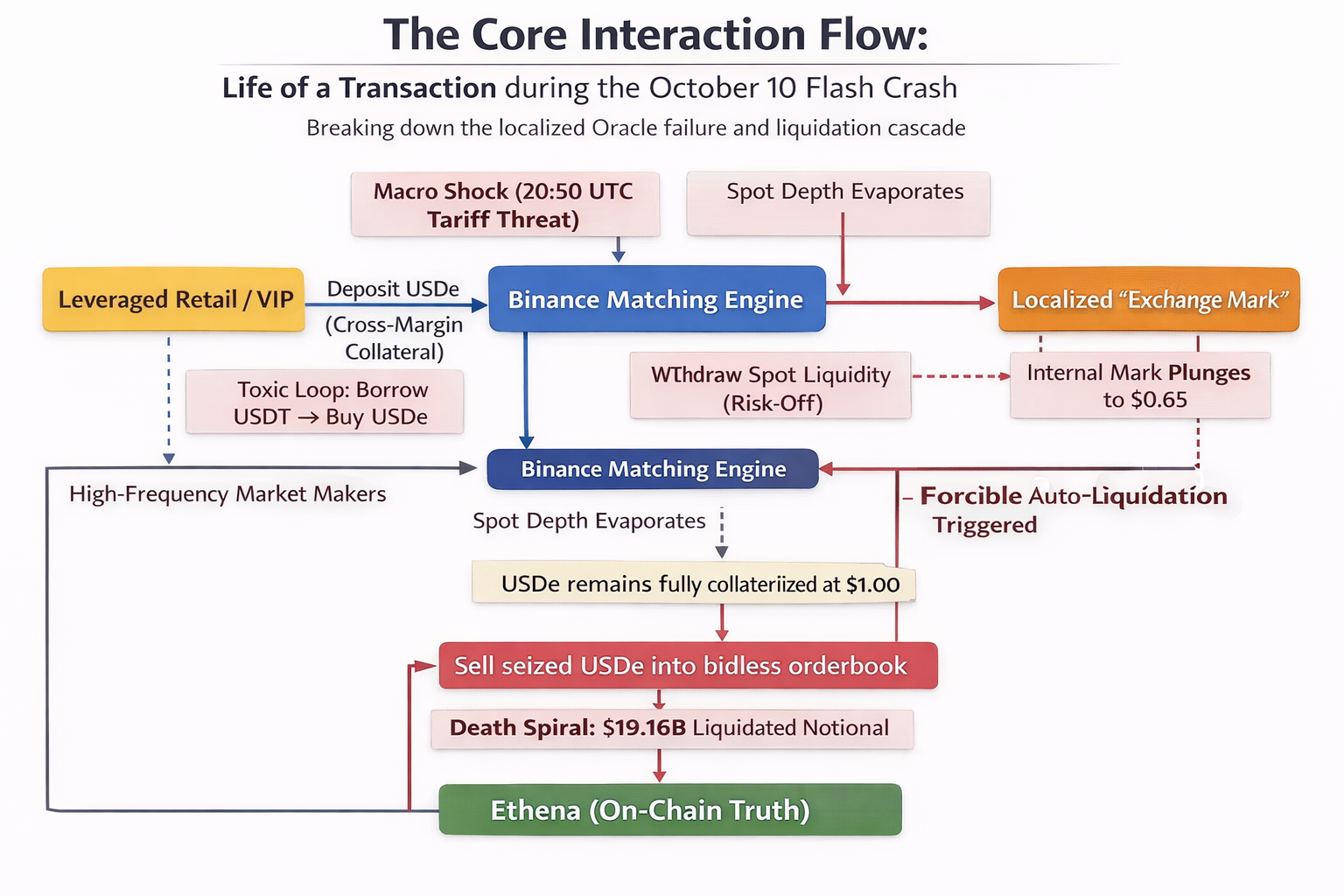
The $19.16 billion liquidation cascade on October 10, 2025, exposes the terminal flaw within centralized exchange infrastructure. The technical engine powering the Binance and OKX margin systems is entirely reliant on the latency and dependency of localized pricing oracles.
A forensic audit of the October 10 timeline reveals the exact mechanics of a centralized death spiral. The foundational error was the risk parameters assigned to Ethena’s USDe. Binance permitted USDe—a synthetic dollar maintaining its peg via a delta-neutral perpetual futures strategy—to function as cross-margin collateral with the same risk weighting as fully reserved fiat stablecoins (USDT/USDC).
This created a toxic "leverage loop." Retail users deposited USDe for a baseline 12% APY, utilized it as collateral to borrow USDT, and recursively purchased more USDe. This self-reinforcing debt structure was built entirely upon an asset dependent on volatile perpetual funding rates.
The structural collapse was triggered by a macro shock. At 20:50 UTC, following a tariff announcement, a risk-off rotation commenced. Between 21:20 and 21:42 UTC, high-frequency market makers withdrew localized liquidity from Binance’s matching engine. As order book depth evaporated, the localized "exchange mark"—the internal oracle dictates margin health—plunged.
The data highlights a complete decoupling from fundamental reality. While USDe traded securely at $1.00 on-chain and Ethena processed redemptions normally, the internal Binance oracle registered a price of $0.65. This localized price failure instantly triggered a violent auto-liquidation cascade. The risk engine forcibly seized and sold user collateral into a bidless market. Between 21:42 and 21:51 UTC, the automated selling drove the price lower, triggering further liquidations in a mathematically inescapable feedback loop. At the peak, the engine liquidated $3.21 billion in 60 seconds (93.5% algorithmic). The contagion infected other illiquid synthetic assets; Wrapped Beacon ETH (wBETH) plunged 80% to $430, and Binance Staked SOL (BNSOL) collapsed to $34.90.
Decentralized lending protocols like Aave bypassed this specific flash crash by hard-coding their oracles to peg USDe to USDT. However, this introduces a different terminal risk: if the underlying synthetic asset actually suffers a fundamental exploit, a hard-pegged oracle will continue to value a worthless asset at $1.00, allowing malicious actors to drain fully reserved assets from lending pools. Centralized platforms actively weaponize yield-bearing synthetics to maximize transaction volume, deliberately externalizing the catastrophic tail-risks of oracle latency onto the retail public.
The Economic Flywheel: Stress-Testing the Value Capture
Reference [Diagram 3: The Value Flywheel].
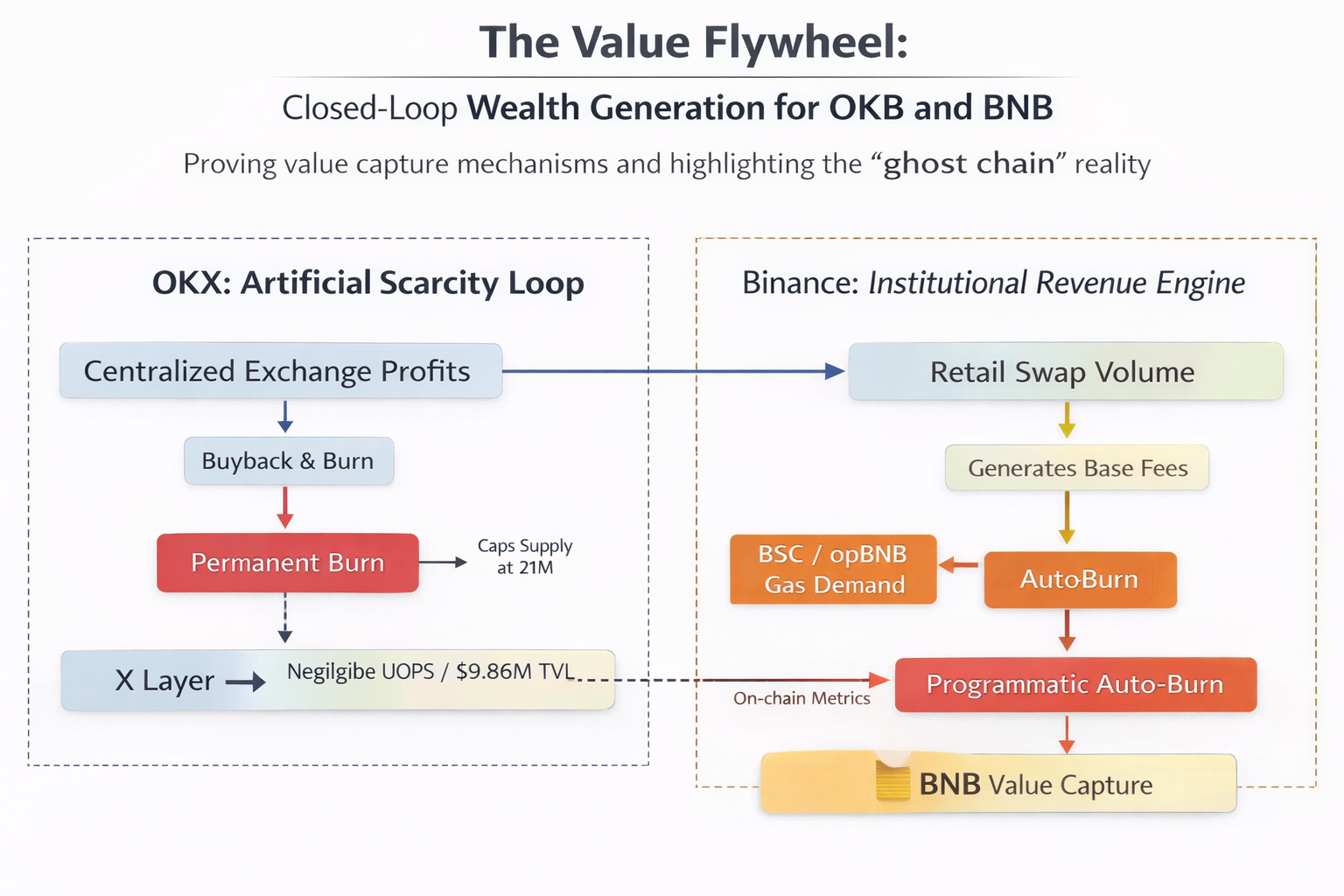
Institutional stress testing of the OKB and BNB tokenomic models reveals a stark divergence between engineered scarcity and mercenary revenue.
- OKB Stress Test (Bear Case Validated): OKX relies entirely on a deflationary shock model. The August 13, 2025, destruction of 65.26 million OKB ($7.6 billion) permanently capped the supply at 21 million tokens. The smart contract was rendered immutable. This action artificially spiked the asset price from $46 to over $140. However, the underlying value capture is non-existent. X Layer, the exclusive gas utility network for OKB, registers a Total Value Locked (TVL) of merely $9.86 million and sub-1.0 daily user operations. The network is an administrative ghost town sustained solely by CEX incentive funds. OKB is strictly a centralized fee-discount proxy devoid of organic, decentralized economic velocity.
- BNB Stress Test (Bull/Bear Dynamics): Binance utilizes a programmatic Auto-Burn targeting a terminal supply of 100 million. In Q1 2026, the foundation burned 1.37 million tokens ($1.27 billion). Unlike OKB, BNB captures genuine on-chain demand. BSC processes 4.3 million Daily Active Users (DAU) and over $40 billion in weekly volume. The $10.2 billion TVL provides a massive fee-generation node.
- The BNB Vulnerability: The critical stress point is liquidity quality. A massive proportion of BSC's $10.2 billion TVL consists of highly incentivized yield farming protocols and volatile synthetic wrappers. This capital is mercenary. In a sustained macro bear market, or under severe regulatory duress, this high-velocity liquidity is mathematically programmed to flee. The instantaneous withdrawal of this capital compresses the auto-burn rate, breaking the deflationary flywheel.
Risk Analysis & Final Verdict
Reference [Diagram 4: Risk Logic].
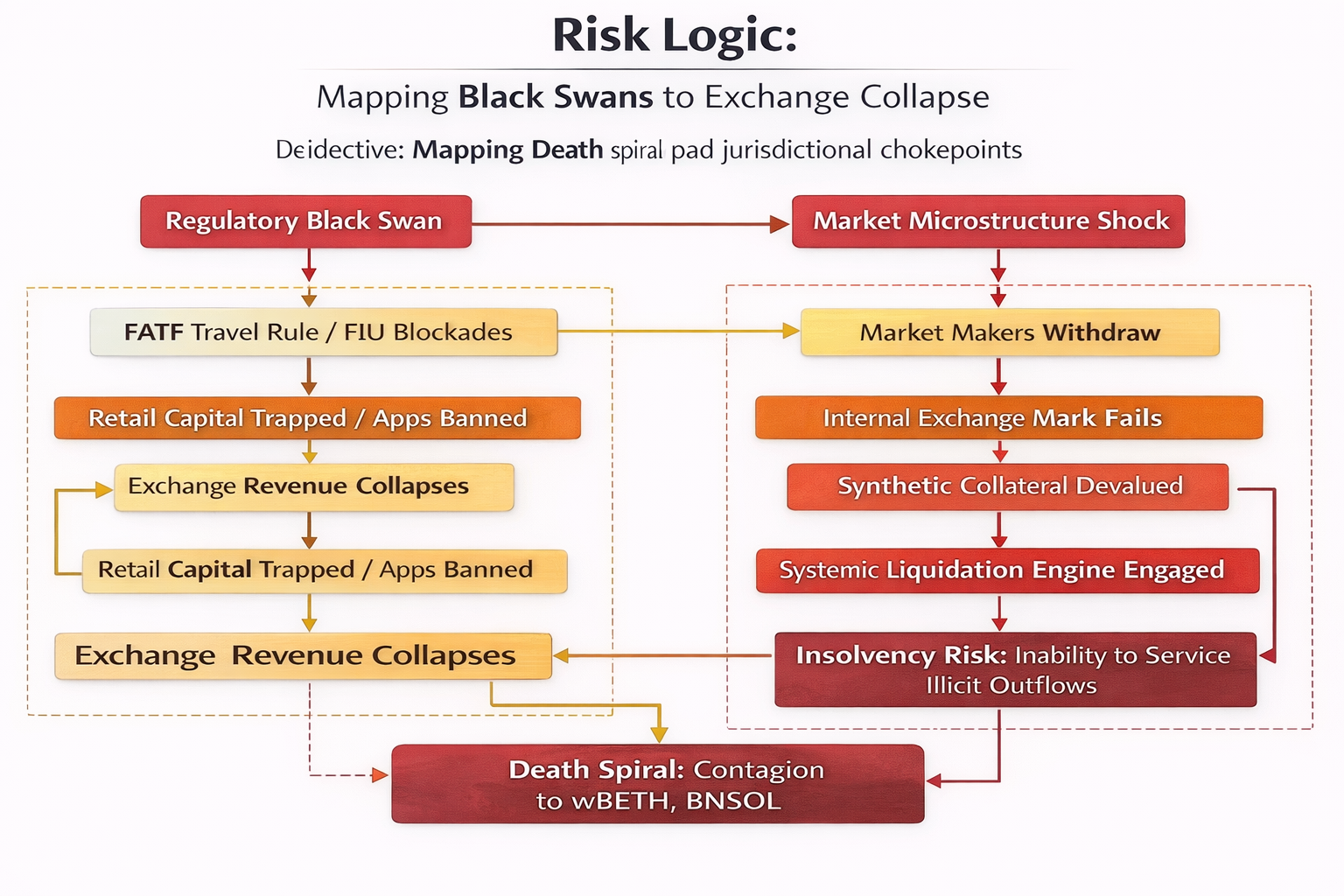
The logical path to a systemic Death Spiral is no longer hypothetical; it is an active, deterministic threat. The centralized exchange oligopoly is currently trapped between decaying internal market microstructures and coordinated global regulatory strangulation.
The competitive moat of jurisdictional arbitrage has evaporated. The January 28, 2026, South Korean FIU blockade cuts off a vital artery of tier-one retail liquidity. Furthermore, the European Union's MiCA Travel Rule and the U.S. GENIUS Act (2025) restrict the fiat-to-crypto stablecoin rails required to sustain CEX margin engines.
The terminal structural threat is the unpriced liability of organized crime syndicates. The ICIJ exposed $408 million flowing through Binance and $161 million through OKX linked to the sanctioned Huione Group. Binance operates under DOJ-appointed monitors; OKX operates under a court-mandated compliance consultant.
The risk logic is absolute: Should global authorities issue secondary indictments or multi-billion dollar seizures based on these post-plea AML failures, the resulting retail panic will trigger an immediate liquidity flight. Market makers will pull spot depth. The internal matching engines will lose their oracle pricing marks. The automated margin systems will indiscriminately liquidate highly leveraged synthetic collateral into bidless order books. The resulting wealth destruction will eclipse the October 10 event.
Strategic Verdict: EXIT
- Strategic Call: EXIT entirely from the OKX/OKB ecosystem. Aggressively REDUCE (70%+) exposure to the Binance/BNB ecosystem.
- Time Horizon: Immediate (0–3 Months). The convergence of the SK FIU blockade and the maturity of DOJ compliance monitoring creates an active, near-term tail risk.
- Watch Metrics:
- Secondary FATF/DOJ indictments regarding Huione Group flows.
- South Korean FIU final registration denials.
- Exchange cross-margin utilization ratios for synthetic assets (e.g., USDe, LSTs).
- VIP-tier negative funding rate subsidies (indicates desperate liquidity retention).
- Exit Targets: Divest all OKB holdings immediately; the engineered 21M supply cap cannot mask a dead L2 execution layer. Liquidate BNB positions on any algorithmic spot rally. Rotate capital exclusively into base-layer, decentralized execution environments (Ethereum, Solana) where block sequencing is distributed, oracle mechanics are mathematically auditable, and protocol survival is not dictated by localized margin engine failures or corporate AML liabilities.