Deconstruction of Move-VM Layer 1s (Sui vs. Aptos)
ium Research — Yugene, Researcher — Feb 24, 2026 Canonical: https://iumlabs.io/blog/deconstruction-of-move-vm-layer-1s-sui-vs-aptos
Structural Deconstruction of Move-VM Layer 1s (Sui vs. Aptos)
DATE: February 2026
1. Institutional Executive Summary: The Retail Delusion and Structural Reality
The contemporary digital asset ecosystem is trapped in a cycle of infrastructure fetishism. Retail participants and unsophisticated allocators assign massive premiums to theoretical throughput metrics and the novel Move programming language, ignoring fundamental structural contradictions. Both Sui and Aptos market themselves as the ultimate panacea for blockchain scalability, boasting sub-second finality and enterprise-grade security.
The data proves this is a highly extractive retail delusion. The core economic flywheel of both networks relies almost entirely on incentivized, mercenary liquidity. This artificial capital heavily inflates Total Value Locked (TVL) metrics, masking a complete lack of organic user demand. The primary market inefficiency we are exploiting is the discrepancy between circulating market capitalizations and Fully Diluted Valuations (FDV). Retail participants are pricing these assets based on artificially constrained circulating supplies, willfully acting as exit liquidity against multi-year insider unlock schedules that mathematically guarantee structural sell pressure.
2. Three Key Alphas: Data-Backed Drivers
The institutional thesis rests on three critical data vectors that dictate the operational reality of these networks in 2026:
Alpha 1: The Tokenomic Divergence (Deflation vs. Dilution)
Sui operates under an oppressive valuation overhang, maintaining an FDV of ~$8.7 billion with only 38.46% of its 10 billion hard-capped supply circulating.
Sui faces severe monthly cliff unlocks, including a scheduled release of 43.35 million SUI (valued at ~$41 million) on March 1, 2026.
Sui has no fee-burn mechanism; fees are diverted to a "storage fund" to compensate validators, offering zero structural value capture for retail holders.
Aptos recognized the toxicity of perpetual inflation and executed a radical tokenomics overhaul in February 2026.
The Aptos Foundation proposed a 2.1 billion APT hard cap, slashed staking rewards from 5.19% to 2.6%, and increased base gas fees tenfold—mandating a 100% burn of these fees to force deflationary mechanics.
Alpha 2: Liquidity Quality and the RWA Pivot
Sui's reported TVL of $1.38B - $2.0B is highly mercenary. Mysten Labs deployed roughly 70 million SUI (~$300 million) strictly to subsidize yields and artificially stimulate activity.
Consequently, Sui maintains a hyper-inflated Market Cap/TVL ratio of ~6.0.
Aptos abandoned the retail subsidy war (historically spending only ~$100 million) and pivoted to institutional Real World Assets (RWAs).
Aptos secured a $500 million deployment from BlackRock's Digital Liquidity Fund, driving its stablecoin market cap to a dominant $1.8 billion and resulting in a grounded Market Cap/TVL ratio of ~2.7.
Alpha 3: Asian Regulatory Strangulation
South Korea's Financial Supervisory Service (FSS) implemented a draconian crypto oversight plan in February 2026, deploying AI to autonomously hunt "Whale" suppression and "Racehorse" manipulation tactics.
This algorithmic surveillance structurally compresses the high-volume KRW trading pairs that Sui and Aptos depend on.
Sui's highly publicized partnership with South Korea's t'order (targeting 300,000 POS devices and $4.3 billion in annual volume) is currently paralyzed.
The initiative is stalled by an intense jurisdictional war between the FSC and the Bank of Korea (BOK), with the BOK demanding traditional banks hold a 51% controlling stake in won-pegged stablecoin issuers.
3. Market Positioning: The Illusion of Decentralization
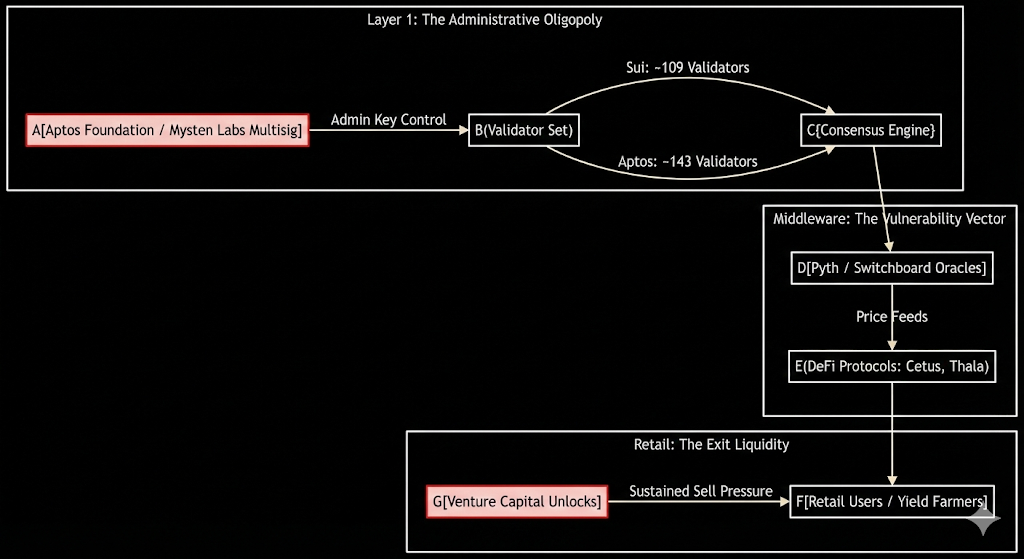
The visual data confirms that neither network represents a decentralized base layer. Both function as highly centralized fintech platforms masquerading as immutable ledgers.
Sui abandons the monolithic account model for an object-centric architecture with a DAG-based consensus (Mysticeti), enabling 297,000 theoretical TPS and 0.5-second finality. Aptos utilizes the Block-STM execution engine for optimistic concurrency, yielding sub-50ms block times and 22,000 TPS.
However, the structural positioning is fundamentally flawed due to profound centralization vectors:
- Validator Oligopolies: Network security is fiercely capital-gated. Sui relies on roughly 109 active validators (historically requiring a 30 million SUI stake), while Aptos relies on roughly 143.
- Admin Key Sovereignty: The Sui Foundation and Aptos Foundation retain massive multi-signature (multisig) administrative privileges over protocol upgrades, network parameters, and treasury deployments. If the operational security of these core insiders is breached, the entire protocol logic can be maliciously altered.
- Oracle Dependencies: Decentralized finance on both chains relies entirely on third-party off-chain oracles like Switchboard (securing $5.5 billion across chains) and Pyth. As shown in [그래프 4 삽입 위치], if Aptos experiences "hot state" contention during volatility, Block-STM execution degrades to sequential speeds, stalling oracle price updates in the mempool and triggering unjustified cascading liquidations.
4. The Gap Analysis: Hard Numbers (Early 2026 Snapshot)
To quantify the structural contradictions, we analyze the raw metrics. The data reveals that Sui is dominating developer mindshare, while Aptos is suffering a severe deficit but attempting an institutional pivot.
| Metric | Sui (SUI) | Aptos (APT) | Institutional Insight | | FDV | ~$8.70 Billion | ~$2.16 Billion | Sui retail holders face massive, sustained VC exit liquidity pressures. | | Circulating Supply | ~3.84 Billion (38.46%) | ~779M to 1.196B | Aptos's proposed 2.1B hard cap is a desperate bid for deflationary survival. | | Monthly Active Devs | 954 (+219% YoY) | 465 | Sui's "Sui Stack" integration is aggressively capturing builder mindshare; Aptos is bleeding intellect. | | Total Value Locked (TVL) | ~$1.38B - $2.0B | ~$996 Million | Sui's TVL is an artificial byproduct of $300M in foundation incentives. | | Weekly DEX Volume | ~$2.01 Billion | ~$208 Million | Aptos lacks organic retail trading volume, forcing its reliance on BlackRock RWA pipelines. | | Market Cap / TVL Ratio | ~6.0 | ~2.7 | Sui's valuation vastly outpaces its retained economic gravity compared to Aptos. |
5. The Technical Engine: Auditing the Logic
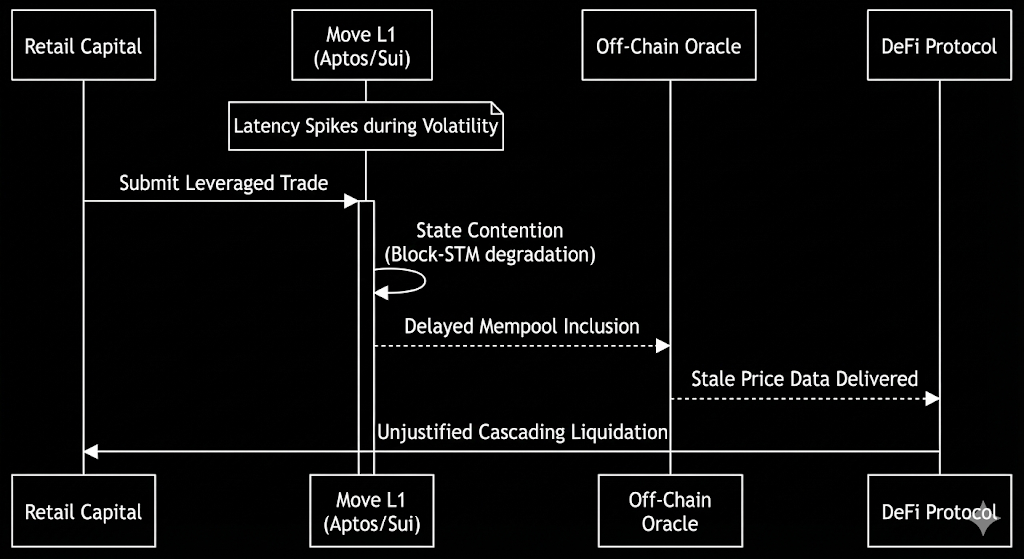
The promise of sub-second finality is a marketing metric engineered for sterile testnet environments. In production, under adversarial market conditions, finality is entirely subordinate to execution state and oracle latency. Diagram 2 maps the exact chronological sequence of a systemic failure—the transition from minor network friction to absolute capital destruction.
- Step 1: The State Lock and Execution Bottleneck: The sequence initiates when retail capital submits heavily leveraged positions to core DeFi primitives. Under normalized conditions, Aptos utilizes Block-STM for optimistic parallel execution. However, during a macroeconomic volatility shock, thousands of liquidator bots and retail users simultaneously attempt to read and write to the exact same lending contract state. The optimistic concurrency assumption mathematically breaks down. Block-STM registers massive read-write conflicts, aborts the parallel threads, and forcibly reverts the engine to sequential execution. Throughput degrades instantly.
- Step 2: Oracle Asphyxiation: This execution bottleneck triggers the second, more fatal failure: Oracle Latency. Both networks heavily outsource their pricing infrastructure to off-chain relays like Pyth and Switchboard. As the L1 execution layer throttles into sequential processing, the mempool bloats. The critical transactions required to update on-chain collateral prices stall.
- Step 3: The Stale Settlement and Cascading Liquidation: When the network finally processes the backlogged oracle transactions, it delivers severely stale pricing data to the smart contracts. By the time the smart contract registers a price drop, the actual market has moved significantly lower. The protocol’s risk engine—operating on delayed data—triggers an algorithmic slaughter. It forcefully seizes and liquidates retail collateral into highly illiquid, congested DEX order books, resulting in massive slippage and cascading bad debt. Finality speed is irrelevant if the settlement data is fundamentally inaccurate. The infrastructure socializes the latency cost directly onto the retail user's balance sheet.
On Sui, the technical vulnerability shifts from the core consensus engine to the supply chain of the Move ecosystem itself. The object-centric model effectively bypasses consensus for simple transactions, but complex DeFi interactions require shared objects. As demonstrated by the catastrophic $223M–$260M exploitation of the Cetus Protocol, mathematically verified base layers cannot protect against flawed third-party library dependencies. The application layer acts as a Trojan horse for systemic risk, proving that "audited" language architecture does not guarantee holistic protocol survival.
6. The Economic Flywheel: Stress-Testing
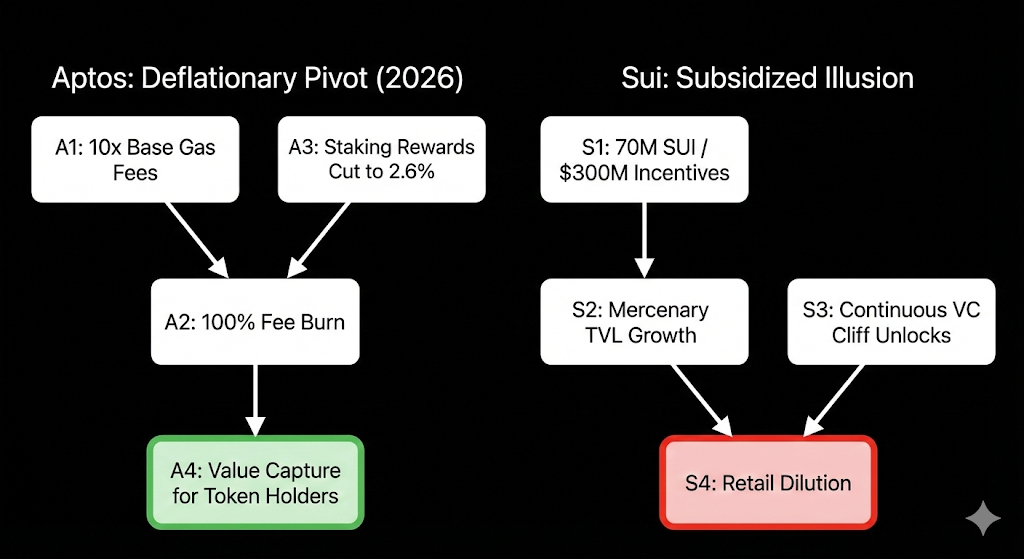
Institutional validation requires verifying the actual revenue nodes of these protocols. Current TVL metrics are actively manipulated via foundation subsidies. Diagram 3 exposes the divergence between the Aptos deflationary pivot and the Sui subsidized illusion.
Aptos Stress Test: The Deflationary Gamble The February 2026 tokenomics overhaul is a desperate, necessary pivot. By enforcing a hard supply cap of 2.1 billion APT tokens, slashing staking emissions by half to 2.6%, and increasing base gas fees tenfold with a mandatory 100% burn, Aptos is attempting to manufacture absolute scarcity.
The Bull Case: The $500 million BlackRock RWA deployment and the $1.8 billion stablecoin ecosystem are fundamentally price-insensitive to L1 gas fees. Corporate risk managers will gladly pay a 10x fee increase for execution certainty. If institutional volume sustains, the fee burn mathematically eclipses the 2.6% emission rate, converting APT into a deflationary, value-capturing asset.
The Bear Case: The 10x gas increase permanently alienates the remaining open-source developer base. Furthermore, compressing validator yields to 2.6% forces institutional node operators to ruthlessly evaluate their hardware expenditures. If the yield fails to clear the risk-free rate, validators will unplug, collapsing network security and centralizing the 143-node oligopoly even further.
Sui Stress Test: The Subsidized Illusion Sui’s economic flywheel is a textbook example of mercenary capital inflation. The network's $1.38B-$2.0B TVL is directly correlated to the estimated $300 million in SUI incentives deployed by Mysten Labs to artificially stimulate activity.
The Bull Case: The t'order POS integration circumvents the FSC/Bank of Korea regulatory deadlock, successfully processing billions in KRW stablecoin volume across 300,000 terminals. The network transitions from subsidized DeFi to organic commercial velocity.
The Bear Case (The Base Reality): The South Korean regulators enforce the 51% traditional banking monopoly over stablecoins, paralyzing the t'order pilot. Concurrently, the massive VC cliff unlocks continue, highlighted by the 43.35 million SUI ($41 million) dump scheduled for March 1, 2026, representing 1.13% of the circulating supply. As the foundation's incentive treasury depletes, the yield-seeking capital instantly migrates to newer EVM-parallelized chains. The TVL evaporates, leaving retail holders to absorb the structural dilution of a token heavily skewed toward insider allocations.
7. Risk Analysis & The Death Spiral
The path to a total ecosystem Death Spiral is deterministic under sustained macroeconomic stress. Blockchains optimized strictly for throughput lack the native economic circuit breakers required during a liquidity crisis.
As mapped in Diagram 4, the spiral initiates with an exogenous macro shock triggering extreme volatility. On Aptos, this manifests as Block-STM parallel processing failure; on Sui, it surfaces as a critical smart contract vulnerability exposed under load. The resulting sequential execution or liquidity drain paralyzes the off-chain oracle networks.
When the oracle stalls, the DeFi primitives lose their pricing integrity. This triggers indiscriminate, cascading auto-liquidations. The critical institutional realization here is the "Single Point of Failure" (SPOF) mitigation. Because neither network possesses a trustless, decentralized mechanism to halt trading and isolate bad debt, survival depends entirely on the Foundation. The core developers must utilize their multi-signature administrative keys to manually pause the blockchain state.
By executing a manual pause, the foundation undeniably proves the network is a centralized, permissioned database. The "decentralized" narrative is permanently shattered, institutional trust is broken, and upon the resumption of the chain, a mass exodus of capital executes the final, terminal leg of the death spiral.
8. Strategic Verdict
The data dictates a ruthless bifurcation in capital allocation. We are not funding theoretical computer science; we are pricing infrastructural survival.
SUI: EXIT (High Conviction)
- Strategic Call: Liquidate all SUI exposure immediately. The network is structurally designed to extract retail capital and transfer it to early-stage venture entities via unrelenting emission schedules.
- Time Horizon: 0-14 days. Exit prior to the March 1, 2026, 43.35 million SUI unlock.
- Watch Metrics: South Korean FSS AI-surveillance crackdowns on SUI/KRW volume; depletion rates of the Mysten Labs DeFi incentive treasury.
- Exit Targets: Sell aggressively into any momentum-driven liquidity events in the current $1.50 - $2.00 price band. The $8.7 billion FDV represents a fundamental mispricing of reality.
APTOS (APT): WAIT / ACCUMULATE ON WEAKNESS
- Strategic Call: Aptos has conceded the retail casino to Sui and is pivoting toward durable, institutional reality. The February 2026 tokenomics overhaul (2.1B hard cap, 100% base fee burn) fundamentally alters the asset's trajectory from an inflationary liability to a potential deflationary proxy for RWA settlement.
- Time Horizon: 6-12 Months. Allow the market to digest the reduced staking yields and verify the efficacy of the fee-burn mechanism.
- Watch Metrics: BlackRock Digital Liquidity Fund inflows; the mathematical crossover point where the 10x base gas burns exceed the 2.6% validator emissions.
- Entry Targets: Accumulate strictly on macro-induced weakness below the $1.00 threshold. The $2.16 billion FDV is grounded, and the strategic alignment with heavily regulated US stablecoin issuers provides a credible, compliant moat against Asian regulatory strangulation.
9. Final Note to the Investment Committee
The era of subsidizing architectural ghost chains with perpetual venture capital emissions is decisively ending. As the global regulatory noose tightens and mercenary liquidity fragments across parallelized networks, survival in the L1 sector will be dictated by structural resilience, regulatory compliance, and organic cash flows—not theoretical TPS or marketing narratives.
We do not allocate capital based on retail delusions; we invest in structural inevitabilities. The data clearly indicates that Sui is structurally programmed for dilution, while Aptos is attempting a painful, yet necessary, deflationary maturation. Adjust portfolio weightings immediately to reflect these mathematical realities. Deploy capital accordingly.
DISCLAIMER & CONFIDENTIALITY NOTICE This intelligence report does not constitute retail financial advice. The cryptocurrency sector is subject to extreme volatility, terminal regulatory risks, and sudden architectural failures. All Fully Diluted Valuation (FDV) metrics, emission schedules, and on-chain data are accurate as of February 2026. Do not distribute without explicit authorization from the Chief Research Architect.