MegaETH The Real-Time Paradox: Structural Arbitrage in the High-Frequency Era
ium Research — Julian, Researcher — Dec 28, 2025 Canonical: https://iumlabs.io/blog/megaeth-the-real-time-paradox-structural-arbitrage-in-the-high-frequency-era
1.The Institutional Alpha MegaETH represents a fundamental deviation from the "modular vs. monolithic" debate, positioning itself instead as a Specialized Execution Layer designed to bridge the chasm between decentralized ledgers and centralized high-frequency trading (HFT) servers. By decoupling execution from consensus, MegaETH effectively creates a "Trustless Cloud" environment capable of 100,000 TPS and 10ms latency.
For institutional allocators, the investment thesis rests on three structural differentiators: The "Yield-Gas" Arbitrage Model: MegaETH inverts the standard L2 revenue model. By integrating Real World Assets (RWAs) into the bridge reserve, the protocol monetizes idle capital to subsidize active state. This eliminates the "User-Pays" friction model, replacing it with an "Opportunity Cost" model where the yield on bridged USDC covers the Sequencer’s OpEx. This is a critical unlocking mechanism for high-volume, low-margin applications (e.g., gaming, HFT). Tokenization of Physics (The Proximity Moat): The protocol introduces a novel "Proximity Market" that acknowledges the speed of light as a constraint. By requiring $MEGA token locks for colocation slots near the active Sequencer, the network captures Maximum Extractable Value (MEV) ex-ante. This creates a structural demand floor for the token driven by HFT firms competing for millisecond advantages, distinct from retail speculation. Anomalous Insider Confidence: The decision to execute a buyback of 4.75% of equity and warrants pre-TGE is a statistical outlier in crypto capital markets. This action—typically reserved for post-revenue maturity—signals that internal valuation models, validated by the "Frontier" testnet performance, significantly exceed the seed ($100M) and public ($1B FDV) rounds.
- Market Positioning: The Valuation-Utility Matrix
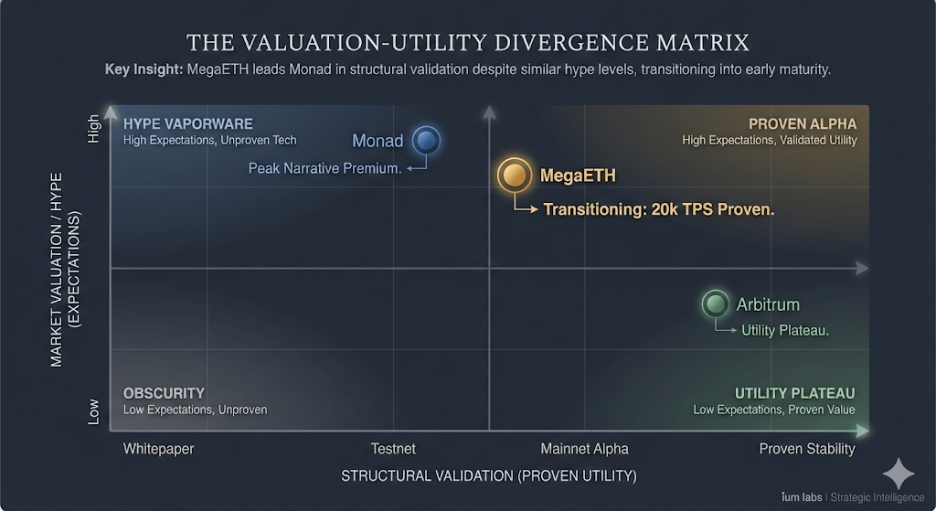 To accurately assess MegaETH's investability, we must look beyond narrative dominance and strictly map its position within the Maturity Phase Framework.
Phase Classification: Late Hype / Early Maturity
Current Status: Transitional Outlier
We classify MegaETH at the precise intersection of the Hype Phase and Early Maturity Phase. While the project benefits from the valuation premium typical of "Hype" (evidenced by the implied $27.8B demand during the capped public sale), it exhibits structural characteristics of a mature asset.
To accurately assess MegaETH's investability, we must look beyond narrative dominance and strictly map its position within the Maturity Phase Framework.
Phase Classification: Late Hype / Early Maturity
Current Status: Transitional Outlier
We classify MegaETH at the precise intersection of the Hype Phase and Early Maturity Phase. While the project benefits from the valuation premium typical of "Hype" (evidenced by the implied $27.8B demand during the capped public sale), it exhibits structural characteristics of a mature asset.
Unlike typical "Hype" projects that rely solely on future promises, MegaETH has validated its thesis via the "Frontier" testnet (20k TPS sustained) and the operational deployment of the USDm economy.
Comparative Analysis: The "Speed" Vertical The market often conflates "high throughput" with "low latency." MegaETH’s positioning is distinct when contrasted with its closest peers: Vs. Monad (Peak Narrative Premium): Monad represents the current ceiling of the "Hype Phase." While it promises 10k TPS via parallelized execution, it remains in Devnet/Testnet limbo. MegaETH trades at a similar narrative premium but possesses a live, stress-tested environment and a unique economic model (Yield-Gas) that Monad lacks. Vs. Sei & Aptos (The "Fast" L1s): Existing high-performance L1s achieve sub-second finality (~380ms for Sei v2), which is sufficient for order books but perceptible to humans ("lag"). MegaETH’s 10ms pre-confirmation targets a different psychological and technical threshold: Real-Time. It moves from "fast blockchain" to "server-grade speed," unlocking use cases (e.g., physics-based on-chain games) that remain impossible on Sei or Aptos. Vs. Arbitrum/Optimism (Utility Plateau): General-purpose L2s have hit a "Utility Plateau." They are constrained by the cost of data posting and general-purpose architecture. MegaETH sacrifices decentralization at the sequencer level (single active sequencer) to achieve performance orders of magnitude higher, effectively positioning itself not as a competitor to Arbitrum, but as a specialized "off-load" engine for specific high-performance workloads.
- Structural Logic: The Mechanics of Real-Time Moving from market positioning to mechanical reality, MegaETH’s advantage relies on a radical departure from the "one node does it all" philosophy. The protocol’s architecture is defined by Node Specialization, a heterogeneous topology that physically decouples execution from verification to break the "Blockchain Trilemma" bottleneck.
The Triangular Economy
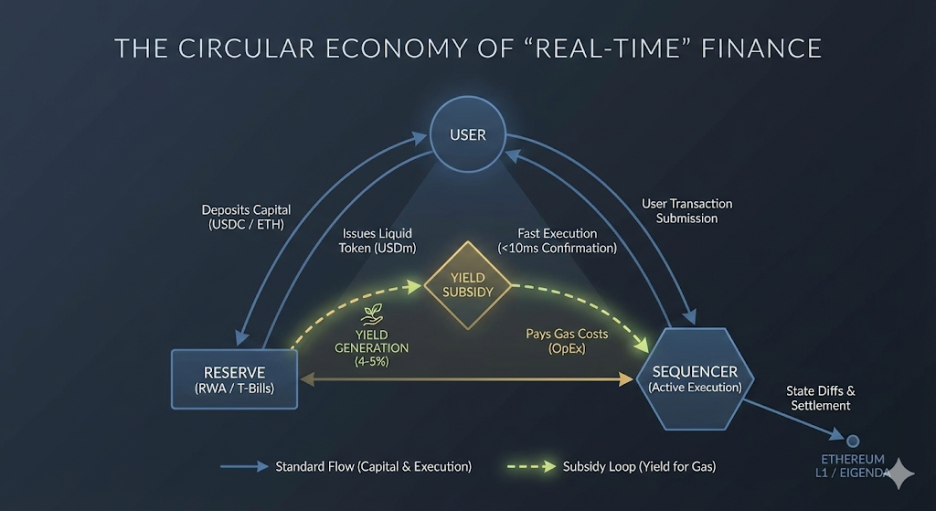 The diagram illustrates a Triangular Structure that fundamentally alters the flow of funds in L2 ecosystems. Unlike Optimism or Arbitrum, where the user pays the Sequencer directly for block space, MegaETH inserts a Liquidity Buffer (USDm Reserve) between the user and the execution layer.
The Economic Layer (Left Branch): The user deposits idle capital (USDC/ETH) into the Reserve. The protocol does not let this capital sit dormant; it is actively deployed into RWA yield strategies (e.g., T-Bills via BlackRock BUIDL).
The Subsidy Loop (Center Connection): This is the critical alpha. The generated yield (4-5%) is stripped and redirected to the Sequencer Wallet. This effectively subsidizes the Operating Expenses (OpEx) of the high-performance hardware, allowing the Sequencer to offer "Zero-Gas" transactions to the user.
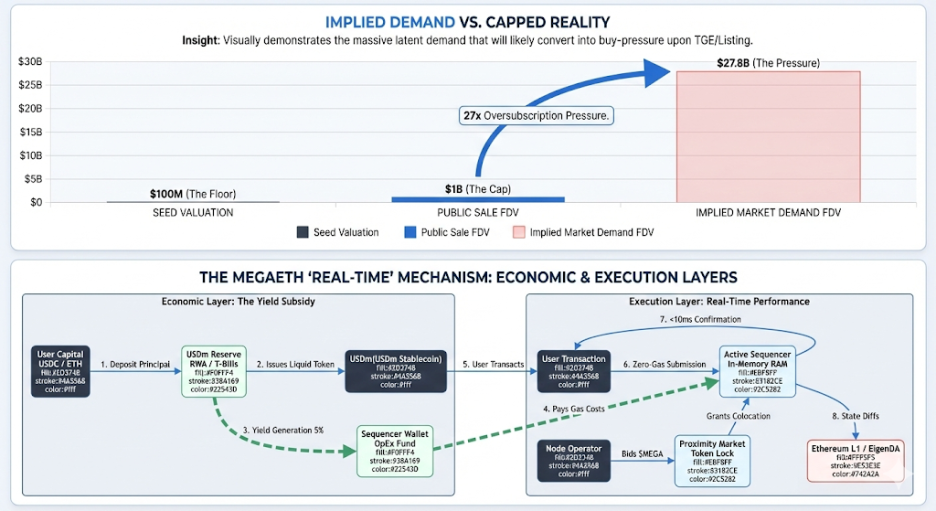 3. The Execution Layer (Right Branch): The user, now free from gas friction, submits high-frequency transactions to the Active Sequencer. This server, utilizing In-Memory RAM rather than disk storage, processes state changes in <10ms and streams "State Diffs" to the Data Availability layer (EigenDA) and Ethereum L1 for settlement
This structure transforms the Sequencer from a "Fee Collector" into a "Yield Recipient," aligning incentives for high TVL rather than just high transaction volume.
- Financial Performance: Quantifying the Valuation Gap The architectural innovation described above has precipitated a measurable dislocation in market pricing. By analyzing the capital flows during the "Frontier" launch and the Public Sale, we can quantify the market's specific appetite for this new "Real-Time" asset class.
The Implied Demand Delta Please refer to [Asset 3: Implied Demand vs. Capped Reality]. This waterfall chart reveals a massive divergence—a "Valuation Gap"—between the protocol’s controlled capitalization and the market’s latent demand. The Valuation Floor ($100M Seed): The initial bar represents the "Smart Money" entry (Vitalik Buterin, Dragonfly). This sets the baseline for technical legitimacy. The Strategic Cap ($1B FDV): The second bar shows the deliberate cap placed on the public sale. This was a mechanism design choice to prevent a "Winner's Curse" scenario for community holders. The 27x Divergence: The "Ghost Bar" (Implied Demand) towers at $27.8 Billion. This figure is derived from the $1.39 billion in bids chasing just 5% of the supply.
Analytical Insight: This delta is not merely speculative froth; it represents a repricing of the "Execution Layer" vertical. The market is effectively signaling that a functioning "Real-Time" blockchain commands a valuation premium comparable to Solana ($60-70B FDV) rather than standard L2s like Optimism ($7B FDV). The 27x oversubscription confirms that institutional liquidity is aggressively seeking exposure to infrastructure that can support non-financial use cases (gaming/social) which require zero marginal cost.
Capital Retention ("Stickiness") Beyond valuation, the Quality of Revenue is validated by the "Stickiness" event of November 25, 2025. The Event: The USDm pre-deposit window hit its $250M cap in minutes, eventually overfilling to $500M due to technical friction. The Insight: In a low-retention environment, technical failures (like the bridge error) typically trigger capital flight. In MegaETH’s case, the capital remained despite the friction. This indicates that the liquidity is mercenary but trapped by utility—specifically, the anticipation of the "Proximity Market." Market makers are not parking capital for simple yield; they are parking it to secure future "Colocation Slots" (via $MEGA accumulation), validating the long-term utility of the token model.
- Structural Risks: The Bear Case While the "Real-Time" thesis is compelling, it introduces specific failure vectors that are structurally distinct from standard Rollups. These are not just "FUD" but mechanical vulnerabilities inherent to the design.
5.1 The Yield Trap (Macro-Dependency Risk) Severity: High | Probability: Medium The entire "Zero-Gas" user experience is subsidized by the Yield Delta between the bridged assets (USDC/ETH) and the Sequencer's OpEx. This model effectively effectively leverages high interest rates to pay for computation. The Scenario: A sharp macroeconomic pivot where Fed rates are cut to <2%. The Mechanical Failure: If the yield generated by the Reserve drops below the Sequencer's fixed hardware costs, the protocol must immediately invert its fee model. "Free Transactions" vanish, and users are suddenly hit with fees. This destroys the unit economics of the GameFi and HFT apps built on the assumption of zero marginal cost.
5.2 The Centralization Vector (Liveness vs. Censorship) Severity: Critical | Probability: Low Unlike Solana, which rotates leaders among thousands of validators, MegaETH relies on a Single Active Sequencer for extended epochs to achieve 10ms latency. The Reality: If the Sequencer goes offline (DDoS or technical failure), the network halts. The "Forced Inclusion" Fallacy: Proponents argue users can bypass the Sequencer via Ethereum L1. While true, this takes ~12 seconds (Ethereum block time). For an HFT firm or a real-time game, a 12-second delay is not a "backup"; it is a total service outage. The "Real-Time" value proposition evaporates the moment the Sequencer falters.
5.3 Operational "Sloppiness" (The Execution Risk) Severity: Medium | Probability: High The November 2025 "Bridge Incident"—where a multisig configuration error allowed the deposit cap to be breached by $250M—reveals a dangerous lack of operational rigor. In a system designed to process $100M+ in volume per second, a single smart contract configuration error is catastrophic. The team has technical brilliance but lacks operational discipline.
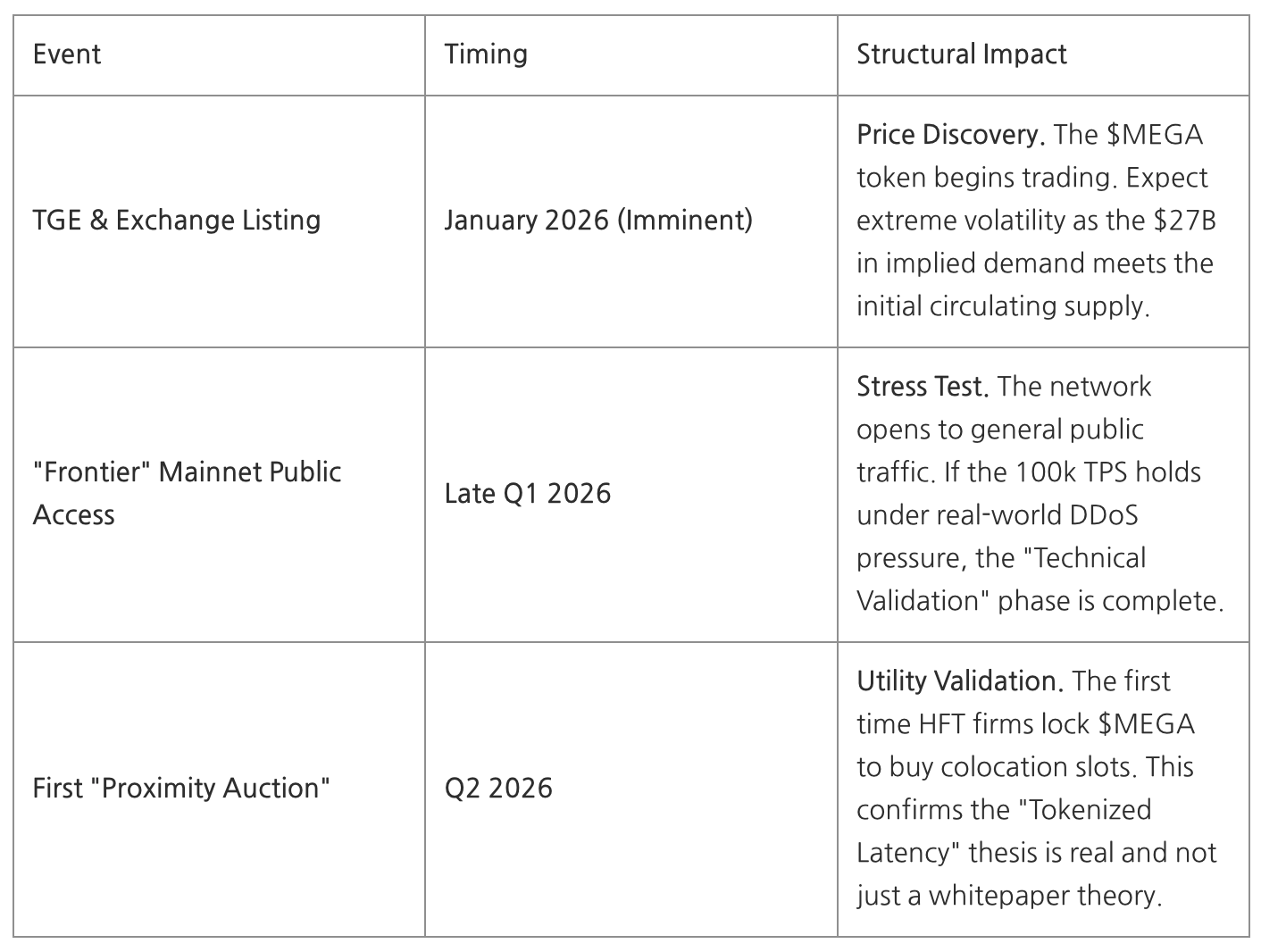
- The Catalyst Calendar: H1 2026 Outlook
The asset is currently undergoing a massive repricing event. The following dates are critical for position management.
- Final Verdict & Strategy The Call: ACCUMULATE (Aggressive) Strategic Rationale: MegaETH is not competing for the "DeFi Degen" user; it is competing for the Global Cloud Server market. It is the only infrastructure capable of hosting the next generation of consumer crypto apps (high-fidelity gaming, social) that require Web2 speed with Web3 settlement. The "Proximity Market" creates a structural demand floor that other L2 tokens (governance only) lack. The Playbook: Enter on Volatility: Use the post-TGE volatility (January) to build a position. Institutional unlock schedules suggest a supply squeeze in Q2. Monitor the Yield: Watch the USDm Reserve APY closely. If it dips below 3%, hedge the position, as the "Zero-Gas" narrative will weaken. Ignore the TVL: Do not judge MegaETH by TVL (Total Value Locked). Judge it by TPS (Transactions Per Second) and Compute Usage. This is a transaction engine, not a savings bank.
Conclusion: The Specialized Execution Layer The era of the "General Purpose Blockchain" is ending. MegaETH signals the start of the Specialized Execution Era, where chains are optimized for specific physical constraints (Speed) rather than broad compatibility. By effectively tokenizing the speed of light, MegaETH offers a distinct, non-correlated asset in a portfolio otherwise saturated with generic L2s. Disclaimer: This report is for informational purposes only and does not constitute financial advice. ium labs holds no responsibility for investment outcomes. Crypto assets are highly volatile. © ium labs 2026. All Rights Reserved.