Monetizing Chaos: How ETHGas Turns L2 Volatility into Institutional Yield
ium Research — Julian, Researcher — 20 Jan, 2026 Canonical: https://iumlabs.io/blog/monetizing-chaos-how-ethgas-turns-l2-volatility-into-institutional-yield
1. The Institutional Executive Summary
The "Gas Wars" of 2021 are dead. We are now in the era of the "Latency War."
For the past five years, the primary constraint of the Ethereum network was capacity. Users fought for inclusion in a congested block, driving gas prices to 200+ gwei. However, the successful execution of the Dencun, Pectra, and Fusaka upgrades has fundamentally inverted the market dynamics. With average gas prices stabilizing below 1 gwei (0.65 gwei as of Jan 21, 2026), the scarcity of blockspace volume has been solved.
The market inefficiency we are exploiting today is Execution Variance.
While the average cost of a transaction has collapsed, the certainty of execution remains priced via a primitive "Priority Gas Auction" (PGA). This spot-market-only structure is wholly insufficient for the new dominant actors on Ethereum: L2 Sequencers and HFT firms. These entities do not care about average costs; they care about 3ms pre-confirmation guarantees and Service Level Agreements (SLAs).
ETHGas represents the inevitable financialization of this stack. It is not building a faster blockchain; it is building the Futures Market for the existing one. By decoupling the "Right to Inclusion" from the "Act of Inclusion," ETHGas allows validators to monetize their monopoly on time, transitioning blockspace from a technical resource into a tradeable financial commodity.
Three Key Alphas (Data-Backed):
- The "SLA" Arbitrage (Volatility Spread): The data reveals a massive divergence. While spot gas is cheap (~0.6 gwei), the volatility of blob pricing for L2s remains extreme. L2 Sequencers are currently exposed to 1000% intraday price spikes. ETHGas captures this spread. By allowing Sequencers to buy blockspace futures, the protocol effectively sells "insurance" against volatility. The premium paid for this certainty is the protocol's real revenue, decoupled from the low spot price.
- The Supply-Side Lock-In ($800M Moat): Unlike competitors like Alkimiya, which attempted to build synthetic derivatives without physical delivery, ETHGas has secured the underlying asset. The $800 Million in Liquidity Commitments from validators creates a "Cold Start" defense. These validators are contractually obligated to honor the futures contracts, ensuring that the market has deep inventory from Day 1. This is not a paper market; it is a physical delivery market.
- The "Proof of Pain" Filter: The user acquisition strategy was a precision vampire attack on high-value users. By retroactively indexing 270,622 ETH in historical gas spending, ETHGas filtered out low-value "airdrop tourists" and captured the top decile of DeFi power users and MEV searchers. The 127,000 Gas IDs generated represent the "Smart Money" of Ethereum—the exact demographic that understands and requires hedging instruments.
2. Market Positioning: The Ecosystem Hierarchy
To understand why ETHGas is uniquely positioned to capture the value of the "Post-Congestion" era, we must dissect its architectural placement. It is not competing against the L1 or L2s; it is the financial connective tissue between them.
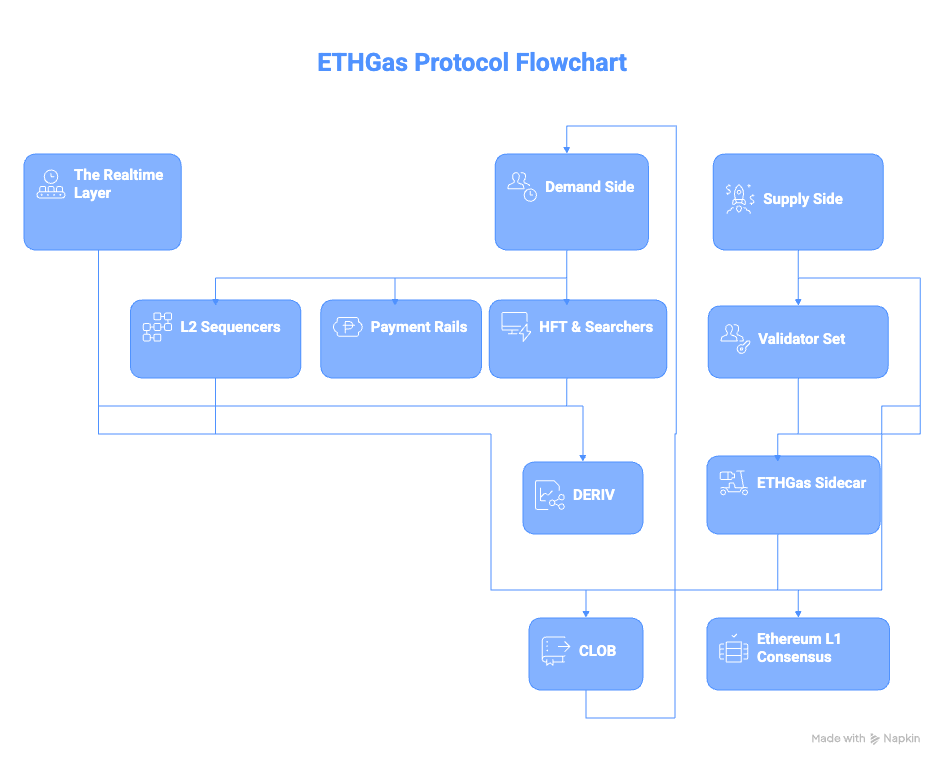
Deconstructing the Hierarchy
1. The Supply Side (The Sellers): At the base, we have the Ethereum L1 Consensus. Note that ETHGas does not touch the consensus logic itself. Instead, it utilizes a "Sidecar" (highlighted in red). This is a crucial strategic choice. By operating as a plugin for validators (similar to MEV-Boost), ETHGas avoids the political gridlock of Ethereum governance. It allows validators to monetize their blockspace before the block is even proposed. The $800M Liquidity Commitment sits here, representing the "inventory" of future slots available for sale.
2. The Realtime Layer (The Marketplace): This is the core innovation. The Central Limit Order Book (CLOB) sits off-chain (or on a high-speed layer), matching bids and asks in ~3ms. This is where the arbitrage happens. The diagram explicitly shows that the "Financial Trade" (Derivative) happens here, decoupled from the slower "Physical Settlement" on L1. This separation allows HFT firms to trade gas risks at NASDAQ speeds, settling only the final positions on Ethereum.
3. The Demand Side (The Buyers): The diagram identifies the new customer base: L2 Sequencers and Payment Rails. These entities are profit-maximizing businesses. They cannot tolerate the uncertainty of the legacy mempool. By connecting directly to the CLOB, they bypass the chaotic "Priority Gas Auction" and secure guaranteed slots for their data blobs.
Why This Position is Superior: ETHGas sits in the "Value Capture" bottleneck. It does not bear the cost of securing the network (L1's job) nor the cost of execution (L2's job). It simply taxes the certainty of the connection. In a world where L2s are fighting a "Race to the Bottom" on fees, the entity that controls the scheduling of those transactions retains the pricing power.
3. The Gap Analysis: Why the Incumbents are Failing
The market for "Pre-confirmations" is crowded, but most competitors are solving the wrong problem. They are engineering technical solutions to what is fundamentally a financial problem.
Competitor A: Alkimiya (The "Paper Tiger")
- The Model: Alkimiya attempted to create a bilateral derivatives market for blockspace (hashpower contracts).
- The Hard Numbers: Despite early hype, the protocol struggles with near-zero volume in perpetual markets.
- The Structural Failure: Alkimiya built a casino without a house. They created the financial instrument (the derivative) but failed to secure the Physical Delivery Mechanism. Without validator buy-in, their contracts were purely speculative "side bets" that could not guarantee actual block inclusion.
- ETHGas Advantage: ETHGas inverted this model. They secured the supply side first ($800M commitments via the Sidecar). An ETHGas future is not a bet on gas price; it is a right to gas usage. This physical delivery component is the difference between a "Prediction Market" and a "Commodity Market."
Competitor B: Flashbots SUAVE (The "Academic Utopia")
- The Model: SUAVE (Single Unified Auction for Value Expression) proposes a completely new chain and Trusted Execution Environment (TEE) to unbundle the transaction supply chain globally.
- The Cynical Reality: SUAVE is Over-Engineered. It requires a massive coordination overhaul of the entire Ethereum ecosystem and relies on nascent privacy technologies (SGX/TEEs) that are historically prone to vulnerabilities. It is a "years-away" solution.
- The Gap: The market needs hedging now. L2 sequencers are bleeding margin today.
- ETHGas Advantage: Pragmatism. ETHGas works with the existing PBS (Proposer-Builder Separation) infrastructure. It doesn't ask validators to trust a new TEE chain; it simply asks them to run a Sidecar and take a profit. While SUAVE tries to solve "Global Privacy" and "Cross-chain MEV," ETHGas is narrowly focused on solving "Price Volatility." In B2B markets, specific pain-killers always beat general vitamins.
4. The Technical Engine: Auditing the "Proof of Inclusion" Logic
While the macro thesis relies on market positioning, the viability of ETHGas rests entirely on the integrity of its execution layer. We are not assessing a static asset; we are auditing a dynamic state machine that bridges the gap between nanosecond trading and 12-second block times.
Refer to [Diagram 2: Faster Financial Settlement with Deterministic Inclusion]. This sequence is not merely a user flow; it is the protocol's "Life of a Transaction." It represents the transition from probabilistic mempool chaos to deterministic financial settlement.
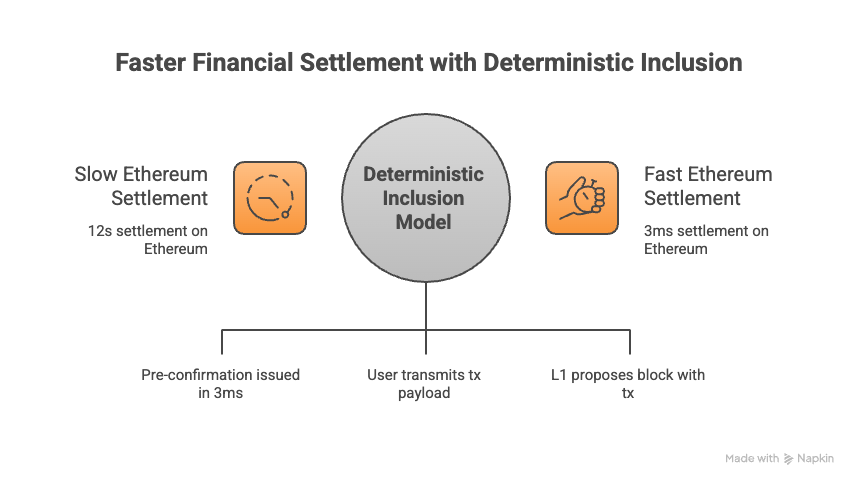
Step-by-Step Execution Analysis
Phase 1: The Financial Trade (T-0)
The Action: The sequence begins with the User (L2 Sequencer or HFT) interacting with the `ETHGas CLOB` (Central Limit Order Book).
The Logic: Unlike the "Dark Forest" of the public mempool where bids are visible and front-runnable, this is a private order book match. The User bids for specific future block space (e.g., Slot #25000). The `Sidecar` (acting for the Validator) asks for a premium.
The Innovation: The Matching Engine executes this trade in ~3ms. The User receives a "Pre-Confirmation Receipt." This is the critical moment: Financial Finality has occurred before Physical Finality. The user effectively owns the rights to that blockspace seconds before the block is even constructed.
Phase 2: The Commitment (T+N)
The Action: The User transmits the actual transaction payload to the `Sidecar`.
The Logic: The Diagram shows the `Sidecar` "Locking" the tx into its local pending block. Crucially, this happens off-chain in a "Shadow State." The Ethereum L1 is unaware of this agreement until proposal. This allows for high-frequency guarantees without clogging the base layer.
Phase 3: The Physical Settlement (T+12s)
The Action: The Ethereum slot clock ticks. The `Sidecar` proposes the block to `L1`.
The Settlement: If the transaction is included, the loop closes. However, the diagram highlights the "Slashing Event" vector (Alt Path). If the Validator fails to include the tx (due to greed, incompetence, or malice), the `Market` contract triggers a slashing event via restaked collateral (e.g., EigenLayer).
The Implication: This converts "Trust" into "Economic Security." The user doesn't trust the validator's goodwill; they trust the validator's fear of losing money.
5. The Economic Flywheel: Stress-Testing the Value Capture
We now turn to the financial physiology of the protocol. Refer to [Diagram 3: The Value Flywheel]. This flowchart visualizes the investment thesis: Can the protocol monetize "Time"?
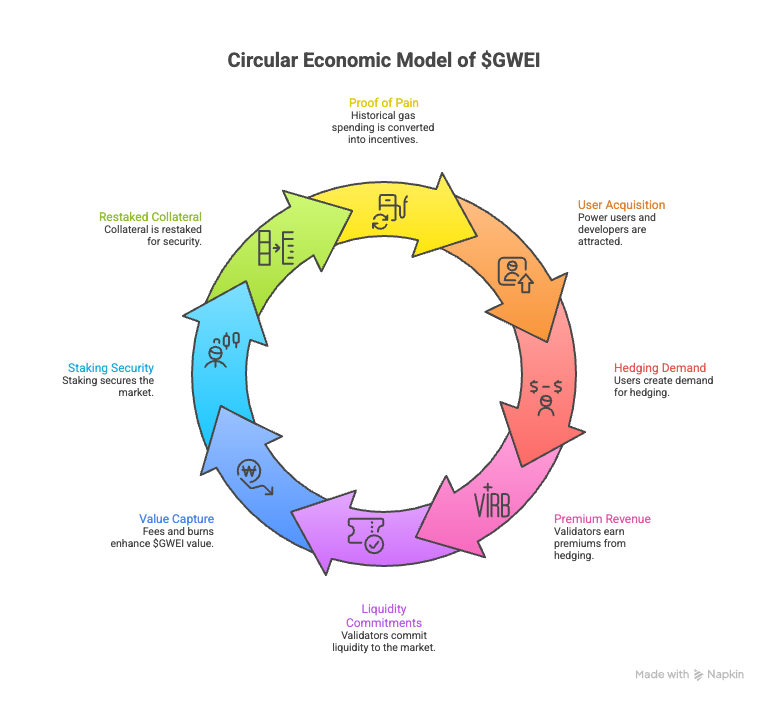
The "Proof of Pain" Bootstrapping
The flywheel begins at the `POP` (Proof of Pain) node. This was the "Vampire Attack" detailed in Part 1.
- The Mechanism: By airdropping tokens based on historical gas burn, ETHGas didn't just get users; it bought a specific type of user. The 127,000 Gas IDs represent the "Hedging Demand" base. These are not retail speculators; they are entities that structurally need the product.
- The Conversion: The diagram shows these `USERS` flowing into `MKT` (The Futures Market). Without this initial seed of high-value users, the order book would be empty, and the liquidity commitments would be worthless.
The Value Capture Node
The core of the thesis lies in the "Value Capture" subgraph.
- Revenue Stream: The protocol takes a cut of every futures contract settled.
- The Sink: This revenue is not distributed as a lazy dividend. It flows into the `GWEI` token via Buyback/Burn or Staking Yields.
- The Correlation: This creates a mechanical link between L2 Volatility and GWEI Price.
- Scenario: L2 activity spikes -> Gas volatility increases -> Hedging demand rises -> Futures premiums explode -> Protocol revenue surges -> More GWEI is burned.
- Result: The token is essentially a "Volatility Call Option" on the entire Ethereum ecosystem.
6. Risk Analysis & Final Verdict
Finally, we examine the existential threats. Refer to [Diagram 4: Risk Logic]. This decision tree maps the "Death Spiral" scenarios that typical whitepapers omit. The critical juncture is the "Regulatory Classification" gate.
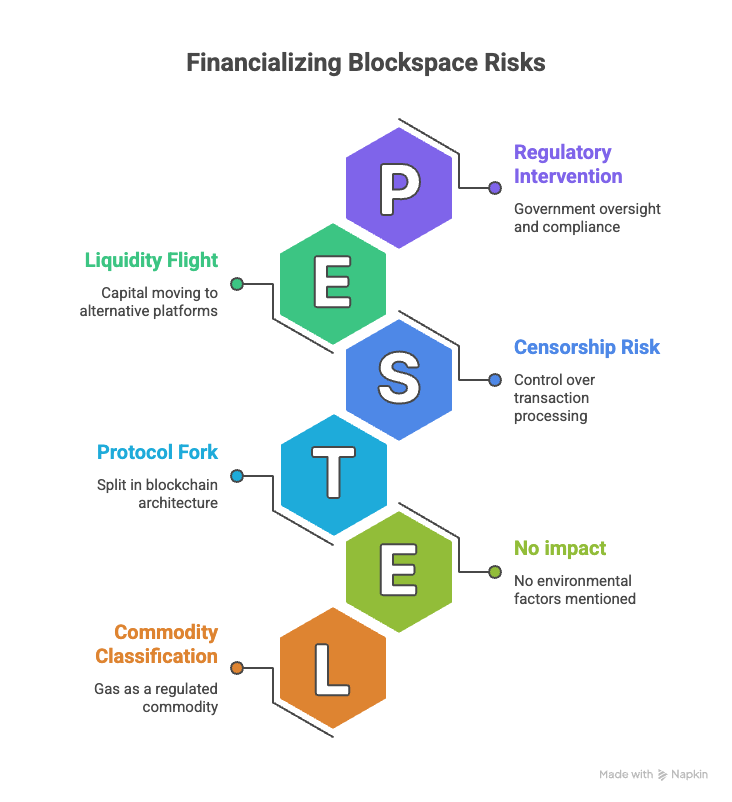
The Regulatory Cliff (The "Swap" Definition)
The diagram explicitly traces the path from `REG` (Regulatory Classification) to regulatory intervention.
- The Risk: If the CFTC classifies "Gas Futures" as regulated "Swaps" (similar to oil or wheat futures), the protocol faces a hard fork.
- The Cascade: `Mandatory KYC` on L1 would be the death knell for the protocol's permissionless nature. The `FORK` node represents the fracturing of liquidity into "Compliant" (Institutions) and "Dark" (DeFi) pools. This fragmentation destroys the network effects of the order book.
The Centralization Vector (The "Cartel" Risk)
The `CARTEL` branch is equally dangerous.
- The Logic: If top validators (Lido, Coinbase) capture >33% of the futures capacity, they can form a cartel to price-gouge L2 sequencers.
- The Outcome: This leads to `GOUGE` and `Liquidity Flight`. If the "Fast Lane" becomes too expensive, users will revert to the "Slow Lane" (Standard Mempool) or migrate to competitors like SUAVE.
The Verdict
Final Rating: ACCUMULATE (Speculative)
- Time Horizon: 6-12 Months (Pre-Regulatory Clarity).
- Risk Profile: High (Series A equivalent).
The Thesis: ETHGas is the "First Mover" in the inevitable financialization of blockspace. The $800M Liquidity Moat provides a defensible position against technical competitors. While the regulatory risks are real, the immediate market demand from L2 Sequencers for "Cost Certainty" is stronger.
The Strategy:
- Entry: Accumulate GWEI in the post-airdrop flush zone ($0.015 - $0.022). The market is mispricing the "Physical Delivery" aspect of their $800M inventory.
- Watch Metric: Monitor the "Basis Spread" (Futures Price vs. Spot Gas Price). A widening spread indicates healthy institutional demand for hedging. If the spread collapses to zero, the product has failed market fit.
- Exit: Target a valuation of $500M - $800M FDV (approx. 3-4x from current levels) as the "Hype Peak" before regulatory scrutiny intensifies in late 2026.
Conclusion: ETHGas has successfully turned the "Bug" of Ethereum (high volatility) into a "Feature" (tradeable volatility). It is a cynical, sophisticated, and necessary evolution of the stack. We are not betting on "Gas going up"; we are betting on "Gas being volatile." In crypto, that is the safest bet of all.