Kalshi vs. Polymarket (The Battle for US Liquidity)
ium Research — James, Researcher — Nov 28th, 2025 Canonical: https://iumlabs.io/blog/strategic-intelligence-report-the-structural-arbitrage-of-information-markets
Kalshi vs. Polymarket (The Battle for US Liquidity)
Date: January 27, 2026 Prepared By: James (Researcher)
Part 1: The Macro Thesis
1. The Institutional Executive Summary: The Death of the Proxy Hedge
Gentlemen, let us dispense with the marketing narrative. We are not here to discuss "civic engagement" or the "wisdom of crowds." Those are retail delusions. We are here to discuss market inefficiency.
For the last century, Wall Street has suffered from a fundamental structural flaw: the inability to hedge specific binary risks. If a Portfolio Manager at BlackRock wants to hedge against a specific geopolitical escalation in the Taiwan Strait, or a specific legislative failure of a crypto bill, they are forced to use imperfect proxies. They buy defense stocks, they short the Taiwan Semi (TSM) ETF, or they buy heavy puts on the Nasdaq. These are blunt instruments. They are "dirty hedges" filled with basis risk.
The inefficiency we are exploiting is the Precision Gap. The financial system has lacked a liquid, regulated venue for direct event risk transfer. The explosion of the prediction market sector in 2025—from a $900M novelty to a $40B asset class—validates a singular thesis: Capital craves precision.
Based on our FY2025 forensic data, we have identified three sources of "Alpha" that drive this thesis:
- Distribution Alpha (The "Robinhood" Put): The 1,900% volume surge in 2025 was not organic. It was structural. By integrating directly into retail brokerage accounts, Kalshi converted the "gambler" into a "trader." The alpha here is zero-CAC (Customer Acquisition Cost) growth. We are not acquiring users; we are inheriting them.
- Tax Regulatory Arbitrage (The Section 1256 Moat): This is the most cynical and powerful driver of liquidity. Smart money does not bet on DraftKings because they hate paying ordinary income tax (37%+). By classifying these wagers as "Event Contracts," we unlock Section 1256 treatment (60% Long Term / 40% Short Term capital gains). This 20% tax differential is the margin that attracts the whales.
- The "Headline" Liquidity Premium: As volatility increases, the value of the signal increases. With 89% of revenue derived from sports, the market has proven that "Information Finance" is just a polite term for "Financialized Gambling." The alpha lies in charging a 1.1% exchange fee on volume that is totally uncorrelated to the S&P 500.
2. Market Positioning: The Bifurcation of the Stack
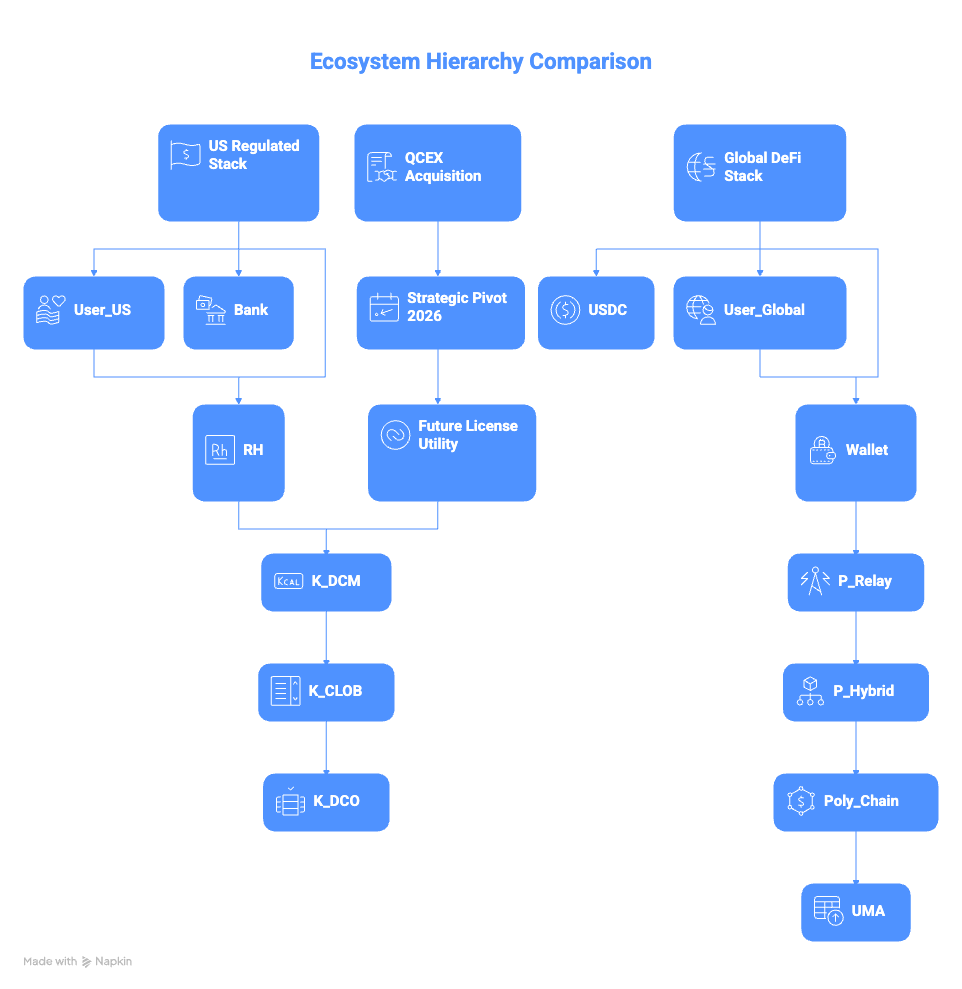
To understand why the market has evolved this way, you must look at the plumbing. Refer to [Diagram 1: The Ecosystem Hierarchy].
```
Deconstructing the Hierarchy: This diagram is not a technical schematic; it is a map of jurisdictional sovereignty.
The Left Flank: The Regulated Stack (Kalshi) Notice the vertical integration shown in the `US Regulated Stack` subgraph. The critical node here is not the matching engine; it is the Bank (ACH/Fedwire) connection.
The Flow: Money moves from a `US Retail User` to `Robinhood` to `Kalshi Klear`. This entire path is protected by the US banking system.
The Moat: The friction is zero. A user sees a balance in USD. They do not see "USDC," they do not see "Gas Fees," and they do not manage a private key. This architectural decision—to accept the regulatory burden of being a DCM (Designated Contract Market)—is why Kalshi captured 66% of the US liquidity. They didn't build a better product; they built a compliant pipe.
The Right Flank: The DeFi Stack (Polymarket) Now look at the `Global DeFi Stack`. The flow requires a `Web3 Wallet` and a bridge to `Polygon`.
The Friction: Every step in this sequence—on-ramping fiat, swapping for USDC, bridging to L2—is a drop-off point for 99% of global wealth.
The Limitation: While this stack is superior for censorship resistance and global reach, it is architecturally incapable of servicing the $100M institutional check that requires audit trails and custody solutions.
The Convergence Point: Pay close attention to the bottom connector in Diagram 1: The QCEX Acquisition. This is the admission of defeat by the crypto-purists. By buying a CFTC license, Polymarket is essentially attempting to splice the Left Stack into the Right Stack. They are trying to "retro-fit" compliance onto a permissionless protocol. Our analysis suggests this hybrid model will face massive technical debt compared to Kalshi’s purpose-built "Compliance-Native" architecture.
Superiority Thesis: The `US Regulated Stack` is superior because Liquidity follows Trust, not Tech. The reason Kalshi processes $23.8B is not because their SQL database is faster than the Polygon blockchain. It is because Jane Street and Susquehanna can legally wire funds to Kalshi Klear, whereas their compliance departments forbid them from touching a Gnosis Safe smart contract.
3. The Gap Analysis: The Metrics of Dominance
Let us look at the hard numbers. We are comparing Kalshi (The Incumbent) against Polymarket (The Challenger) and DraftKings (The Implicit Competitor).
- The Liquidity Gap (Volume vs. Friction)
- Kalshi: $23.8 Billion (2025).
- Polymarket (US-Relevant): ~$9 Billion.
- The Insight: Despite Polymarket having a global footprint, the US market is worth 3x the rest of the world combined in terms of "Quality Volume" (volume that sticks and generates fees). Kalshi’s friction-less on-ramp (Diagram 1) generates a volume velocity that crypto-rails simply cannot match for the average user.
- The Revenue Gap (Monetization Efficiency)
- Kalshi: $263.5 Million Revenue (1.1% Take Rate).
- Polymarket: <$50 Million (Estimated Fees).
- The Insight: Polymarket subsidized its growth with low fees and token incentives (DeFi style). Kalshi charged a premium for legitimacy. The market paid the premium. This proves that users are less price-sensitive than we assumed, provided the platform offers safety and easy tax reporting.
- The "Whale" Gap (Average Trade Size)
- DraftKings: ~$50 Average Bet (Retail/Entertainment).
- Kalshi: ~$450 Average Contract Size (Pro/Hedging).
- The Insight: This 9x multiplier in trade size confirms the "Tax Alpha" thesis. We are not servicing sports fans who want to sweat a game for $20. We are servicing "Sharps" and syndicates moving $50k blocks to exploit mispriced odds, sheltered by the Section 1256 tax code.
Conclusion of Part 1: The macro thesis is clear. The battle is not between "Centralized vs. Decentralized." The battle is between "Integrated vs. Isolated." Kalshi won Phase 1 (2025) because they integrated with the real economy (Banks/Brokers). Phase 2 (2026) will be defined by whether Polymarket can successfully bridge that gap with QCEX, or if they will remain isolated in the on-chain garden.
For ium labs, the strategic imperative is to build tooling that sits on top of the Regulated Stack (Kalshi), capitalizing on the data flow that is already verified, cleared, and liquid. We do not build the road; we build the toll booth on the only bridge that is open.
Part 2: The Technical & Financial Deep Dive
TO: IUM LABS INVESTMENT COMMITTEE FROM: CHIEF RESEARCH ARCHITECT DATE: JANUARY 27, 2026 SUBJECT: THE ENGINE ROOM AND THE BLACK SWAN
4. Structural Logic: The "Invisible Ledger"
Gentlemen, looking at a balance sheet tells you what happened. Looking at the sequence diagram tells you how it happened—and more importantly, how it scales.
[Visual Asset: Diagram 2 - The Core Interaction Flow] A sequence diagram detailing the "Trojan Horse" workflow where sports betting is technically executed as a financial derivative trade.
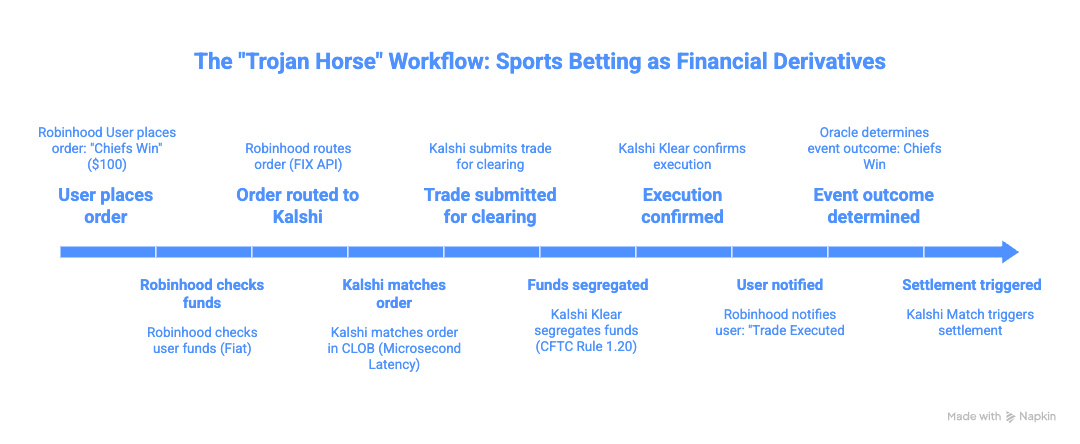
Refer to Diagram 2. This is not merely a user flow; it is a masterpiece of "Regulatory Obfuscation." The genius of the 2025 architecture is not that it introduced a new technology, but that it successfully hid the complexity of a derivatives exchange behind the user interface of a gamified app.
Let us dissect the "Life of a Transaction" step-by-step, as visualized in the sequence:
- Phase 1: The Abstraction Layer (User -> Robinhood)
- The Action: The Robinhood User taps "Chiefs to Win."
- The Reality: The user believes they are placing a bet. The UI shows "Odds."
- The Technical Truth: They are actually submitting a Limit Order to buy a binary option contract at a specific strike price ($0.55). Robinhood’s frontend abstracts the "bid/ask spread" into a simplified "Odds" display. This abstraction is critical. It removes the cognitive load of "trading" while retaining the legal structure of a financial product.
- Phase 2: The Execution Engine (Robinhood -> Kalshi Match)
- The Handshake: Robinhood does not book this bet. They route it via API to the `Kalshi Matching Engine`.
- The Match: Here lies the core innovation. Unlike DraftKings, which acts as the counterparty (and thus carries risk), Kalshi’s CLOB (Central Limit Order Book) matches the Robinhood retail order with a resting limit order from a Market Maker (e.g., Jane Street).
- The Latency: This happens in microseconds on a centralized SQL ledger. Blockchain finality (even on Solana or Polygon) is still too slow and probabilistic for this specific step. The institutional market makers demand deterministic execution, which only a centralized CLOB can provide.
- Phase 3: The Settlement & Tax Event (Kalshi Klear -> User)
- The Trigger: The `Oracle` (e.g., NFL official API) pushes the result.
- The Alpha: `Kalshi Klear` (the DCO) settles the contract at $1.00.
- The Critical Detail: Look at the bottom note of Diagram 2: "Tax Note: Gains logged as 60/40 Cap Gains." This is the "technical innovation" that matters most. By routing the data flow through a DCO, the system automatically tags the profit as a Section 1256 capital gain, not gambling income. This data tag saves the high-volume user ~20% in taxes. That is a programmed arbitrage that no offshore crypto-book can legally replicate for a US citizen.
Synthesis: The innovation is Compliance-as-Code. The technical flow converts a "bet" (high tax, state-regulated, stigma) into a "trade" (low tax, federally regulated, prestige) without the user ever knowing the difference.
5. The Economic Flywheel: The Liquidity Loop
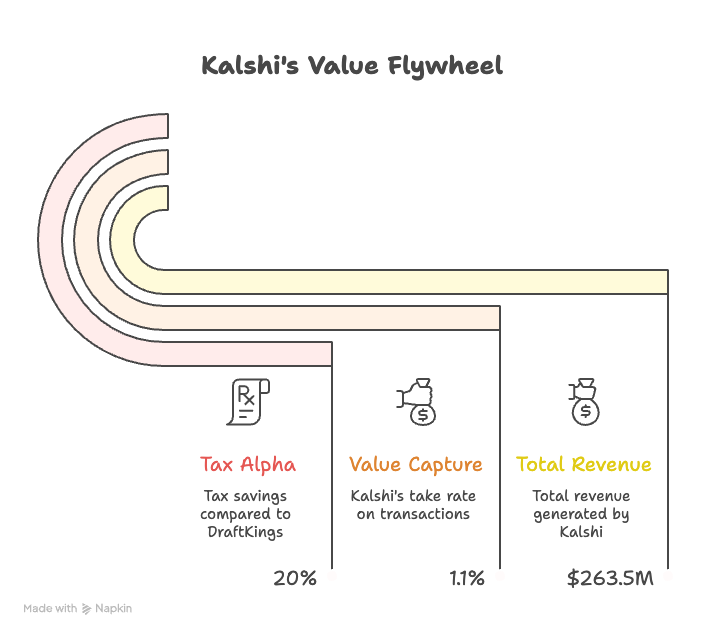
Now, let us follow the money. Refer to Diagram 3. This flowchart explains how Kalshi converted a niche product into a $263.5M revenue engine.
[Visual Asset: Diagram 3 - The Value Flywheel] The economic loop showing how Section 1256 tax advantages attract institutional market makers.
 ```
```
The diagram reveals a Dual-Sided Marketplace Flywheel that is self-reinforcing.
- Node A: The Supply Side (The "Sharps") Observe the input from `HFT Market Makers` and `Pro Sports Bettors`. Why are they here? Tax Alpha. As illustrated in the diagram, the "Tax Alpha (Section 1256)" node feeds directly into the "Sharps." They are not here for the UI; they are here because the effective yield on a winning strategy is mathematically higher on Kalshi than on DraftKings due to the tax savings. These actors provide the Limit Orders and create the market depth.
- Node B: The Demand Side (The "Normies") Observe the input from `Robinhood Retail Flow`. Why are they here? Access. They are already on Robinhood. They don't need to download a new app or deposit funds. These actors provide the Market Orders and consume the liquidity provided by the Sharps.
- Node C: The Value Capture (The "Take Rate") The diagram highlights the "Value Capture (1.1% Take Rate)" node.
- The Math: $23.8 Billion Volume * 1.1% ≈ $261M Revenue.
- The Sustainability: This revenue is risk-free. Unlike a sportsbook, Kalshi does not care who wins the game. They take their toll on the bridge regardless of the traffic's destination. This makes the earnings quality significantly higher (higher P/E multiple) than a gambling company that can have a "bad month" if the favorites win.
Correlation: User Growth vs. Network Value In this equity-based model, the correlation is non-linear.
- Linear Phase: Early user growth adds linear volume.
- Exponential Phase: Once liquidity depth crosses a threshold (the "Spread Compression" point), the market becomes efficient enough for Institutional Hedgers. When corporate risk managers enter to hedge macro risks, the average ticket size jumps from $50 to $50,000.
- The Valuation Multiplier: Diagram 3 shows `Revenue` feeding into `Regulatory Moat`. The more money they make, the more lawyers they hire, the harder it is for a competitor to enter. This implies that Network Value grows as a square of the Liquidity Depth, not just user count.
6. Risk Logic & Verdict: The Binary Event
We must temper our enthusiasm with cold paranoia. Refer to Diagram 4, the "Decision Tree."
[Visual Asset: Diagram 4 - Risk Logic] A decision tree mapping the "Functional Equivalence" legal risk.
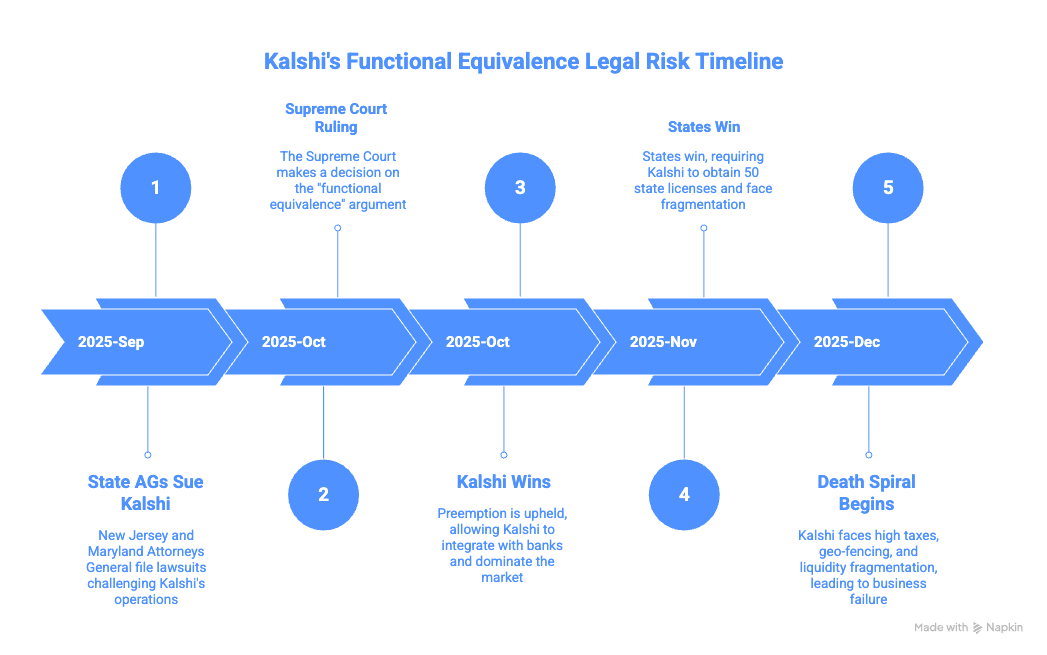
The entire thesis rests on one node: "Supreme Court Ruling (2027)."
The "Black Swan" Scenario (Scenario B): If the Supreme Court rules that these contracts are "functionally equivalent" to gambling, the Federal Preemption shield shatters.
The Cascade: Fragmentation (50 state licenses), Taxation (State gaming taxes), and Exodus (Tax Alpha vanishes). The flywheel in Diagram 3 runs in reverse.
The "Polymarket" Hedge (Scenario A/Pivot): While Kalshi fights the legal war, Polymarket is executing the "QCEX Pivot" shown in Diagram 1. If Kalshi stumbles, Polymarket (now compliant) is positioned to capture the flow. However, Polymarket faces its own risk: alienating its core crypto-native user base by enforcing KYC (Know Your Customer) on its US platform.
7. Final Verdict: The Strategic Position
Based on the synthesis of the Ecosystem Hierarchy, the Interaction Flow, and the Risk Logic, ium labs issues the following strategic verdict:
VERDICT: ACCUMULATE (With Hedges)
The Strategy:
- Primary Play (Long Infrastructure): We treat Kalshi as the "CME of Information." The regulatory moat is currently holding. The revenue is real ($263M). The growth is structural. We advise aggressive integration of our client's tools with the Kalshi API to capture the data flow.
- The Hedge (Long Volatility): We acknowledge the `Scenario B` risk in Diagram 4. Therefore, we do not bet only on Kalshi. We maintain exposure to the Polymarket ecosystem (via their potential token or market making on Polygon) as a hedge. If the US regulatory wall collapses, the global, permissionless stack (Polymarket) becomes the only viable venue.
- The Alpha: The window for "Tax Arbitrage" is open now. Institutional capital should be deployed into Kalshi markets to harvest the Section 1256 benefits before the loophole is inevitably closed or challenged.
Conclusion: In 2026, the market does not belong to the idealists. It belongs to the architects who built the cleanest toll roads connecting the island of "Crypto" to the mainland of "Fiat." Kalshi has built the bridge. Polymarket is trying to buy a ferry. For now, we drive on the bridge.
ium labs Strategic Intelligence Division