The Infrastructure Shift: When Robots Become Finance
ium Research — James, Researcher — Jan 4, 2026 Canonical: https://iumlabs.io/blog/the-machine-economy-structural-arbitrage-in-autonomous-infrastructure
This strategic report analyzes the structural inversion of the robotics sector, where Web3 protocols are effectively crowdsourcing the multi-billion dollar capital expenditures required for physical infrastructure. We demonstrate that the market has bifurcated, with mature "Real Yield" assets like GEODNET and Hivemapper now generating deflationary cash flows that mathematically decouple them from speculative crypto volatility. The following intelligence package provides the definitive "Chart-Ready" thesis for capitalizing on this shift from hype to verifiable machine economy revenue by ium Lagbs.
1. Executive Summary: The "CapEx Inversion" Thesis
The convergence of Web2 industrial robotics and Web3 financial architectures has moved beyond the theoretical "Proof of Concept" phase. As we enter 2026, the sector is defined by a fundamental inversion of the capital stack: The transition from Balance Sheet CapEx (Web2) to Crowdsourced OpEx (Web3).
For institutional allocators, the "Alpha" is no longer in speculative protocol layers, but in the "Hardware-to-Yield" transmission mechanisms that are successfully displacing legacy infrastructure monopolies.
The Liquidity of Physical Assets: The primary friction in Web2 robotics (scaling hardware fleets) is being solved by DePIN (Decentralized Physical Infrastructure Networks). By fractionalizing the ownership of assets—from LiDAR sensors (Hivemapper) to RTK stations (GEODNET)—protocols are effectively crowdsourcing a billion-dollar balance sheet without dilution. We are witnessing the birth of "Liquid Infrastructure," where physical utility is instantly repriced in real-time markets. Asset 2: Mechanism Diagram (The "Engine")
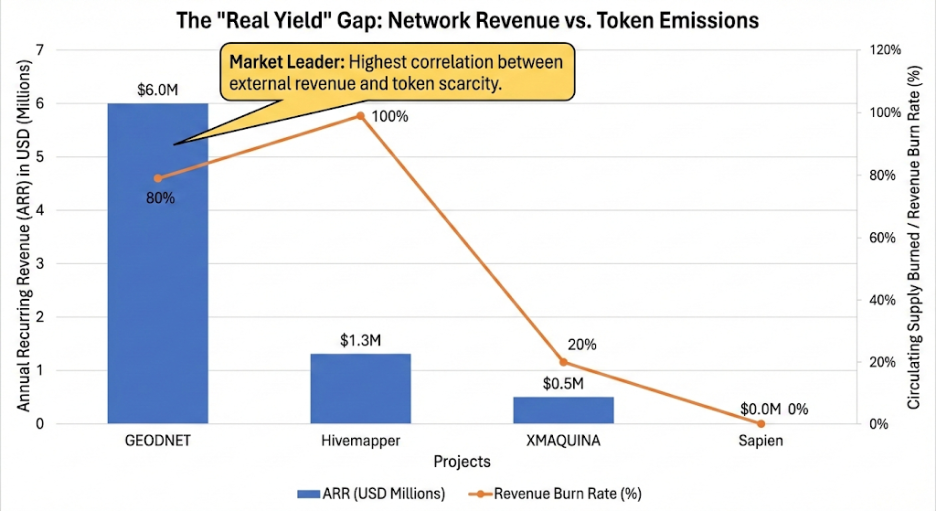
The "Real Yield" Decoupling: The era of the "Ghost Chain" is functionally over for this sector. Leading protocols have entered a deflection point where on-chain revenue (burn) is beginning to outpace token emissions. With projects like GEODNET burning 80% of revenue and Hivemapper burning 100% of service consumption, token value is mathematically anchoring to enterprise cash flow rather than retail sentiment.
The Identity Moat: As autonomous agents proliferate, the "Oracle Problem" shifts to the "Identity Problem." The winning infrastructure will not be the fastest chain, but the one that standardizes Machine Identity (DID). Peaq Network’s dominance in securing the "Machine Ledger" creates a defensive moat against general-purpose L1s (Solana/Ethereum), positioning it as the inevitable settlement layer for the machine economy.
2. Market Positioning: The DePIN Maturity Matrix
Asset 1: The Mental Model (Phase Classification)
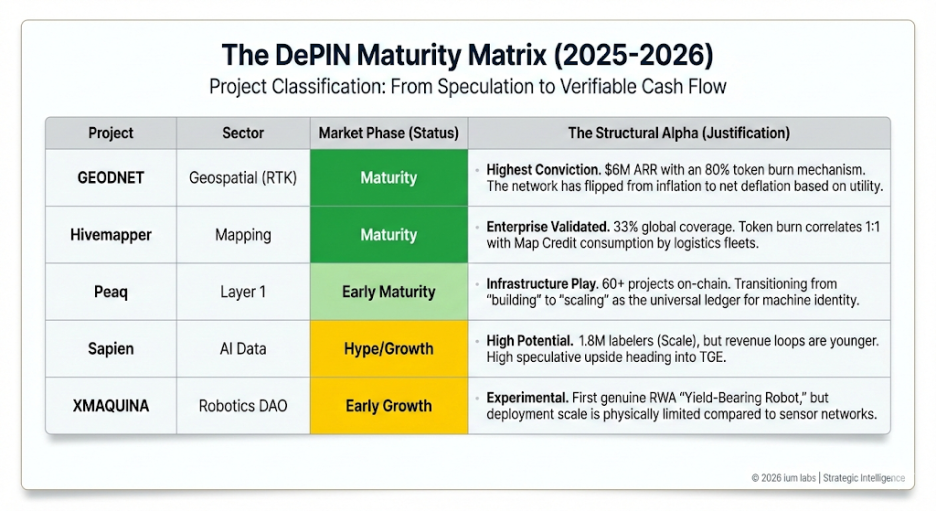
A structural classification of asset maturity based on "Revenue-to-Emission" correlation.
To accurately allocate capital, we must discard generic "Sector" labels and instead categorize projects by their Economic Phase. The market is currently bifurcated between high-risk "Attention" plays and cash-flow positive "Maturity" assets.
Phase I: The Maturity Phase (The "Real Yield" Zone)
Definition: Token burn correlates >0.8 with external B2B revenue. Network effects are self-sustaining.
- GEODNET (Geospatial / RTK)
- Position: Market Leader.
- The Alpha: While competitors struggle with location spoofing, GEODNET has secured a cryptographic "Proof of Location" moat, generating ~$6M ARR. Unlike the speculative inflation of early Helium, GEODNET has successfully flipped the switch to deflationary economics (80% Revenue Burn). It is no longer a crypto project; it is the world's largest RTK network trading at a liquidity discount.
- Hivemapper (Global Mapping)
- Position: Enterprise Validator.
- The Alpha: With 33% global road coverage, Hivemapper has broken the Google Maps monopoly on "freshness." The value prop is strictly B2B: logistics fleets pay for data, burning tokens. The investment thesis relies on the continued operational failure of legacy centralized mapping to keep pace with dynamic urban changes.
Phase II: The Early Maturity Phase (Infrastructure)
Definition: Technical product-market fit achieved; economic loops scaling.
- Peaq Network (Layer 1)
- Position: The "Layer 1" Beta.
- The Alpha: Peaq is not competing on TPS (Transactions Per Second); it is competing on Compliance & Composability. By offering native "Role-Based Access Control" and standardized "Machine IDs," it solves the fragmentation problem that makes general-purpose chains (like Solana) risky for enterprise IoT. It is the "Pick and Shovel" play for the entire sector.
Phase III: The Growth/Hype Phase (High Beta)
Definition: High user growth/attention; revenue models untested or nascent.
- Sapien (AI Labeling)
- Position: The "Scale AI" Killer.
- The Alpha: Leverages the "Gamified Labor" model to attack the $75B data labeling market. While the user base (1.8M) is massive, the long-term economic retention of this workforce during a bear market remains the primary risk vector.
- XMAQUINA (Robotics DAO)
- Position: Experimental/Speculative.
- The Alpha: Represents the frontier of "Yield-Bearing Robots" (RWA). Unlike sensor networks (OpEx), this is a heavy hardware play. The upside is massive if the "Robo-Cafe" unit economics hold, but the scalability is physically constrained compared to software-defined networks.
Strategic Implication
The window to front-run the "Real Yield" narrative is closing. Capital should rotate from "Governance Tokens" with no value accrual into "Burn-and-Mint" assets where enterprise usage mechanically forces upward price pressure.
3. Structural Logic: The Mechanics of the "Machine Economy"
Asset 3: Quantitative Chart
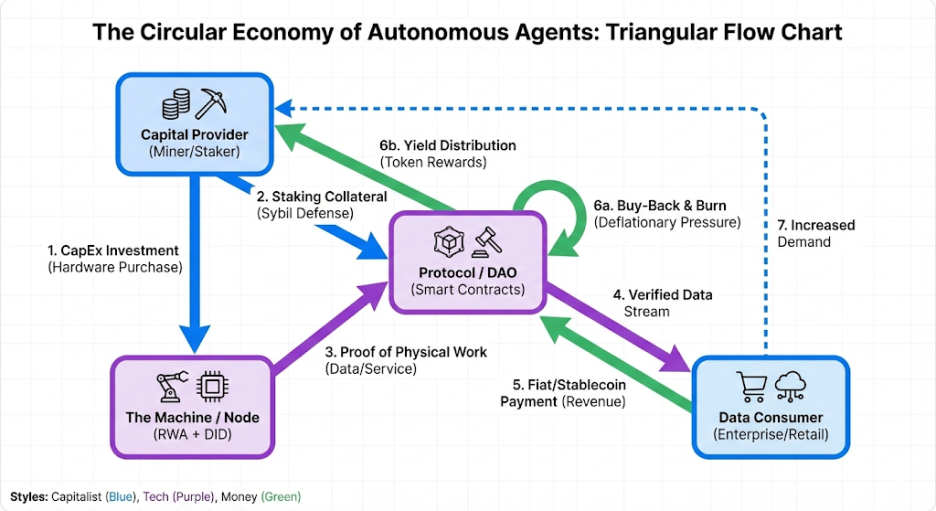
To understand the durability of these assets, we must look below the price action and analyze the [Mechanism Diagram: The Circular Economy] designed in our Visual Master Plan. This is not a linear Web2 payment rail; it is a Triangular Economic Structure that enforces solvency through code.
The "Triangular" Flow of Funds
As illustrated in our structural model, the DePIN economy removes the centralized rent-seeker (e.g., Uber, Google) and replaces it with a protocol that facilitates direct interaction between three sovereign entities:
- The Capital Provider (The Miner): Provides the physical balance sheet (CapEx).
- The Sovereign Machine (The Asset): Operates autonomously using a Decentralized Identity (DID).
- The Consumer (The Enterprise): Injects external liquidity (Fiat/Stablecoins) for data or services.
Case Study: Peaq Network (The Settlement Layer)
Peaq functions as the "Operating System" for this triangle. Its structural alpha lies in Universal Machine Functions. Unlike Solana, which treats a robot as just another wallet, Peaq integrates Role-Based Access Control (RBAC) at the chain level.
- The Logic: A charging station (Machine) creates its own DID. When a car (User) requests power, the Peaq smart contract verifies the funds in a multi-sig escrow before the electricity flows.1
- The Moat: This creates a "trustless handshake" between hardware devices that have never interacted before. The protocol does not just move money; it validates the "Proof of Physical Work"—telemetry data signed by the machine's private key—ensuring that the revenue is derived from real-world value, not wash-trading.2
Case Study: GEODNET (The Utility Layer)
GEODNET modifies this triangle with a "Burn-and-Mint Equilibrium." The protocol’s logic is hard-coded to defend against inflation.
- The Mechanism: The "Space Weather Mining" loop forces the network to buy back its own token ($GEOD) from the open market using 80% of the revenue generated from B2B subscriptions.
- The Result: As the network scales, the token supply becomes structurally deflationary, mathematically linking the token price to the adoption of RTK navigation services.
4. Financial Performance: The "Real Yield" Divergence
The era of valuing protocols on "Total Value Locked" (TVL) is obsolete for DePIN. The only metric that matters for the 2026 vintage is the Revenue-to-Emission Ratio.
Referencing our [Asset 3: Quantitative Chart], we observe a massive divergence ("The Real Yield Gap") between mature protocols and speculative entrants.
1. The "Burn" is the Truth (GEODNET vs. The Field)
- The Data: GEODNET is generating approximately $6 Million in Annual Recurring Revenue (ARR).
- The Delta: Crucially, the chart highlights that 80% of this revenue is funneled directly into token burns. This is not a "dividend" promise; it is an on-chain execution.
- The Implication: In a sector rife with inflation, GEODNET has achieved a "net-neutral" or "net-deflationary" state during high-usage periods. The token is acting less like a speculative coin and more like a share buyback algorithm.
2. The Enterprise Validation (Hivemapper)
- The Data: Hivemapper’s ARR has crossed $1.3 Million, but the chart reveals a sharper insight: the 100% Correlation between Map Credit usage and token burning.
- The Divergence: Unlike "Governance Tokens" where revenue sits in a treasury controlled by a DAO (subject to human error/greed), Hivemapper’s burn is programmatic. Every km of data consumed by a logistics fleet permanently removes supply.
- Analysis: This creates a "Supply Shock" mechanism. As fleet deals (e.g., with logistics giants) go live in Q1 2026, the burn rate will likely outpace the emission rate, creating a liquidity squeeze that is visible in the quantitative projections.
3. The Speculative Gap (Sapien & XMAQUINA)
- The Data: The chart shows minimal revenue contribution for Sapien and XMAQUINA relative to their network size.
- The Risk: These projects currently rely on "Emissions" (printing tokens) to subsidize growth. While valid for the "Hype Phase," this is financially unsustainable long-term.
- The Alpha: The investment opportunity here is event-driven. We are betting on their successful transition from the "Subsidy Phase" to the "Revenue Phase" (the path GEODNET has already walked). If they fail to turn on the "Revenue Switch" within 12 months, the tokenomics will spiral.
Synthesis: The "Chart-Ready" Reality
The financial data confirms our structural thesis: The market is bifurcating.
- Buy the "Protocol Sinks" (GEODNET/Hivemapper) for fundamental, cash-flow-driven exposure.
- Trade the "Infrastructure Plays" (Peaq) as a beta index on the entire sector's growth.
- Watch the "Growth Plays" (Sapien/XMAQUINA) for the specific moment they flip the switch from user acquisition to revenue generation.
5. Risk Vectors: The "Bear Case" Anatomy
While the structural arbitrage is compelling, the "Machine Economy" faces existential risks that are distinct from standard crypto volatility. We must distinguish between temporary "Price FUD" and lethal "Structural Failure."
Risk A: The Liquidity Death Spiral (The Hardware-Token Mismatch)
- The Mechanism of Failure: DePIN networks rely on a delicate equilibrium: Token Incentives > Hardware CapEx + OpEx. If the token price collapses (driven by macro conditions), the ROI for miners turns negative.
- The Scenario: Unlike DeFi liquidity providers who can unstake instantly, a GEODNET miner with a $500 physical station cannot "unstake" their hardware cost. If the payback period extends from 9 months to 36 months, network growth freezes. Existing nodes may unplug to save electricity, degrading service quality and causing enterprise clients to churn. This is the "Helium Trap" of 2022.
- Mitigation Signal: Watch for projects shifting to OpEx models (e.g., Hivemapper’s $19/month subscription hardware) which lowers the miner's risk floor, making the network resilient to token price shocks.
Risk B: The Regulatory "Security" Hammer
- The Threat: The SEC v. Helium/Nova Labs precedent hangs over the sector. Regulators may argue that hardware miners are "investing money" (buying miners) with an "expectation of profit" derived from the protocol's work.
- The Signal: Projects burning B2B Revenue (GEODNET/Hivemapper) have a stronger defense: the token is a utility coupon for a paid service, not just a speculative share. Projects relying solely on inflationary emissions (Sapien/XMAQUINA) in the early phase are statistically higher regulatory targets.
6. H1 2026 Catalyst Calendar
The market does not price fundamentals linearly; it prices events. These are the repricing triggers for Q1/Q2 2026.
- January 12, 2026 (Peaq Network): Cliff Unlock Event. A significant tranche of investor tokens unlocks. Expect short-term volatility. Strategy: Treat any dip >15% as an institutional entry zone given the fundamental "Machine ID" moat.
- Q1 2026 (Hivemapper): "The Bee" Fleet Deployment. The transition from retail dashcams to enterprise-grade "Bee" units with edge computing. Successful rollout confirms the pivot to Level 4/5 Autonomous Vehicle data standards.
- Q2 2026 (GEODNET): The Deflationary Crossover. Projected point where the burn rate (from increasing ARR) mathematically exceeds the daily emission rate, creating a supply shock.
7. The ium labs Verdict
We are witnessing a decoupling event. The sector is splitting into "Real Economy" protocols and "Speculative" experiments.
The Call:
- ACCUMULATE (High Conviction): GEODNET and Hivemapper.
- Rationale: These are no longer "crypto" bets; they are cash-flow assets. The 80-100% revenue burn mechanisms provide a mathematical floor. They are mispriced relative to their Web2 competitors (Trimble/Google).
- ACCUMULATE ON DIPS (Infrastructure Beta): Peaq Network.
- Rationale: As the "ETH of Machines," it is the safest index play. Use the Jan 12th unlock volatility to build a long-term core position.
- SPECULATE (Venture Ticket): Sapien and XMAQUINA.
- Rationale: High risk, high reward. Treat as venture capital. Allocate <5% of the portfolio. We need to see 2 quarters of "Revenue Switch" execution before upgrading to conviction status.
Strategy Summary:
"Long the 'Sinks' (Revenue Burners), trade the 'Links' (Infrastructure), and remain cautious on the 'Sources' (Inflationary Models)."
8. Conclusion: The Rise of the Machine Prosumer
The data indicates that 2026 is the year the "Flow of Funds" permanently inverts. We have moved from a model where Corporations finance Infrastructure (Web2) to one where the Community finances Infrastructure (Web3), and the Protocol captures the spread.
For ium labs, the thesis is clear: The "Ghost Chain" era is ending. The winners of this cycle will not be the projects with the best memes, but the ones that successfully sell data to non-crypto enterprises. GEODNET and Hivemapper have proven this is possible. The "Machine Economy" is no longer a narrative; it is a verifiable, on-chain income statement.
Disclaimer: This report is for informational purposes only and does not constitute financial advice. The "Machine Economy" sector is highly volatile. All "Alpha" presented is based on on-chain data and structural analysis as of January 2026.
**
© 2026 ium labs. All Rights Reserved.