The Walled Garden: Why Upbit and Bithumb Are the Only Gateways Left
ium Research — Julian, Researcher — Jan 4, 2026 Canonical: https://iumlabs.io/blog/the-walled-garden-why-upbit-and-bithumb-are-the-only-gateways-left
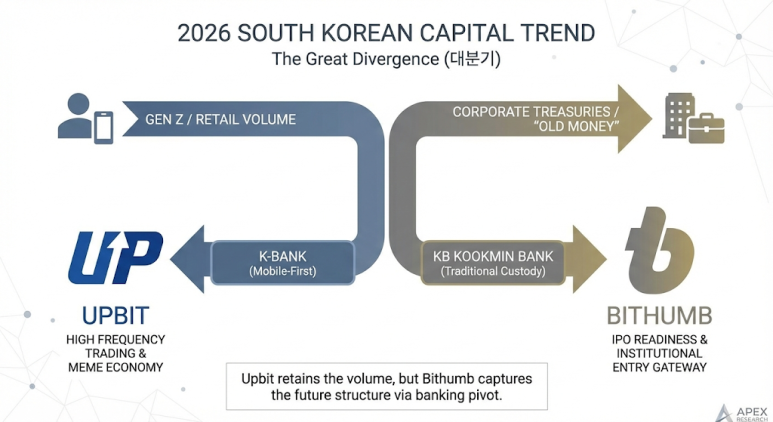
South Korea’s crypto market has evolved from a retail casino into a fortress. For global projects in 2026, the market is defined by a "Great Divergence"—a split between the defensive dominance of Upbit and the aggressive institutional pivot of Bithumb.
Success is no longer about "entering Korea"; it is about navigating a "Walled Garden" enforced by strict capital controls and the FATF Travel Rule. This report provides the strategic intelligence required to access the $663B liquidity pool trapped within this unique regulatory architecture.
- Key Takeaways: The "Alpha" Protocol
The "Money Move" Shift (Institutional Alpha) The tectonic shift of 2026 is the migration of banking infrastructure. Bithumb’s strategic pivot to KB Kookmin Bank—South Korea’s largest custodian of corporate wealth—effectively ends the retail-only era. While Upbit retains the high-frequency Gen Z "degen" volume via K-Bank, Bithumb has positioned itself as the exclusive gateway for the incoming wave of corporate treasuries and "old money" post-IPO.
The Liquidity Paradox (Operational Alpha) Security now comes at the cost of velocity. With Upbit enforcing a rigid 99% Cold Wallet Mandate (Post-Hack Protocol), the market faces structural "Liquidity Friction." Projects must anticipate artificially induced scarcity on order books and widened spreads during volatility events, as the speed of capital deployment on the market leader has been intentionally throttled.
The Regulatory Moat (Compliance Alpha) The South Korean market has transitioned from a global casino to a "Walled Garden." Success is now binary, determined solely by the FATF Travel Rule Whitelist. Projects listed on non-compliant foreign exchanges are effectively embargoed from Korean liquidity ($663B annual volume). Thus, a Dual-Listing Strategy (Binance Global + Upbit/Bithumb) remains the only mathematical path to full valuation.
- Phase Analysis: The "Maturity vs. Renaissance" Split
Current Classification: Transitional Phase (Maturity $\rightarrow$ Institutional Renaissance)
The South Korean market is currently undergoing a "Bifurcated Phase Shift." It is no longer in the wild Attention Phase of 2017, nor the pure Hype Phase of 2021. Instead, the duopoly has split into two distinct strategic realities:
A. The "Defensive Maturity" of Upbit (The Incumbent)
Upbit sits firmly in the Maturity Phase. Comparable to Coinbase in the US, it has achieved saturation dominance (~70% market share). Its current strategy is purely defensive: focused on retaining its massive Gen Z/Millennial user base while navigating antitrust probes and managing the reputational fallout of the 2025 hack.
Comparative Position: Unlike competitors still fighting for user acquisition, Upbit is the market beta. Its growth is flat, but its liquidity depth is unrivaled. It is the "Walled Garden" that prioritizes stability over innovation.
B. The "Institutional Hype" of Bithumb (The Challenger)
In sharp contrast, Bithumb has artificially engineered a return to the Hype Phase. By targeting a 2026 IPO and switching banking partners to KB Kookmin, it has re-ignited speculative interest not just in listed tokens, but in the exchange platform itself.
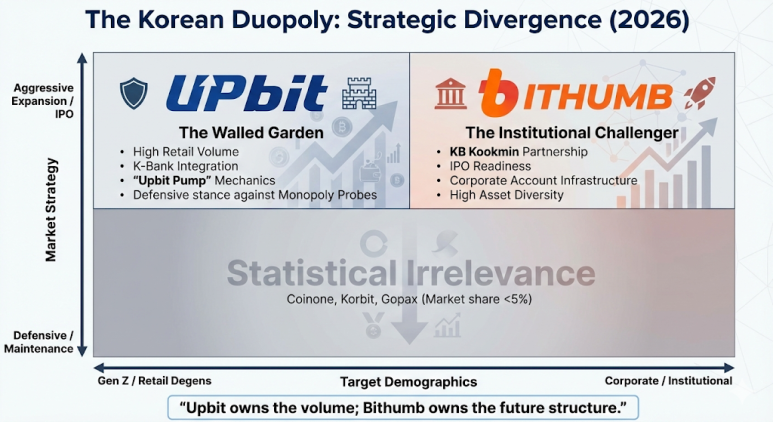
Comparative Position: Unlike smaller competitors (Coinone, Korbit) stuck in the "Trough of Disillusionment" (<5% market share), Bithumb is aggressively expanding. It is successfully pivoting from a "Retail Runner-Up" to the "Institutional Premier," targeting a demographic (Corporate/Wealth) that Upbit’s internet-bank infrastructure cannot effectively serve.
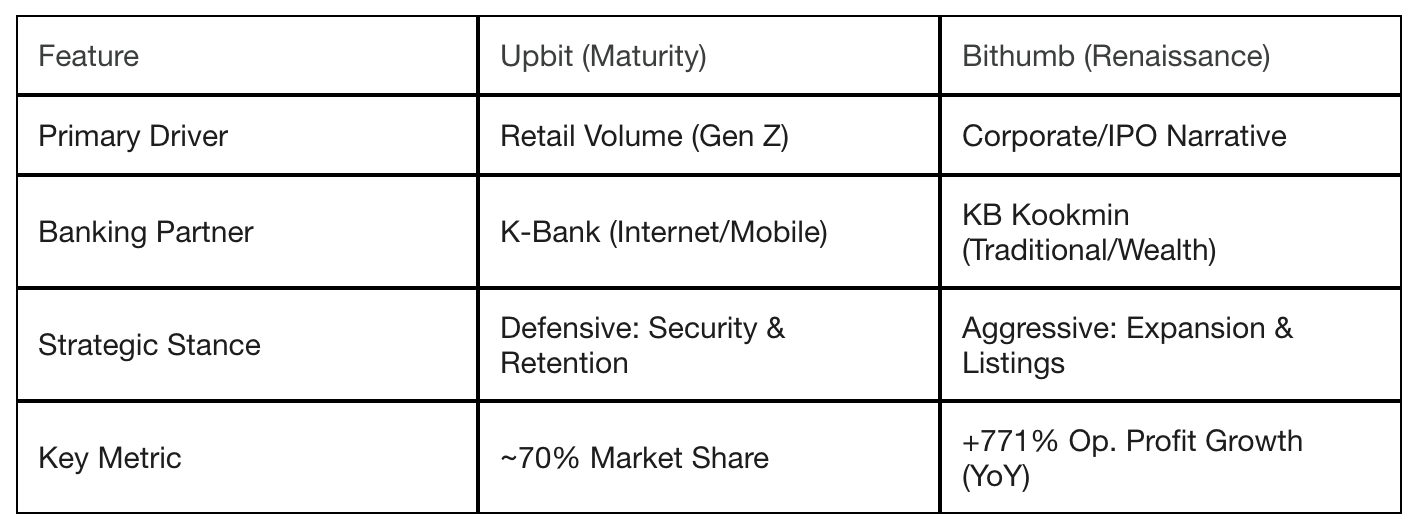
Analyst Note: We are witnessing the decoupling of the "Kimchi Premium." It is no longer a monolithic force, but two distinct liquidity pools with different velocities and participant profiles.
PART 2: THE MECHANISM DEEP DIVE & FINANCIAL ARCHITECTURE
3. The Structural Logic: The "Walled Garden" Mechanism
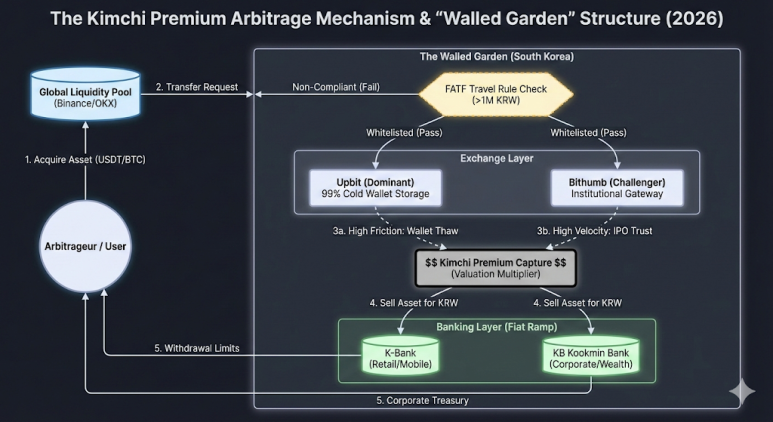
The hegemony of Upbit and Bithumb is not merely a product of market share; it is enforced by a unique Triangular Regulatory Structure that effectively isolates the South Korean liquidity pool from the global market. This isolation is the mechanical driver of the "Kimchi Premium" and the reason why these two exchanges function less like trading venues and more like sovereign monetary gateways.
To understand the 2026 ecosystem, we must deconstruct the "Arbitrage Valve" mechanism step-by-step.
3.1. The Triangular Structure (Exchange $\leftrightarrow$ Bank $\leftrightarrow$ User)
Unlike global exchanges where stablecoins (USDT/USDC) form the primary settlement layer, the South Korean market relies on a rigid Fiat-Tethered Architecture.
- The Real-Name Verification Link: A user cannot simply deposit funds. They must hold a specific bank account tied to the exchange (Upbit $\leftrightarrow$ K-Bank; Bithumb $\leftrightarrow$ KB Kookmin).
- The "Siloed" Settlement: Capital cannot move laterally between exchanges. A user cannot send KRW from Upbit to Bithumb directly; they must withdraw to their bank, then deposit to the rival bank, then deposit to the rival exchange. This friction reduces the velocity of capital rotation, solidifying the stickiness of the incumbent (Upbit).
3.2. The Travel Rule "Valve"
The diagram below illustrates the flow of funds in this closed loop. The critical control point is the FATF Travel Rule Hexagon.
- The Filter: For any transaction >1M KRW (~$680), the exchange must verify the sender/receiver identity.
- The Binary Outcome: If a global exchange is not on the "Whitelist" (VASP Alliance), the transaction is rejected. This creates a "Semi-Permeable Membrane" where liquidity can only enter from compliant sources (e.g., Binance, OKX), effectively filtering out "Grey Market" liquidity and consolidating volume into the hands of the duopoly.
- On-Chain & Financial Performance: The "Profit Flip"
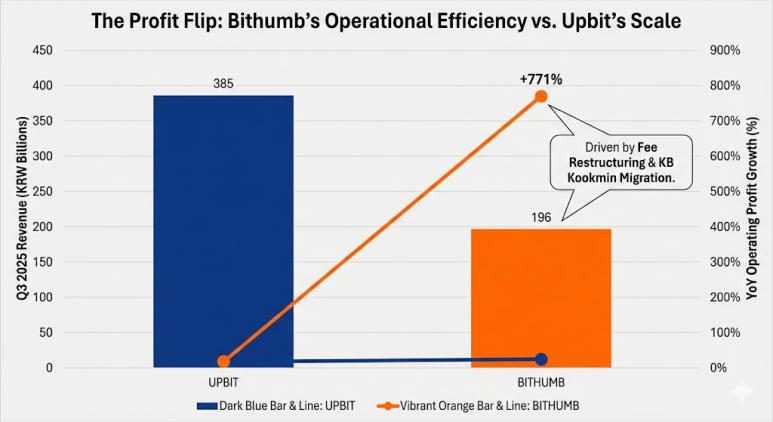
While the structural mechanism explains how they control the market, the financial data explains why the hierarchy is shifting. The 2025 financial disclosures reveal a pivotal divergence in operational efficiency.
Metric (Q3 2025)
Upbit (Dunamu)
Bithumb
The Delta (Analysis)
Revenue
KRW 385.9B ($265M)
KRW 196B ($135M)
Upbit still commands ~2x the raw revenue, leveraging its massive 70% market share.
Op. Profit Growth
Moderate/Flat
+771% (YoY)
This is the critical signal. Bithumb is growing nearly 8x faster in profitability, driven by aggressive fee restructuring and the KB Kookmin migration.
Net Profit
KRW 239B
KRW 105.4B
Bithumb's net profit surged 3,285% YoY, indicating a successful pivot from "survival mode" to high-margin expansion.
Strategic Interpretation
- Revenue vs. Incentives: Upbit’s revenue represents "Organic Stickiness"—users stay because of liquidity depth and UI familiarity (the K-Bank mobile integration). Bithumb’s explosive growth represents "Incentivized Velocity"—users are migrating for lower fees and the superior banking ramp of KB Kookmin.
- The "Listing Effect" Value: The revenue disparity confirms that an Upbit listing is still the "Gold Standard" for volume (generating 2x the fees). However, Bithumb’s growth trajectory suggests that its listing impact is rapidly appreciating. For a token issuer, Bithumb now offers a higher marginal return on listing effort compared to 2024.
- Market Efficiency: Bithumb’s +771% operating profit growth proves that its corporate restructuring (spinning off non-essential businesses for IPO prep) has successfully streamlined its "Burn Rate." It is now a leaner, more aggressive competitor than the monolithic Upbit.
PART 3: STRUCTURAL RISKS, FUTURE OUTLOOK & VERDICT
5. Structural Risks: The Bear Case for 2026
While the "Institutional Turn" paints a bullish narrative for adoption, the market’s infrastructure remains brittle. Below are the three fatal structural flaws that could decapitate value for unprepared projects.
Risk A: The "Ownership Cap" Destabilization (Existential)
- The Threat: South Korea’s Financial Services Commission (FSC) has proposed designating major exchanges as "Core Infrastructure," capping shareholder ownership at 15-20%.
- The Impact: This is not FUD; it is a governance earthquake. It would force Dunamu Chairman Song Chi-hyung (Upbit) and Bithumb Holdings (73% stake) to liquidate massive equity blocks.
- Adverse Outcome: A forced sell-off of exchange equity could lead to a temporary vacuum in leadership, delayed decision-making on listings, and a strategic freeze on new initiatives (e.g., global expansion) while the boardroom reshuffles.
Risk B: Liquidity Friction & The "Deep Freeze" (Operational)
- The Threat: Upbit’s 99% Cold Wallet Mandate, implemented post-November 2025 hack, is a double-edged sword.
- The Impact: While assets are secure, they are illiquid. Moving funds from deep cold storage to hot wallets for withdrawal requests now requires multi-sig human intervention, introducing significant latency.
- Adverse Outcome: During high-volatility events (e.g., a global market crash), arbitrageurs cannot exit positions fast enough. The "Kimchi Premium" could invert or blow out to dangerous levels (20%+), trapping liquidity inside the exchange and causing severe price decoupling from global spot prices.
Risk C: The "Stablecoin Stalemate" (Regulatory)
- The Threat: The Digital Asset Basic Law has been delayed until late 2026 due to a turf war between the Bank of Korea and the FSC over who controls stablecoin reserves.
- The Impact: Without a legal KRW stablecoin, the market remains tethered to the inefficient banking rail system.
- Adverse Outcome: If a project relies on on-chain DeFi interactions, the Korean market remains a "dead end." Users can buy the token, but they cannot use it in DeFi without exiting the Korean ecosystem entirely—a taxable and friction-heavy event.
6. Future Outlook: The Catalyst Calendar (H1 2026)
Catalyst Event
Estimated Timeline
Probability
Strategic Implication
Bithumb IPO Filing
Q2 2026
High
The "Legitimacy Pump." A successful filing will trigger a repricing of all assets listed on Bithumb as "institutional grade," attracting traditional capital.
FATF Travel Rule Tightening
Q1 2026
Certain
The "Grey Market" Purge. Non-compliant foreign exchanges (e.g., smaller offshore derivatives platforms) will be blacklisted, cutting off their arbitrage routes.
Won Stablecoin Pilot
Q3 2026
Medium
The "Velocity Unlock." If Naver or Kakao are granted a pilot license, on-chain velocity in Korea will explode, bypassing legacy banking rails.
7. The Final Verdict
VERDICT: ACCUMULATE (Strategic Allocation)
Status: Institutional Renaissance via Bithumb / Defensive Maintenance via Upbit.
South Korea in 2026 is no longer a speculative casino; it is a high-barrier, high-reward "Walled Garden." The risks are structural, but the liquidity is sovereign.
- For Retail Tokens (Gaming/Memes): Target Upbit. The volume is unmatched, but issuers must prepare for "Deep Freeze" liquidity friction during volatility.
- For Institutional/RWA Tokens: Target Bithumb. The KB Kookmin partnership and IPO narrative provide the only viable runway for corporate capital entry.
🧑💻 Analyst’s Note: Do not view Korea as a single market. View it as two distinct liquidity engines. You do not "enter Korea"—you either "play the Upbit pump" or "invest in the Bithumb pivot."
**CLOSING **
The era of easy access to the Korean market is over. The "Great Divergence" between Upbit and Bithumb has created a complex landscape where success requires precise strategic navigation.
- Upbit remains the king of retail volume but is barricading itself behind high walls of security and cold storage.
- Bithumb is reinventing itself as the institutional bridge, leveraging traditional banking alliances to capture the next wave of capital.
For ium labs clients, the directive is clear: Adopt a Dual-Track Strategy. Leverage Upbit for liquidity depth and Bithumb for institutional legitimacy. In the Walled Garden of 2026, only those with the right keys—regulatory compliance and strategic listing placement—will unlock the value trapped inside.
[Disclaimer]
This report is for informational purposes only and does not constitute financial advice. The analysis is based on data available as of January 2026. Market conditions in the cryptocurrency sector are highly volatile and subject to rapid regulatory changes.
© 2026 ium Labs. All Rights Reserved.