When Does a Tokenized Money Fund Add Value?
Two comparable USD money funds expose the economics of cash redemption, distribution fees and collateral use. A reproducible model puts a price on faster access to money.
Originally published by Panasia Research.
- Topic
- Tokenized funds
- Published
- 2026-09-11
- Reading
- 17 min
- Sections
- 07
- References
- 12
 IUM LABSResearch
Cover artwork and image sources
- Cover: AI-assisted collage · Photo: Danist Soh / Unsplash.
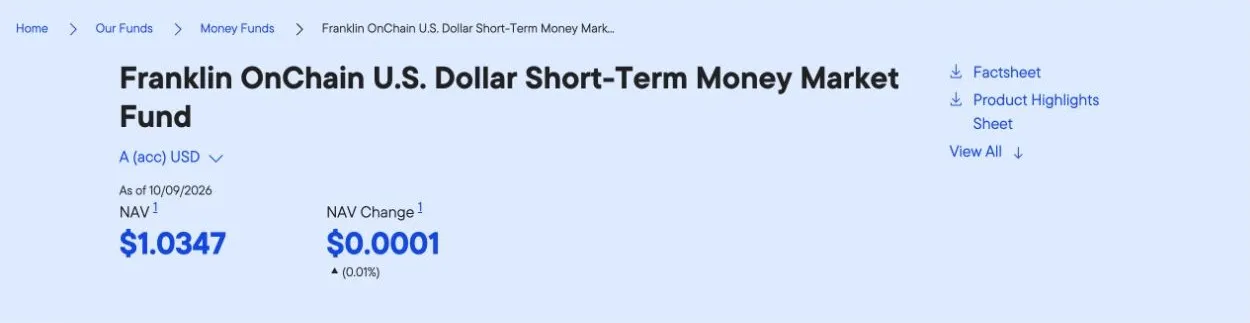
- Franklin Templeton Singapore product page header: Franklin OnChain U.S. Dollar Short-Term Money Market Fund, A (acc) USD share class, NAV as of September 10, 2026 · Franklin Templeton Singapore, captured September 12, 2026
Key takeaways
- 01
The reviewed terms do not establish faster direct cash redemption for the tokenized fund. Payment windows are commitments, not measured processing times.
- 02
Distribution terms can outweigh the portfolio. The tokenized fund lists a subscription fee of up to 1%, the conventional Class A a current entry charge of 0%. At a 3.50% annual rate, the bottom of the Fed’s target range on July 29, 2026, 1% is about 104 days of income.
- 03
At an assumed 4% annual net carry difference, three additional productive days on USD 1 million are worth USD 328.77. A 10 bp fee needs 9.13 days to break even.
- 04
Recurring use can justify infrastructure costs; collateral borrowing can meet a deadline. Both require an actual counterparty and an economic comparison with the available alternatives.
- 05
In Korea, the FSC’s September 4, 2026 roadmap puts tokenization of privately pooled money market funds in its first phase from February 2027, and stablecoin-linked payments in its last phase, pending a stablecoin law.
A treasury does not buy a faster ledger. It buys income on cash that would otherwise sit idle, or access to money when a payment is due. A tokenized money-market fund earns its place only when those outcomes improve after costs.
Our comparison of two Franklin Templeton USD money-market funds leads to a specific conclusion: the public terms do not establish a faster direct cash exit for the tokenized product. Its stronger economic case requires an additional use for the fund shares: settlement with an accepting counterparty, or financing against eligible collateral. That additional use must save enough capital or operating expense to pay for distribution, conversion and financing.
The distinction matters most over short holding periods. Small transaction charges can consume several days of money-market income. This paper measures that hurdle, separates documented product terms from hypothetical economics, and identifies the circumstances that would change the conclusion.
A comparison with a defined buyer
We study an already onboarded, non-US Singapore treasury investor with USD cash, access to both selected share classes and a USD 1 million allocation. This is a conditional comparison of product economics; it does not imply every corporate account is eligible. A retail saver starting with USD 20 faces a different access problem.
The pair is Franklin OnChain U.S. Dollar Short-Term Money Market Fund and Franklin U.S. Dollar Short-Term Money Market Fund, both A (acc) USD. Both are Franklin Templeton short-term USD money market funds, and both factsheets name the same comparator benchmark, the Bloomberg U.S. Treasury 1-3 Month Index. That makes the pair more informative than comparing a tokenized bond with a money fund.
| Comparison boundary | Tokenized fund | Conventional fund |
|---|---|---|
| Share-class identifier | SGXZ71843866 | LU0128526901 |
| Legal vehicle | Singapore VCC sub-fund | Luxembourg FTIF sub-fund |
| Currency / income treatment | USD / accumulating | USD / accumulating |
| Published minimum | USD 20 | USD 1,000 |
| Benchmark | Bloomberg U.S. Treasury 1-3 Month | Bloomberg U.S. Treasury 1-3 Month |
Source: Franklin Templeton Singapore. The product page screen below shows the NAV as of September 10, 2026.
Identifiers, minimums and benchmark are from the share-class factsheets; the legal vehicles are from the Product Highlights Sheets.
The funds remain separate portfolios in different legal structures. Matching manager, currency and stated purpose does not hold credit exposures, holdings or domicile constant. We therefore compare observable terms and outcomes, without attributing return differences to tokenization. We also exclude Franklin's US government money fund: a feature of a different fund is not evidence of the same feature for this Singapore fund.
Institutional distribution is real: Marketnode announced its appointment as an authorised distributor in March 2026. Distribution access, however, answers where an eligible customer can obtain exposure; it does not by itself supply a secondary buyer or a lending facility.
The cash exit still has a dealing calendar
The conventional fund’s Product Highlights Sheet specifies payment within one Dealing Day following the Dealing Day on which a sale request is received and accepted. Its Singapore representative’s cutoff is 4 p.m. on a Dealing Day; a later accepted request uses the next Dealing Day’s valuation.
The tokenized fund’s sheet describes normal redemption proceeds within seven Business Days after receipt and acceptance, with requests after its 4.30 p.m. Singapore deadline carried to the next Dealing Day. Its register combines blockchain records with off-chain information. Token recordkeeping does not remove the fund’s dealing process.
Both calendars run on US market days. The conventional fund deals on days when the New York Stock Exchange is open for normal business and Singapore banks are open. The tokenized fund’s Business Day also requires US bond markets and banks in Singapore and the United States to be open.
The dealing window, in the fund documents
“Sale proceeds will be paid within one Dealing Day following the Dealing Day of the receipt and acceptance of the sale request.”
Conventional fund, Product Highlights Sheet, page 4
A sale request accepted by 4 p.m. on a Dealing Day is priced at that day’s net asset value; a later request takes the next Dealing Day’s value.
Open the conventional fund’s Product Highlights Sheet (PDF)
“You will normally receive your redemption proceeds within 7 Business Days from the receipt and acceptance of the redemption request.”
Tokenized fund, Product Highlights Sheet, page 4
A request received after the Dealing Deadline, or on a day that is not a Dealing Day, is treated as received on the next Dealing Day.
Product Highlights Sheets, page 4 of each. These documents define payment windows, not measured processing times.
These are documented payment windows, not measured execution times. Seven days is not an observed average; one day is not a promise that holds under every stress condition. Both sheets also allow redemptions to be deferred once they pass 10% of a fund’s or a class’s shares on one Dealing Day. We cannot conclude that the tokenized fund normally takes six extra days. We can conclude that the reviewed terms provide no stronger direct-redemption timing commitment.
For a treasury that must pay a supplier in bank dollars, there are three economically distinct routes:
| Route | What changes hands? | What makes the payment possible? |
|---|---|---|
| Fund redemption | Shares are cancelled for proceeds | Fund processing and cash delivery |
| Sale or transfer to a counterparty | An existing holding changes owner | A willing, eligible recipient and an acceptable settlement asset |
| Collateral borrowing | The holding supports a loan | A lender, collateral acceptance and borrowing capacity |
The second route can avoid waiting for the fund by transferring the waiting period to a buyer. The third finances that period. Neither removes the economic cost of supplying cash. A claim of instant liquidity must identify who supplies it, in what currency, at what size and price.
The endpoint is decisive. A token or stablecoin that cannot satisfy a bank-dollar invoice still requires conversion and payout. Conversely, if an existing obligation can be settled directly with the fund token, redemption may be unnecessary. Our base-case treasury therefore measures time until the required payment can be completed, rather than time until a blockchain transaction confirms.
Banks are building bank-money options for that last leg. MAS launched BLOOM in October 2025 to “enable settlement in tokenised bank liabilities and well-regulated stablecoins.” On September 10, 2026, DBS, OCBC and UOB reported live domestic Singapore dollar transactions using tokenized deposits on Swift’s ledger, with final settlement still through existing systems. Neither turns a fund token into a payment asset; both are candidates for the payment leg after a sale or a loan.
Distribution costs can dominate the return
The published charges give a useful check on the economics of a short holding period.
The tokenized fund’s Product Highlights Sheet lists a subscription fee of “currently up to 1%,” with a maximum of 1%, and notes that some distributors may charge their customers additional fees. The conventional sheet lists Class A’s current entry charge at 0.00%, with a permitted maximum of 1.50%. The factsheets carry the same split: the tokenized factsheet calculates its after-sales-charge returns on an initial sales charge of 1%, the conventional factsheet on 0%.
A one-time charge is easiest to judge in days of income. On July 29, 2026 the Federal Reserve held the target range for the federal funds rate at 3.50% to 3.75%. At a 3.50% annual rate, a 1% entry charge equals about 104 days of income on the same amount; at 3.75%, about 97 days. A money fund’s yield is not the policy rate, so these are orders of magnitude, not fund returns.
Source: ium Labs calculation
On a holding of a few months, a full charge can exceed the income. That does not show that blockchain reduced investment performance. It shows that the investor’s distribution terms can matter far more than small return differences between the portfolios. A waived charge changes that comparison immediately.
The published fee is an allowance, not proof that every buyer pays the maximum. The economically relevant input is the quote for the investor’s actual channel and share class.
Recurring charges also require care. The Product Highlights Sheets show an expense ratio of 0.20% for the tokenized Class A (annualised, as at December 31, 2025) and 0.25% for the conventional Class A (financial year ended June 30, 2025). The factsheets call the first a total expense ratio and the second an ongoing charges figure, and each says the measure does not include all expenses paid by the fund. These figures do not establish a permanent five-basis-point advantage.
Published returns are already net of fund expenses. Subtracting the displayed expense ratios from them again would double-count. For forward economics, the model below uses an assumed net carry difference, with incremental transaction and service costs handled separately.
How many days are worth paying for?
Consider USD 1 million that can earn an additional 4% per year instead of sitting in a zero-yield balance. If tokenization genuinely keeps that whole amount productive for three extra calendar days, the incremental income is:
USD 1,000,000 × 4% × 3 / 365 = USD 328.77.
That is 3.29 basis points of principal. This is a scenario, not a measured advantage of either fund. The 4% input is a net opportunity-cost assumption, not a quoted yield. If the alternative cash balance earns 2%, while the productive balance earns 4%, the relevant difference is 2% and the benefit halves.
Let P be the affected principal, r the annual net carry difference, d the calendar days of idle time avoided, and f the incremental one-time cost as a fraction of that principal. The timing-only benefit is P × (r × d / 365 − f). The break-even number of days is 365 × f / r when r is positive.
Source: ium Labs calculation
Figure 1. One-time incremental fee divided by the value of an additional productive day. Assumed net carry difference: 4% per year; simple ACT/365. ium Labs scenario calculations, not observed product performance.
At the assumed 4% carry difference, a ten-basis-point incremental charge requires 9.13 days of additional productive use. A 100-basis-point charge requires 91.25 days. A three-day improvement cannot cover either hurdle on timing income alone. If no idle time is removed, this component of value is zero even when the transfer itself is fast.
| Calendar days of idle time avoided | Value at 2% net carry | Value at 4% net carry | Value at 6% net carry |
|---|---|---|---|
| 1 | USD 54.79 | USD 109.59 | USD 164.38 |
| 3 | USD 164.38 | USD 328.77 | USD 493.15 |
| 7 | USD 383.56 | USD 767.12 | USD 1,150.68 |
| 30 | USD 1,643.84 | USD 3,287.67 | USD 4,931.51 |
ium Labs calculations on USD 1 million, simple ACT/365 accrual, before incremental transaction and service charges. These are calendar days of additional productive use, not fund settlement promises.
This comparison is deliberately favourable to the tokenized route: it assumes the affected cash would otherwise earn nothing at the 4% setting, is entirely deployable, and can be used for the required payment at the end. Conversion spreads, market impact and operating costs reduce the available budget. Avoided failed-payment penalties or operational labour can increase total value, but must be added as separate, evidenced benefits.
Repeated use changes the economics
A one-time setup or acquisition fee can be amortised over many uses of the same holding. A per-transfer fee cannot. Distinguishing those two cost types is essential for a treasury product.
Assume the same USD 1 million pool avoids three idle days each month, for 12 non-overlapping cycles. At a 4% carry difference, using the entire pool each time creates USD 3,945.21 of annual gross benefit. If only one quarter of the pool is needed in those cycles, the benefit falls to USD 986.30. That is the maximum annual budget for all incremental costs before the timing benefit disappears.
Source: ium Labs calculation
Figure 2. Annual gross benefit before additional costs, with three saved days per month over twelve non-overlapping cycles. Assumed net carry difference: 4% per year. Utilisation is the share of the cash pool used in each cycle. ium Labs calculations.
The annual benefit is P × utilisation × r × days per cycle × cycles / 365. The model assumes a constant pool, simple accrual and no overlap between saved periods. It is not trading volume: moving the same token repeatedly does not multiply income unless it removes distinct periods of idle cash.
This produces a practical product-design threshold. Under the quarter-utilisation scenario, a ten-basis-point annual platform charge on the whole USD 1 million pool costs USD 1,000 and exceeds the USD 986 benefit before any transfer charges. An identical technology priced per actively used balance could have different economics. The relevant adoption metric is productive balance-days added, rather than gross token transfer volume.
Our companion paper, Stablecoin Payments in Asia, applies the same released-capital test to payment funding and reaches the same hurdle: a fee has to buy days of productive money.
Collateral creates financing capacity, with a price
An additional use for a money-fund token is already described in a specific Asian distribution context. In February 2026, Secured Finance announced that eligible users may pledge uMINT, “UBS Asset Management’s tokenized money market fund token distributed via DigiFT,” to access on-chain liquidity in USDC, JPYC and other supported tokens, subject to eligibility and platform terms. This is an integration announcement; we found no financing-volume history or universal borrowing quote in it. It also does not establish collateral acceptance for the Franklin fund examined above.
The pattern is wider than one platform. The BIS wrote in June 2026 that tokenised money market fund shares “are being piloted as reserve assets for stablecoins and more broadly as collateral available on the ledger.”
A named route from fund holdings to financing
On February 5, 2026, Secured Finance announced that it is integrating tokenized real-world assets issued and distributed by DigiFT as eligible collateral, with uMINT as the first supported asset. The integration concerns eligible uMINT collateral on Secured Finance; it does not establish a lending route for the Franklin fund.
Read Secured Finance’s announcement
The mechanism deserves its own calculation. Assume an eligible investor holds USD 1 million of a qualifying fund token, borrows USD 800,000 at an 80% loan-to-value ratio, earns 4% net on the fund, and pays 6% annual interest on a three-day loan. All rates, the loan-to-value ratio and the loan's availability here are hypothetical.
| Three-day bridge calculation | Amount |
|---|---|
| Interest on USD 800,000 at 6% | USD 394.52 |
| Fund income retained on the USD 800,000 that would otherwise be redeemed, at 4% | USD 263.01 |
| Incremental financing cost versus redeeming that amount | USD 131.51 |
ium Labs calculations, simple ACT/365, excluding transaction charges, conversion, collateral haircuts beyond the assumed loan-to-value ratio and liquidation costs.
Crediting income on the entire USD 1 million against the loan would misstate the incremental benefit: the USD 200,000 not needed for payment could stay invested under either route. The correct comparison retains income only on the amount that would otherwise be sold.
Borrowing can still be useful when redemption cannot meet a deadline. The USD 131.51 is then a price for earlier financing, not evidence of free liquidity. A conventional credit line at the same effective rate and speed would provide the same financial service; the tokenized route must improve access, operational execution or total cost to win the comparison.
Collateral also commits more assets than the cash raised. The hypothetical USD 800,000 loan encumbers USD 1 million, and a lender may require more collateral or liquidate after a valuation change. Repayment needs its own cash source. A product that solves today's payment by creating an unplanned future funding need has shifted the problem, even if the initial transaction worked perfectly.
Where the evidence supports adoption
For the defined treasury, the conventional fund remains a demanding benchmark. The reviewed pair does not establish a reason to pay a tokenization premium for ordinary fund holding and direct bank-cash redemption. This is a conclusion about the evidence and use case, not a universal ranking of tokenized funds.
| Treasury requirement | Economic test | Assessment from this study |
|---|---|---|
| Hold USD cash and redeem for a scheduled bank payment | Net return, actual charge and usable-cash deadline | No demonstrated token-specific advantage in the reviewed pair |
| Settle an obligation with a recipient that accepts the fund token | Avoided idle balance-days and operating cost exceed incremental fees | Plausible benefit; requires an actual accepting route |
| Obtain funding before redemption can complete | All-in bridge cost beats available financing alternatives | Mechanism evidenced separately for eligible uMINT users; rates and capacity remain transaction-specific |
| Invest a small starting balance | Available product and channel minimums | The USD 20 published minimum addresses an access need absent from our USD 1 million case |
The strongest case for tokenized money funds is therefore a recurring workflow in which investment exposure stays useful between investment and payment. Its economics depend on counterparties and utilisation. Merely putting a fund in a wallet does not demonstrate either.
Our assessment would change with evidence that an eligible user can complete a specified payment sooner at a competitive all-in price. A useful validation would record the same payment amount and endpoint across both routes, capturing order acceptance, usable-cash arrival, itemised charges and any failed attempts. Repeated observations around cutoffs and non-business days would distinguish a dependable service from a favourable demonstration.
For providers, the implication is concrete: price the workflow against the capital it releases, publish executable exit and collateral terms, and measure saved balance-days. For researchers, the burden is equally clear: an adoption claim needs a counterfactual with the same payment endpoint. That is the difference between documenting tokenization and demonstrating its value.
For a team looking at Korea, the domestic version of this question has a date but not yet a market. The FSC’s September 4, 2026 roadmap says the first phase of securities tokenization “will begin from February 2027” and covers “privately pooled money market funds (MMFs) and bonds exclusively reserved for institutional investors.” Its final stage would establish “an on-chain payments infrastructure linked to stablecoins,” with timing tied to “the pending legislation on stablecoin.” Edaily reported in July 2026 that ten digital asset and stablecoin bills were still pending. A Korean tokenized-fund product should therefore be judged on the same workflow economics as here, with institutional buyers first and no assumed won stablecoin settlement leg. Our August paper on the stalled Digital Asset Basic Act covers the statute that leg depends on. Eligibility and structure in Korea are questions for Korean counsel.
Method and Limits
This paper is dated September 11, 2026 and uses material published on or before that date. It compares two Franklin Templeton funds from their own documents: the two Product Highlights Sheets and the two A (acc) USD factsheets. It adds Marketnode’s distribution notice, Secured Finance’s collateral announcement, the BIS Annual Economic Report chapter of June 2026, the Federal Reserve’s statement of July 29, 2026, a MAS release, the September 10, 2026 release of DBS, OCBC and UOB, and, for Korea, an FSC release and an Edaily report: 12 sources in all. The sample is purposive and limited to one manager’s two products. No authenticated investment, redemption or borrowing was conducted, and provider-reported figures have not been independently audited. The authors reviewed the fund documents and captured the product page on September 12, 2026.
Franklin replaces fund documents at the same address. When every figure was later re-checked, those addresses served versions prepared after this paper’s date. Each term this paper quotes from them (identifiers, minimums, benchmark, dealing deadlines, payment windows, the register, charges and expense ratios) appears in the later versions, and we use those versions for nothing else; the sources list marks them as undated for that reason. An earlier version of this paper compared three-month returns from the July 31, 2026 factsheets. Those figures could not be re-checked and were removed; the charge comparison now rests on the published charges and our arithmetic.
The model uses simple ACT/365, USD and unrounded intermediate values. Displayed outputs are rounded to two decimals; one basis point equals 0.01%. The timing model assumes otherwise comparable exposure and a positive net carry difference. It omits compounding, tax, changes in NAV and unquoted service costs; those exclusions make its output a budget for additional costs, not an investable return forecast. The comparison does not remove the funds' capital risk. Conclusions apply to the defined workflow and change when access, charges, endpoints or financing alternatives change.
Uncertain at the cut-off: actual redemption times under either fund’s terms; the charge an investor’s own channel applies; whether any lender accepts the Franklin fund as collateral; and, in Korea, the subordinate rules for token securities, which the FSC planned to propose by the end of September 2026, and the stablecoin law. Nothing here is legal or investment advice.
References
[1]Franklin Templeton. Franklin OnChain U.S. Dollar Short-Term Money Market Fund, A (acc) USD: factsheet (re-checked at this address; current version postdates this paper). franklintempleton.com.sg.
[2]Franklin Templeton. Franklin U.S. Dollar Short-Term Money Market Fund, A (acc) USD: factsheet (re-checked at this address; current version postdates this paper). franklintempleton.com.sg.
[3]Franklin Templeton. Franklin U.S. Dollar Short-Term Money Market Fund: Product Highlights Sheet, pages 1, 3 and 4 (re-checked at this address; current version postdates this paper). franklintempleton.com.sg.
[4]Franklin Templeton. Franklin OnChain U.S. Dollar Short-Term Money Market Fund: Product Highlights Sheet, pages 1 to 5 (re-checked at this address; current version postdates this paper). franklintempleton.com.sg.
[5]Marketnode. 2026-03-31. Marketnode to Distribute Franklin Templeton OnChain Money Fund. marketnode.com.
[6]Secured Finance. 2026-02-05. uMINT as Eligible On-Chain Collateral: Bringing Tokenized Money Markets into DeFi Financing. medium.com.
[7]Bank for International Settlements. 2026-06-28. Annual Economic Report 2026, chapter III: Anchoring trust in money: innovation beyond stablecoins. bis.org.
[8]Board of Governors of the Federal Reserve System. 2026-07-29. Federal Reserve issues FOMC statement. federalreserve.gov.
[9]Monetary Authority of Singapore. 2025-10-16. MAS Launches BLOOM Initiative to Extend Settlement Capabilities. mas.gov.sg.
[10]DBS, OCBC and UOB. 2026-09-10. DBS, OCBC and UOB complete first live blockchain-enabled SGD transactions on Swift’s ledger (including Note to Editors). dbs.com.
[11]Financial Services Commission (Korea). 2026-09-04. FSC Introduces Policy Roadmap on Digital Transformation and Tokenization of Securities Issuance and Circulation. fsc.go.kr.
[12]Edaily. 2026-07-21. 금융위 "스테이블코인 조속 입법…AI 커머스 신중 검토"(종합). edaily.co.kr.